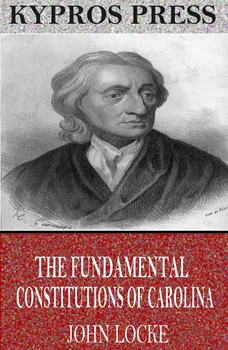
The Fundamental Constitutions of Carolina

John Locke was one of the most famous philosophers during the Age of Enlightenment. Locke is often referred to as The Father of Liberalism and his writings influenced other great philosophers including Voltaire and Rousseau. This edition of The Fundamental Constitutions of Carolina includes a table of contents.

Om denne boken

John Locke was one of the most famous philosophers during the Age of Enlightenment. Locke is often referred to as The Father of Liberalism and his writings influenced other great philosophers including Voltaire and Rousseau. This edition of The Fundamental Constitutions of Carolina includes a table of contents.

Kom i gang med denne boken i dag for 0 kr

  • Få full tilgang til alle bøkene i appen i prøveperioden
  • Ingen forpliktelser, si opp når du vil
Prøv gratis nå
Mer enn 52 000 personer har gitt Nextory 5 stjerner på App Store og Google Play.

  1. Ensayo sobre la tolerancia : El Locke desconocido: la precuela de «Carta sobre la tolerancia» y 18 textos fundamentales.

    John Locke

  2. Second Treatise of Government :

    John Locke

  3. An Essay Concerning Humane Understanding : Volume 1MDCXC, Based on the 2nd Edition, Books 1 and 2

    John Locke

  4. 50 citations de John Locke

    John Locke

  5. 250 citations de philosophes anglais

    David Hume, John Locke, Francis Bacon, Thomas Hobbes, Thomas More

  6. 1800 Citations de philosophes

    Aristote, Épicure, Platon, Thalès de Milet, – Socrate, Protagoras, Anaximandre, Épictète, Héraclite, Marc Aurèle, René Descartes, Michel de Montaigne, Alexis de Tocqueville, Voltaire, Charles De Montesquieu, Jean-Jacques Rousseau, Emmanuel Kant, Hannah Arendt, Gottfried Wilhelm Leibniz, Georg Wilhelm Friedrich Hegel, Friedrich Nietzsche, Arthur Schopenhauer, David Hume, John Locke, Francis Bacon, Thomas Hobbes, Thomas More, Confucius, Érasme, Lao Tseu, Baruch Spinoza, Søren Kierkegaard, Nicolas Machiavel, Thomas d'Aquin, Henry David Thoreau

  7. Muutamia mietteitä kasvatuksesta

    John Locke

  8. 50 Meisterwerke der Philosophie : Metaphysik, Das Gastmahl, Bhagavadgita, Tractatus logico-philosophicus, Kritik der reinen Vernunft, Also sprach Zarathustra, Selbstbetrachtungen von Marcus Aurelius

    Ludwig Wittgenstein, Edmund Husserl, Karl Marx, Søren Kierkegaard, Friedrich Nietzsche, Ralph Waldo Emerson, John Stuart Mill, Georg Wilhelm Hegel, Friedrich Schelling, Johann Gottlieb Fichte, Immanuel Kant, John Locke, Montesquieu, Jean-Jacques Rousseau, David Hume, Gottfried Wilhelm Leibniz, Baruch Spinoza, - Konfuzius, Lao Tse, Platon, Xenophon, - Aristoteles, Marcus Tullius Cicero, Seneca, Epiktet, Marc Aurel, Plotin, Thomas von Aquin, Nicolaus von Cues, - Erasmus von Rotterdam, Niccolò Machiavelli, Tommaso Campanella, Martin Luther, Giordano Bruno, Samuel von Pufendorf, Abbé Castel Saint-Pierre, Michel de Montaigne, René Descartes, Francis Bacon, Blaise Pascal

  9. Die größten Philosophen der Aufklärung : Neues Organon, Kritik der reinen Vernunft, Der Gesellschaftsvertrag, Candide, Monadologie, Mathematische Principien der Naturlehre

    Jean-Jacques Rousseau, Voltaire, Denis Diderot, David Hume, Johann Gottfried Herder, John Locke, Thomas Hobbes, Benjamin Franklin, Francis Bacon, Immanuel Kant, Montesquieu, Baruch Spinoza, Isaac Newton, Freiherr von Leibniz, René Descartes

  10. Philosophie der Aufklärung : Die wichtigsten Werke von Immanuel Kant, John Locke, Rousseau, Voltaire, Denis Diderot, David Hume, Leibniz, Johann Gottfried Herder

    Johann Gottfried Herder, Montesquieu, David Hume, Denis Diderot, Jean-Jacques Rousseau, John Locke, Thomas Hobbes, Benjamin Franklin, Francis Bacon, Immanuel Kant, Baruch Spinoza, Isaac Newton, Freiherr von Leibniz, Voltaire, René Descartes

  11. Gesammelte Werke von John Locke : Bereicherte Ausgabe. Brief über die Toleranz + Ein Versuch über den menschlichen Verstand + Gedanken über Erziehung

    John Locke

  12. Die Philosophie des Geistes : Bereicherte Ausgabe. Entdecken Sie Lockes faszinierende Analyse des menschlichen Verstandes und die Natur des Bewusstseins in dieser bahnbrechenden philosophischen Arbeit

    John Locke