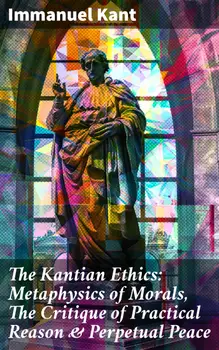
The Kantian Ethics: Metaphysics of Morals, The Critique of Practical Reason & Perpetual Peace : Enriched edition. Exploring the Moral Foundations of Reason and Autonomy

Immanuel Kant'Äôs "The Kantian Ethics: Metaphysics of Morals, The Critique of Practical Reason & Perpetual Peace" intricately weaves together the foundational principles of his moral philosophy. Kant's works present a rigorous exploration of normative ethics grounded in the notions of duty and the categorical imperative, prompting readers to consider moral law as inherently universal and absolute. Through meticulous argumentation, he critiques prior ethical systems, establishing a unique moral framework that fosters autonomy and rationality, while also envisioning a path to everlasting peace through moral governance in international relations, as articulated in "Perpetual Peace." Kant, a luminary of the Enlightenment and a pivotal figure in modern philosophy, was profoundly influenced by the tumultuous sociopolitical landscape of 18th-century Europe. His background in rationalist and empiricist traditions informed his critical approach, enabling him to challenge prevailing ethical doctrines and articulate a novel conception of moral obligation. His commitment to reason, autonomy, and universal ethics mirrors his lifelong pursuit of knowledge and enlightenment, often reflecting on the human condition and society's moral progress. This compilation is essential for scholars and students of philosophy, as it not only elucidates Kant's ethico-political theories but also inspires contemporary ethical discourse. Readers seeking a transformative understanding of moral reasoning are encouraged to engage with Kant's profound insights, which remain relevant in navigating ethical dilemmas today.

In this enriched edition, we have carefully created added value for your reading experience:

- A comprehensive Introduction outlines these selected works' unifying features, themes, or stylistic evolutions.

- The Author Biography highlights personal milestones and literary influences that shape the entire body of writing.

- A Historical Context section situates the works in their broader era—social currents, cultural trends, and key events that underpin their creation.

- A concise Synopsis (Selection) offers an accessible overview of the included texts, helping readers navigate plotlines and main ideas without revealing critical twists.

- A unified Analysis examines recurring motifs and stylistic hallmarks across the collection, tying the stories together while spotlighting the different work's strengths.

- Reflection questions inspire deeper contemplation of the author's overarching message, inviting readers to draw connections among different texts and relate them to modern contexts.

- Lastly, our hand‐picked Memorable Quotes distill pivotal lines and turning points, serving as touchstones for the collection's central themes.
Om denne boken

Immanuel Kant'Äôs "The Kantian Ethics: Metaphysics of Morals, The Critique of Practical Reason & Perpetual Peace" intricately weaves together the foundational principles of his moral philosophy. Kant's works present a rigorous exploration of normative ethics grounded in the notions of duty and the categorical imperative, prompting readers to consider moral law as inherently universal and absolute. Through meticulous argumentation, he critiques prior ethical systems, establishing a unique moral framework that fosters autonomy and rationality, while also envisioning a path to everlasting peace through moral governance in international relations, as articulated in "Perpetual Peace." Kant, a luminary of the Enlightenment and a pivotal figure in modern philosophy, was profoundly influenced by the tumultuous sociopolitical landscape of 18th-century Europe. His background in rationalist and empiricist traditions informed his critical approach, enabling him to challenge prevailing ethical doctrines and articulate a novel conception of moral obligation. His commitment to reason, autonomy, and universal ethics mirrors his lifelong pursuit of knowledge and enlightenment, often reflecting on the human condition and society's moral progress. This compilation is essential for scholars and students of philosophy, as it not only elucidates Kant's ethico-political theories but also inspires contemporary ethical discourse. Readers seeking a transformative understanding of moral reasoning are encouraged to engage with Kant's profound insights, which remain relevant in navigating ethical dilemmas today.

In this enriched edition, we have carefully created added value for your reading experience:

- A comprehensive Introduction outlines these selected works' unifying features, themes, or stylistic evolutions.

- The Author Biography highlights personal milestones and literary influences that shape the entire body of writing.

- A Historical Context section situates the works in their broader era—social currents, cultural trends, and key events that underpin their creation.

- A concise Synopsis (Selection) offers an accessible overview of the included texts, helping readers navigate plotlines and main ideas without revealing critical twists.

- A unified Analysis examines recurring motifs and stylistic hallmarks across the collection, tying the stories together while spotlighting the different work's strengths.

- Reflection questions inspire deeper contemplation of the author's overarching message, inviting readers to draw connections among different texts and relate them to modern contexts.

- Lastly, our hand‐picked Memorable Quotes distill pivotal lines and turning points, serving as touchstones for the collection's central themes.

Kom i gang med denne boken i dag for 0 kr

  • Få full tilgang til alle bøkene i appen i prøveperioden
  • Ingen forpliktelser, si opp når du vil
Prøv gratis nå
Mer enn 52 000 personer har gitt Nextory 5 stjerner på App Store og Google Play.

  1. Ny

    100 Clásicos de la Literatura Universal

    Francis Scott Fitzgerald, Mary Shelley, Lyman Frank Baum, Louisa May Alcott, Dante Alighieri, Jane Austen, Ambrose Bierce, Emily Brontë, Edgar Rice Burroughs, Lewis Carroll, Wilkie Collins, René Descartes, Charles Dickens, Emily Dickinson, Alexandre Dumas, Gustave Flaubert, Benito Pérez Galdós, Johann Wolfgang von Goethe, Thomas Hardy, E T A Hoffmann, Washington Irving, Henry James, James Joyce, Franz Kafka, Gaston Leroux, Federico García Lorca, H.P. Lovecraft, Publio Virgilio Marón, Lucy Maud Montgomery, John William Polidori, Marco Polo, Antoine de Saint-Exupéry, Emilio Salgari, Walter Scott, Mark Twain, Jules Verne, Julio Verne, H.G. Wells, Edith Wharton, Mary Wollstonecraft, Stefan Zweig, Sun Tzu, Bram Stoker, - Aristoteles, George Bernard Shaw, Henryk Sienkiewicz, Concepción Arenal, Charlotte Brontë, Miguel de Cervantes, G.K. Chesterton, Daniel Defoe, Fyodor Mikhailovich Dostoyevsky, Arthur Conan Doyle, Sigmund Freud, H. Rider Haggard, Homero, Immanuel Kant, Rudyard Kipling, Molière, Friedrich Nietzsche, Fernando de Rojas, Sófocles, William Makepeace Thackeray, León Tolstói, Voltaire, Ramón María del Valle-Inclán, Oscar Wilde, Virginia Woolf

  2. 12 Masterpieces You Have to Read Before You Die. Philosophy

    Niccolo Machiavelli, Tommaso Campanella, Francis Bacon, Thomas More, John Stuart Mill, Immanuel Kant, Kahlil Gibran, Leo Tolstoy, G.K. Chesterton, Henry David Thoreau

  3. Om pedagogikk

    Immanuel Kant

  4. Critique of Pure Reason

    Immanuel Kant

  5. Prolegomena to Any Future Metaphysics that Will Be Able to Present Itself as a Science

    Immanuel Kant

  6. 3.0

    Classic Philosophical Works (Thus Spoke Zarathustra, The Apology of Socrates, Tao Te Ching...)

    Plato, Friedrich Nietzsche, Herman Hesse, Leo Tolstoy, Immanuel Kant, Sun Tzu

  7. 3.8

    Kant's Foundations of Ethics

    Immanuel Kant

  8. 50 Short Story Masterpieces you have to listen before you die (Golden Deer Classics)

    F. Scott Fitzgerald, O.Henry, Mark Twain, Kahlil Gibran, W. W. Jacobs, Anonymous, Thomas Jefferson, Founding Fathers, Plato, Lord Alfred Tennyson, T. S. Eliot, William Dean Howells, Karl Marx, Friedrich Engels, Leo Tolstoy, Washington Irving, Samuel Taylor Coleridge, Bram Stoker, Sun Tzu, Edgar Allan Poe, Lao Tzu, Oscar Wilde, William Blake, Patrick Henry, H.G. Wells, Saki, Herman Melville, Clement Clarke Moore, Bret Harte, Immanuel Kant, Jack London, Henry Ford, G.K. Chesterton, Charles Perrault, Anton Chekhov, D. H. Lawrence, Fyodor Dostoevsky, Franz Kafka, James Joyce, John Muir

  9. Kant's Three Critiques : Enriched edition. The Critique of Pure Reason, The Critique of Practical Reason & The Critique of Judgment

    Immanuel Kant

  10. 5.0

    Fundamental Principles of the Metaphysics of Morals

    Immanuel Kant

  11. Grundlegung zur Metaphysik der Sitten

    Immanuel Kant

  12. Beantwortung der Frage: Was ist Aufklärung?

    Immanuel Kant