The Last Man : "A Pandemic Novel"

The Last Man is a post-apocalyptic science fiction novel by Mary Shelley, which was first published in 1826. The book tells of a future world that has been ravaged by a plague. The novel was harshly reviewed at the time, and was virtually unknown – having been eclipsed by Shelley's more popular works – until a scholarly revival in the 1960s. It contains semi-biographical portraits of Romantic figures in Shelley's circle, particularly Shelley's late husband Percy Bysshe Shelley and Lord Byron.

Plot Summary:

Introduction

Mary Shelley states in the introduction that in 1818 she discovered, in the Sibyl's cave near Naples, a collection of prophetic writings painted on leaves by the Cumaean Sibyl. She has edited these writings into the current narrative, the first-person narrative of a man living at the end of the 21st century, commencing in 2073 and concluding in 2100. Despite the chronological setting, the world of The Last Man appears to be relatively similar to the era in which it was written.

Failure of Romantic Political Ideals

The Last Man not only laments the loss of Shelley's friends, but also questions the Romantic political ideals for which they stood. In a sense, the plague is metaphorical, since the revolutionary idyll of the élite group is corroded from within by flaws of human nature. As literary scholar Kari Lokke writes, "in its refusal to place humanity at the center of the universe, its questioning of our privileged position in relation to nature, then, The Last Man constitutes a profound and prophetic challenge to Western humanism." Specifically, Mary Shelley, in making references to the failure of the French Revolution and the Godwinian, Wollstonecraftian, and Burkean responses to it, "attacks Enlightenment faith in the inevitability of progress through collective efforts".

Isolation

Hugh Luke argues, "By ending her story with the picture of the Earth's solitary inhabitant, she has brought nearly the whole weight of the novel to bear upon the idea that the condition of the individual being is essentially isolated and therefore ultimately tragic". Shelley shares this theme of tragic isolation with the poetry of Lord Byron and William Wordsworth.

Science and Medicine

Just as her earlier and better known novel Frankenstein (1818) engaged with scientific questions of electromagnetism, chemistry, and materialism, The Last Man finds Shelley again attempting to understand the scope of scientific inquiry. Unlike the earlier novel's warnings about Faustian over-reaching, this novel's devastating apocalypse strongly suggests that medicine had become too timid and ultimately come too late.
Om denne boken

The Last Man is a post-apocalyptic science fiction novel by Mary Shelley, which was first published in 1826. The book tells of a future world that has been ravaged by a plague. The novel was harshly reviewed at the time, and was virtually unknown – having been eclipsed by Shelley's more popular works – until a scholarly revival in the 1960s. It contains semi-biographical portraits of Romantic figures in Shelley's circle, particularly Shelley's late husband Percy Bysshe Shelley and Lord Byron.

Plot Summary:

Introduction

Mary Shelley states in the introduction that in 1818 she discovered, in the Sibyl's cave near Naples, a collection of prophetic writings painted on leaves by the Cumaean Sibyl. She has edited these writings into the current narrative, the first-person narrative of a man living at the end of the 21st century, commencing in 2073 and concluding in 2100. Despite the chronological setting, the world of The Last Man appears to be relatively similar to the era in which it was written.

Failure of Romantic Political Ideals

The Last Man not only laments the loss of Shelley's friends, but also questions the Romantic political ideals for which they stood. In a sense, the plague is metaphorical, since the revolutionary idyll of the élite group is corroded from within by flaws of human nature. As literary scholar Kari Lokke writes, "in its refusal to place humanity at the center of the universe, its questioning of our privileged position in relation to nature, then, The Last Man constitutes a profound and prophetic challenge to Western humanism." Specifically, Mary Shelley, in making references to the failure of the French Revolution and the Godwinian, Wollstonecraftian, and Burkean responses to it, "attacks Enlightenment faith in the inevitability of progress through collective efforts".

Isolation

Hugh Luke argues, "By ending her story with the picture of the Earth's solitary inhabitant, she has brought nearly the whole weight of the novel to bear upon the idea that the condition of the individual being is essentially isolated and therefore ultimately tragic". Shelley shares this theme of tragic isolation with the poetry of Lord Byron and William Wordsworth.

Science and Medicine

Just as her earlier and better known novel Frankenstein (1818) engaged with scientific questions of electromagnetism, chemistry, and materialism, The Last Man finds Shelley again attempting to understand the scope of scientific inquiry. Unlike the earlier novel's warnings about Faustian over-reaching, this novel's devastating apocalypse strongly suggests that medicine had become too timid and ultimately come too late.
Kom i gang med denne boken i dag for 0 kr

  • Få full tilgang til alle bøkene i appen i prøveperioden
  • Ingen forpliktelser, si opp når du vil
Prøv gratis nå
Mer enn 52 000 personer har gitt Nextory 5 stjerner på App Store og Google Play.

  1. 50 Masterpieces you have to read before you die

    Frances Hodgson Burnett, Homer, Charles Dickens, Lyman Frank Baum, Nathaniel Hawthorne, Thomas Hardy, Robert Louis Stevenson, Henry Haggard, Wilkie Collins, H.G. Wells, Sir Walter Scott, Lucy Maud Montgomery, Louisa May Alcott, Henry Fielding, Mary Shelley, Arthur Conan Doyle, Leo Tolstoy, Euripides, Fyodor Dostoevsky, Alexander Pushkin, James Fenimore Cooper, Daniel Defoe, Joseph Conrad, Jonathan Swift, William Shakespeare, Oscar Wilde, John Bunyan, Charles Darwin, Alfred Tennyson, Bram Stoker, James Joyce, Dante Alighieri, Howard Pyle, Jane Austen, Emily Bronte, Giovanni Boccaccio, Rudyard Kipling

  2. 3.0

    50 Masterpieces you have to read before you die vol: 1 (2020 Edition) : Included: Little Women, The Richest Man in Babylon Emma, The Call Of The Wild ....

    Louisa May Alcott, Dante Alighieri, Marcus Aurelius, Jane Austen, L. Frank Baum, Charlotte Brontë, Emily Brontë, Anne Brontë, Miguel de Cervantes, Agatha Christie, George S. Clason, Arthur Conan Doyle, Joseph Conrad, Charles Dickens, Fyodor Dostoyevsky, Alexandre Dumas, George Eliot, G.K. Chesterton, G.K. Chesterton, Zane Grey, Nathaniel Hawthorne, Napoleon Hill, Homer, Victor Hugo, Frances Hodgson Burnett, Washington Irving, Henry James, Franz Kafka, Rudyard Kipling, Jack London, Leo Tolstoy, H.P. Lovecraft, Lucy Maud Montgomery, Joseph Murphy, Robert Louis Stevenson, Edgar Allan Poe, Marcel Proust, Publius, Mary Shelley, Bram Stoker, Mark Twain, Sun Tzu, Lew Wallace, Wallace D. Wattles, H.G. Wells

  3. 4.1

    Frankenstein

    Mary Shelley

  4. Ny

    The Last Man

    Mary Shelley

  5. Tellers of Tales 200 Years of Timeless Stories : Featuring Charlotte Bronte, Ambrose Bierce, W.B. Yates and Many Others. Narrated by Kennedy Center Award Winning Actor Dennis Edward Delaney.

    Charlotte Bronte, Ambrose Bierce, W.B. Yates, Saki, Evelyn Everett, Carl Stephensen, Mark Twain, Prosper Merimee, Anna Katherine Green, David Earl DeWitt, O.Henry, Agatha Christie, Harriet H. Jacobs, H.G. Wells, Arthur Conan Doyle, Richard Middleton, Hans Christian Anderson, Rudyard Kipling, Edgar Allan Poe, W. Jacobs, Mary Shelley, Bret Harte, G.K. Chesterton, George G. Toudouze, Dennis Edward Delaney

  6. 50 Vintage Sci-Fi Short Stories 4 - More than 29 hours of Vintage Science Fiction : From Mary Shelley to Philip K. Dick — 29 Hours of Sci-Fi That Shaped the Future

    William F. Nolan, Robert Zacks, Isaac Asimov, Ray Bradbury, Mary Shelley, Mack Reynolds, Edward Halibut, Leigh Brackett, Robert F. Young, Fredric Brown, Robert Silverberg, Jack Williamson, William Hope Hodgson, Evelyn E. Smith, Gordon R. Dickson, Theodore Sturgeon, Clifford D. Simak, Arthur C. Clarke, Robert A. Heinlein, August Derleth, Lawrence M. Jannifer, Ambrose Bierce, Henry Kuttner, Allen K. Lang, Carl W. Ganzlin, H.G. Wells, Margaret St. Clair, Carl Jacobi, Philip K Dick, Andre Norton, Murray Leinster, Ross Rocklynne, Harry Harrison, Frank M. Robinson, Alfred Coppel, Lynn Venable

  7. 4.5

    Frankenstein :

    Mary Shelley

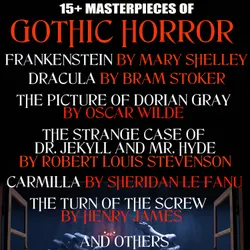
  8. 15+ Masterpieces of Gothic Horror. Classics Collection : Frankenstein, Dracula, The Picture of Dorian Gray, The Strange Case of Dr. Jekyll and Mr. Hyde, Carmilla, The Turn of the Screw and others

    Mary Shelley, Bram Stoker, Oscar Wilde, Robert Louis Stevenson, Edgar Allan Poe, Washington Irving, Sheridan Le Fanu, Henry James, Arthur Machen, Nikolai Gogol

  9. 3.6

    Frankenstein :

    Mary Shelley

  10. 4.0

    Frankenstein

    Mary Shelley

  11. 4.5
    #2

    Matilda

    Mary Shelley

  12. HALLOWEEN Ultimate Collection: 200+ Mysteries, Horror Classics & Supernatural Tales : An Enthralling Collection of Horror, Mystery, and Supernatural Tales

    Wilhelm Hauff, Charles Dickens, Mark Twain, Harriet Beecher Stowe, Edgar Allan Poe, William Hope Hodgson, John Buchan, George MacDonald, Bram Stoker, Anatole France, Jack London, Henry James, Théophile Gautier, Arthur Conan Doyle, Richard Le Gallienne, Ralph Adams Cram, Guy De Maupassant, Thomas Hardy, William Archer, Daniel Defoe, Brander Matthews, Lafcadio Hearn, Ambrose Bierce, Ellis Parker Butler, Washington Irving, Nathaniel Hawthorne, Grant Allen, Arthur Machen, Wilkie Collins, Thomas Peckett Prest, James Malcolm Rymer, Fergus Hume, Walter Hubbell, Leopold Kompert, Florence Marryat, John William Polidori, Vincent O'Sullivan, W. Jacobs, M.P. Shiel, E F Benson, M. R. James, H.P. Lovecraft, Francis Marion Crawford, Mary Shelley, Margaret Oliphant, Frank R. Stockton, A. T. Quiller-Couch, Leonard Kip, Katherine Rickford, Bithia Mary Croker, Catherine L. Pirkis, Pedro De Alarçon, Pliny the Younger, Helena Blavatsky, Villiers de l'Isle-Adam, William F. Harvey, Fiona Macleod, William T. Stead, Gambier Bolton, Andrew Jackson Davis, Nizida, Walter F. Prince, Chester Bailey Fernando