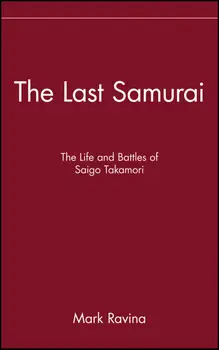
The Last Samurai : The Life and Battles of Saigo Takamori

The dramatic arc of Saigo Takamori's life, from his humble origins as a lowly samurai, to national leadership, to his death as a rebel leader, has captivated generations of Japanese readers and now Americans as well - his life is the inspiration for a major Hollywood film, The Last Samurai, starring Tom Cruise and Ken Watanabe. In this vibrant new biography, Mark Ravina, professor of history and Director of East Asian Studies at Emory University, explores the facts behind Hollywood storytelling and Japanese legends, and explains the passion and poignancy of Saigo's life. Known both for his scholarly research and his appearances on The History Channel, Ravina recreates the world in which Saigo lived and died, the last days of the samurai. The Last Samurai traces Saigo's life from his early days as a tax clerk in far southwestern Japan, through his rise to national prominence as a fierce imperial loyalist. Saigo was twice exiled for his political activities -- sent to Japan's remote southwestern islands where he fully expected to die. But exile only increased his reputation for loyalty, and in 1864 he was brought back to the capital to help his lord fight for the restoration of the emperor. In 1868, Saigo commanded his lord's forces in the battles which toppled the shogunate and he became and leader in the emperor Meiji's new government. But Saigo found only anguish in national leadership. He understood the need for a modern conscript army but longed for the days of the traditional warrior. Saigo hoped to die in service to the emperor. In 1873, he sought appointment as envoy to Korea, where he planned to demand that the Korean king show deference to the Japanese emperor, drawing his sword, if necessary, top defend imperial honor. Denied this chance to show his courage and loyalty, he retreated to his homeland and spent his last years as a schoolteacher, training samurai boys in frugality, honesty, and courage. In 1876, when the government stripped samurai of their swords, Saigo's followers rose in rebellion and Saigo became their reluctant leader. His insurrection became the bloodiest war Japan had seen in centuries, killing over 12,000 men on both sides and nearly bankrupting the new imperial government. The imperial government denounced Saigo as a rebel and a traitor, but their propaganda could not overcome his fame and in 1889, twelve years after his death, the government relented, pardoned Saigo of all crimes, and posthumously restored him to imperial court rank. In THE LAST SAMURAI, Saigo is as compelling a character as Robert E. Lee was to Americans-a great and noble warrior who followed the dictates of honor and loyalty, even though it meant civil war in a country to which he'd devoted his life. Saigo's life is a fascinating look into Japanese feudal society and a history of a country as it struggled between its long traditions and the dictates of a modern future.
Om denne boken

The dramatic arc of Saigo Takamori's life, from his humble origins as a lowly samurai, to national leadership, to his death as a rebel leader, has captivated generations of Japanese readers and now Americans as well - his life is the inspiration for a major Hollywood film, The Last Samurai, starring Tom Cruise and Ken Watanabe. In this vibrant new biography, Mark Ravina, professor of history and Director of East Asian Studies at Emory University, explores the facts behind Hollywood storytelling and Japanese legends, and explains the passion and poignancy of Saigo's life. Known both for his scholarly research and his appearances on The History Channel, Ravina recreates the world in which Saigo lived and died, the last days of the samurai. The Last Samurai traces Saigo's life from his early days as a tax clerk in far southwestern Japan, through his rise to national prominence as a fierce imperial loyalist. Saigo was twice exiled for his political activities -- sent to Japan's remote southwestern islands where he fully expected to die. But exile only increased his reputation for loyalty, and in 1864 he was brought back to the capital to help his lord fight for the restoration of the emperor. In 1868, Saigo commanded his lord's forces in the battles which toppled the shogunate and he became and leader in the emperor Meiji's new government. But Saigo found only anguish in national leadership. He understood the need for a modern conscript army but longed for the days of the traditional warrior. Saigo hoped to die in service to the emperor. In 1873, he sought appointment as envoy to Korea, where he planned to demand that the Korean king show deference to the Japanese emperor, drawing his sword, if necessary, top defend imperial honor. Denied this chance to show his courage and loyalty, he retreated to his homeland and spent his last years as a schoolteacher, training samurai boys in frugality, honesty, and courage. In 1876, when the government stripped samurai of their swords, Saigo's followers rose in rebellion and Saigo became their reluctant leader. His insurrection became the bloodiest war Japan had seen in centuries, killing over 12,000 men on both sides and nearly bankrupting the new imperial government. The imperial government denounced Saigo as a rebel and a traitor, but their propaganda could not overcome his fame and in 1889, twelve years after his death, the government relented, pardoned Saigo of all crimes, and posthumously restored him to imperial court rank. In THE LAST SAMURAI, Saigo is as compelling a character as Robert E. Lee was to Americans-a great and noble warrior who followed the dictates of honor and loyalty, even though it meant civil war in a country to which he'd devoted his life. Saigo's life is a fascinating look into Japanese feudal society and a history of a country as it struggled between its long traditions and the dictates of a modern future.

Kom i gang med denne boken i dag for 0 kr

  • Få full tilgang til alle bøkene i appen i prøveperioden
  • Ingen forpliktelser, si opp når du vil
Prøv gratis nå
Mer enn 52 000 personer har gitt Nextory 5 stjerner på App Store og Google Play.

Andre lesere likte disse

Hopp over listen
  1. The Complete Works of St. Augustine : Confessions, The City of God, On Christian Doctrine, Moral Treatises, Enchiridion (With Letters and Biography)

    Saint Augustine Hippo

  2. Detective Stories

    Arthur Conan Doyle, Arthur Reeve, Edgar Allan Poe, Anton Chekov, Wilkie Collins, Thomas Hanshew

  3. Tao Te Ching : The Timeless Classic of Taoist Wisdom, by Lao Tzu

    Laozi, Lao Tzu

  4. Summary : Review and Analysis of Sinek's Book

    BusinessNews Publishing

  5. The Prosperity & Wealth Bible

    George Matthew Adams, James Allen, William Walker Atkinson, Marcus Aurelius, P.T. Barnum, Genevieve Behrend, George S. Clason, Robert Collier, Russell H. Conwell, Emile Coue, Charles Fillmore, Emmet Fox, Benjamin Franklin, Kahlil Gibran, Neville Goddard, Charles F. Haanel, Harvey Hardman, Napoleon Hill, Elbert Hubbard, William Crosbie Hunter, H.A. Lewis, Niccolo Machiavelli, Orison Swett Marden, Joseph Murphy, Miyamoto Musashi, Earl Nightingale, F.W. Sears, Florence Scovel Shinn, Elizabeth Towne, Lao Tzu, Sun Tzu, Wallace D. Wattles

  6. An Illustrated Guide to The Lost Symbol

    John Weber

  7. Transactional Analysis in Psychotherapy :

    Eric Berne

  8. 5.0

    Don't Panic : Douglas Adams and the Hitchhiker's Guide to the Galaxy

    Neil Gaiman

  9. 5.0

    600 Quotes from Major Leaders

    Marcus Aurelius, Napoleon Bonaparte, Winston Churchill, Charles de Gaulle, Mahatma Gandhi, Abraham Lincoln

  10. 4.1

    A Dog’s Heart

    Mikhail Bulgakov

  11. The Letters of St. Teresa

    St. Teresa of Avila

  12. RESTful API Design Patterns and Best Practices : Master REST API design with real-world patterns, lifecycle management, and OpenAPI practices

    Andrzej Jarzyna, Samir Amzani