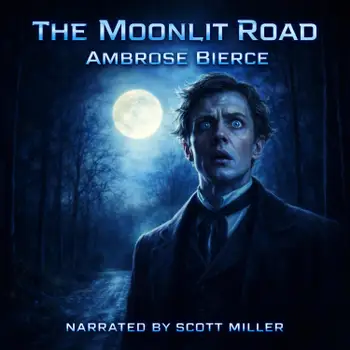
The Moonlit Road : A Confession Under Moonlight

Some stories whisper. This one confesses.

The Moonlit Road unfolds through three testimonies, each offering a fragment of a night that shattered a family and refused to stay buried. A wealthy planter suspects betrayal and returns home before dawn to prove it. A son recalls what he saw under a white, unforgiving moon. And a voice from beyond the grave speaks of terror in the darkness and a face that would not embrace her when she reached for him. No narrator holds the whole truth. Each account deepens the dread, tightening the sense that something was seen that should not have been—and that what was done cannot be undone.

Bierce builds his tension through restraint. There is no spectacle, no melodrama, only the steady pressure of memory and guilt pressing inward. The setting is domestic and familiar: a Southern estate, a quiet staircase, a country road. Yet the calm details make the eruption of violence more disturbing. When the moon rises again, the past does not rest. Someone returns to the place where love once lived, and the living must decide what they are looking at.

Ambrose Bierce (1842–c.1914) was one of the sharpest and most unsettling voices in American literature. A Civil War veteran who saw brutal combat at Shiloh and Chickamauga, Bierce carried the war’s psychological scars into his fiction. He became widely known for his newspaper work and for The Devil’s Dictionary, but his short stories remain his most enduring legacy. Tales such as An Occurrence at Owl Creek Bridge and Chickamauga show his mastery of fractured perspective and moral reckoning. The Moonlit Road stands among his most chilling pieces, blending psychological torment with the uncanny in a way that still unsettles modern readers.

Press play—and step onto the road.

Om denne boken

Some stories whisper. This one confesses.

The Moonlit Road unfolds through three testimonies, each offering a fragment of a night that shattered a family and refused to stay buried. A wealthy planter suspects betrayal and returns home before dawn to prove it. A son recalls what he saw under a white, unforgiving moon. And a voice from beyond the grave speaks of terror in the darkness and a face that would not embrace her when she reached for him. No narrator holds the whole truth. Each account deepens the dread, tightening the sense that something was seen that should not have been—and that what was done cannot be undone.

Bierce builds his tension through restraint. There is no spectacle, no melodrama, only the steady pressure of memory and guilt pressing inward. The setting is domestic and familiar: a Southern estate, a quiet staircase, a country road. Yet the calm details make the eruption of violence more disturbing. When the moon rises again, the past does not rest. Someone returns to the place where love once lived, and the living must decide what they are looking at.

Ambrose Bierce (1842–c.1914) was one of the sharpest and most unsettling voices in American literature. A Civil War veteran who saw brutal combat at Shiloh and Chickamauga, Bierce carried the war’s psychological scars into his fiction. He became widely known for his newspaper work and for The Devil’s Dictionary, but his short stories remain his most enduring legacy. Tales such as An Occurrence at Owl Creek Bridge and Chickamauga show his mastery of fractured perspective and moral reckoning. The Moonlit Road stands among his most chilling pieces, blending psychological torment with the uncanny in a way that still unsettles modern readers.

Press play—and step onto the road.
Kom i gang med denne boken i dag for 0 kr

  • Få full tilgang til alle bøkene i appen i prøveperioden
  • Ingen forpliktelser, si opp når du vil
Prøv gratis nå
Mer enn 52 000 personer har gitt Nextory 5 stjerner på App Store og Google Play.

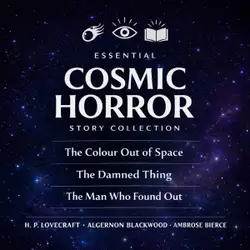
  1. Essential Cosmic Horror Story Collection : The Colour out of Space, The Damned Thing and The Man Who Found Out

    H.P. Lovecraft, Algernon Blackwood, Ambrose Bierce

  2. World's Greatest Short Stories

    Daniel Defoe, Benjamin Franklin, Washington Irving, Mateo Falcone, Charlotte Bronte, Mary Shelley, Nathaniel Hawthorne, Nikolai Gogol, Edgar Allan Poe, Fyodor Dostoyevsky, Charles Dickens, Herman Melville, Mark Twain, Guy De Maupassant, Oscar Wilde, Leo Tolstoy, H.G. Wells, Ambrose Bierce, Stephen Crane, Kate Chopin, Jack London, E. M. Forster

  3. The Monk and the Hangman's Daughter

    Ambrose Bierce

  4. 4.0

    An Occurrence at Owl Creek Bridge

    Ambrose Bierce

  5. 31. juli

    Sommernachtshorror. Eine Schauergeschichte. : Hörbuchzeit: Klassiker der Weltliteratur

    Hörbuchzeit, Ambrose Bierce

  6. Ny

    100 obras maestras que debes leer antes de morir

    Francis Scott Fitzgerald, Mary Shelley, Lyman Frank Baum, Edith Nesbit, Dante Alighieri, Jane Austen, Ambrose Bierce, Emily Brontë, Edgar Rice Burroughs, Lewis Carroll, Wilkie Collins, René Descartes, Charles Dickens, Emily Dickinson, Alexandre Dumas, Gustave Flaubert, Benito Pérez Galdós, Johann Wolfgang Goethe, Thomas Hardy, E. T. Hoffmann, Washington Irving, Henry James, James Joyce, Franz Kafka, Gaston Leroux, Federico García Lorca, H.P. Lovecraft, Publio Virgilio Marón, Lucy Maud Montgomery, John William Polidori, Marco Polo, Antoine de Saint-Exupéry, Emilio Salgari, Walter Scott, Mark Twain, Jules Verne

  7. Ny

    Ein Zyniker betrachtet das Leben : Essays

    Ambrose Bierce

  8. Ny

    A Resumed Identity

    Ambrose Bierce

  9. Ny

    The Complete Works of Ambrose Bierce

    Ambrose Bierce

  10. Staley Fleming's Hallucination :

    Ambrose Bierce

  11. 1900 to 1939 Science Fiction - 17 Classic Science Fiction Short Stories from 1900 to 1939

    H.G. Wells, Murray Leinster, H.P. Lovecraft, Robert E. Howard, Clark Ashton Smith, Jack Williamson, Henry Kuttner, Paul Ernst, Mack Reynolds, George T. Spillman, William Hope Hodgson, August Derleth, Carl W. Ganzlin, Ambrose Bierce, Carl Jacobi, William Brittain, Edmond Hamilton, Frank Belknap Long