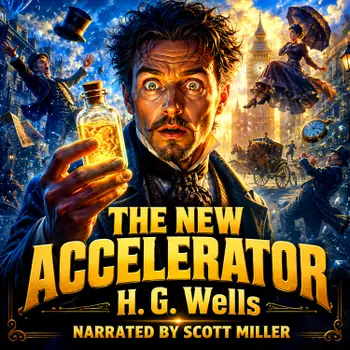
The New Accelerator : The Day The World Stood Still

What if a single drop of medicine could give you hours while everyone else experiences only seconds?

When Professor Gibberne unveils a revolutionary stimulant known as the New Accelerator, the promise seems irresistible. The drug does far more than sharpen the mind or energize the body. It speeds every process of human life to such an astonishing degree that the rest of the world appears almost motionless. For one extraordinary experiment, the professor and his skeptical friend step outside ordinary experience and into a reality where fluttering curtains hang frozen in midair, conversations become silent statues, and even a bee drifts through the sky with agonizing slowness.

At first, the experience feels exhilarating. Freed from the pace of everyday life, the pair explore a world that seems suspended for their private inspection. Yet the longer they remain in this accelerated state, the more unexpected complications arise. What begins as scientific triumph quickly raises practical questions, ethical concerns, and physical dangers that no laboratory test could fully predict. Wells combines humor, wonder, and scientific speculation to create one of the most imaginative thought experiments ever written.

Published in 1901, The New Accelerator remains remarkably fresh. Long before modern discussions about productivity, time management, and human enhancement, Wells imagined a discovery capable of transforming every profession and every aspect of daily life. The story showcases his gift for taking a single scientific idea and following it to surprising and entertaining conclusions.

H. G. Wells (1866–1946) was one of the most influential writers in the history of science fiction. His novels include The Time Machine, The War of the Worlds, The Invisible Man, and The First Men in the Moon, works that helped establish many of the foundations of modern speculative fiction.
Om denne boken

What if a single drop of medicine could give you hours while everyone else experiences only seconds?

When Professor Gibberne unveils a revolutionary stimulant known as the New Accelerator, the promise seems irresistible. The drug does far more than sharpen the mind or energize the body. It speeds every process of human life to such an astonishing degree that the rest of the world appears almost motionless. For one extraordinary experiment, the professor and his skeptical friend step outside ordinary experience and into a reality where fluttering curtains hang frozen in midair, conversations become silent statues, and even a bee drifts through the sky with agonizing slowness.

At first, the experience feels exhilarating. Freed from the pace of everyday life, the pair explore a world that seems suspended for their private inspection. Yet the longer they remain in this accelerated state, the more unexpected complications arise. What begins as scientific triumph quickly raises practical questions, ethical concerns, and physical dangers that no laboratory test could fully predict. Wells combines humor, wonder, and scientific speculation to create one of the most imaginative thought experiments ever written.

Published in 1901, The New Accelerator remains remarkably fresh. Long before modern discussions about productivity, time management, and human enhancement, Wells imagined a discovery capable of transforming every profession and every aspect of daily life. The story showcases his gift for taking a single scientific idea and following it to surprising and entertaining conclusions.

H. G. Wells (1866–1946) was one of the most influential writers in the history of science fiction. His novels include The Time Machine, The War of the Worlds, The Invisible Man, and The First Men in the Moon, works that helped establish many of the foundations of modern speculative fiction.
Kom i gang med denne boken i dag for 0 kr

  • Få full tilgang til alle bøkene i appen i prøveperioden
  • Ingen forpliktelser, si opp når du vil
Prøv gratis nå
Mer enn 52 000 personer har gitt Nextory 5 stjerner på App Store og Google Play.

  1. 3.0

    50 Masterpieces you have to read before you die vol: 1 (2020 Edition) : Included: Little Women, The Richest Man in Babylon Emma, The Call Of The Wild ....

    Louisa May Alcott, Dante Alighieri, Marcus Aurelius, Jane Austen, L. Frank Baum, Charlotte Brontë, Emily Brontë, Anne Brontë, Miguel de Cervantes, Agatha Christie, George S. Clason, Arthur Conan Doyle, Joseph Conrad, Charles Dickens, Fyodor Dostoyevsky, Alexandre Dumas, George Eliot, G.K. Chesterton, G.K. Chesterton, Zane Grey, Nathaniel Hawthorne, Napoleon Hill, Homer, Victor Hugo, Frances Hodgson Burnett, Washington Irving, Henry James, Franz Kafka, Rudyard Kipling, Jack London, Leo Tolstoy, H.P. Lovecraft, Lucy Maud Montgomery, Joseph Murphy, Robert Louis Stevenson, Edgar Allan Poe, Marcel Proust, Publius, Mary Shelley, Bram Stoker, Mark Twain, Sun Tzu, Lew Wallace, Wallace D. Wattles, H.G. Wells

  2. 3.9

    Klodenes kamp

    H.G. Wells

  3. 50 Masterpieces you have to read before you die

    Frances Hodgson Burnett, Homer, Charles Dickens, Lyman Frank Baum, Nathaniel Hawthorne, Thomas Hardy, Robert Louis Stevenson, Henry Haggard, Wilkie Collins, H.G. Wells, Sir Walter Scott, Lucy Maud Montgomery, Louisa May Alcott, Henry Fielding, Mary Shelley, Arthur Conan Doyle, Leo Tolstoy, Euripides, Fyodor Dostoevsky, Alexander Pushkin, James Fenimore Cooper, Daniel Defoe, Joseph Conrad, Jonathan Swift, William Shakespeare, Oscar Wilde, John Bunyan, Charles Darwin, Alfred Tennyson, Bram Stoker, James Joyce, Dante Alighieri, Howard Pyle, Jane Austen, Emily Bronte, Giovanni Boccaccio, Rudyard Kipling

  4. Ny
    3.8

    The Invisible Man

    H.G. Wells

  5. 3.2
    #6

    The Time Machine

    H.G. Wells

  6. A Modern Utopia

    H.G. Wells

  7. Ny

    100 Clásicos de la Literatura Universal

    Francis Scott Fitzgerald, Mary Shelley, Lyman Frank Baum, Louisa May Alcott, Dante Alighieri, Jane Austen, Ambrose Bierce, Emily Brontë, Edgar Rice Burroughs, Lewis Carroll, Wilkie Collins, René Descartes, Charles Dickens, Emily Dickinson, Alexandre Dumas, Gustave Flaubert, Benito Pérez Galdós, Johann Wolfgang von Goethe, Thomas Hardy, E T A Hoffmann, Washington Irving, Henry James, James Joyce, Franz Kafka, Gaston Leroux, Federico García Lorca, H.P. Lovecraft, Publio Virgilio Marón, Lucy Maud Montgomery, John William Polidori, Marco Polo, Antoine de Saint-Exupéry, Emilio Salgari, Walter Scott, Mark Twain, Jules Verne, Julio Verne, H.G. Wells, Edith Wharton, Mary Wollstonecraft, Stefan Zweig, Sun Tzu, Bram Stoker, - Aristoteles, George Bernard Shaw, Henryk Sienkiewicz, Concepción Arenal, Charlotte Brontë, Miguel de Cervantes, G.K. Chesterton, Daniel Defoe, Fyodor Mikhailovich Dostoyevsky, Arthur Conan Doyle, Sigmund Freud, H. Rider Haggard, Homero, Immanuel Kant, Rudyard Kipling, Molière, Friedrich Nietzsche, Fernando de Rojas, Sófocles, William Makepeace Thackeray, León Tolstói, Voltaire, Ramón María del Valle-Inclán, Oscar Wilde, Virginia Woolf

  8. Ny

    The War in the Air

    H.G. Wells

  9. Ny

    The Star : The apocalyptic SciFi masterpiece, with additional material for students and book groups

    H.G. Wells

  10. 4.1

    The War of the Worlds

    H.G. Wells

  11. Tellers of Tales 200 Years of Timeless Stories : Featuring Charlotte Bronte, Ambrose Bierce, W.B. Yates and Many Others. Narrated by Kennedy Center Award Winning Actor Dennis Edward Delaney.

    Charlotte Bronte, Ambrose Bierce, W.B. Yates, Saki, Evelyn Everett, Carl Stephensen, Mark Twain, Prosper Merimee, Anna Katherine Green, David Earl DeWitt, O.Henry, Agatha Christie, Harriet H. Jacobs, H.G. Wells, Arthur Conan Doyle, Richard Middleton, Hans Christian Anderson, Rudyard Kipling, Edgar Allan Poe, W. Jacobs, Mary Shelley, Bret Harte, G.K. Chesterton, George G. Toudouze, Dennis Edward Delaney

  12. The Magic Shop

    H.G. Wells