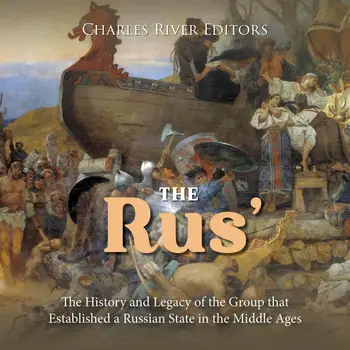
The Rus’: The History and Legacy of the Group that Established a Russian State in the Middle Ages

For many, the Rus might be synonyms for Russia or Russians, perhaps an early form of the civilization that later became Russia. This is partly true. Modern-day Russia lays claim as a successor to the Rus, particularly the Kievan Rus empire that dominated, with oscillating borders, the area around today’s Kiev and Ukraine between the 8th and 11th centuries. Crucially, the Rus had roots in the Nordic region. Initially, they would travel into modern-day Russia, Ukraine, and beyond to trade. Only later would they start to settle in the region and then become known as the Rus.

As with many other groups, the origins of the Rus are tied to the dominance of the Vikings over Western Europe in the early part of the Dark Ages or Medieval Era. Their Scandinavian brethren also traveled eastwards, behaving in similar ways but ultimately settling and assimilating in the region in an idiosyncratic manner. The Rus focused on several trade routes. The most important of these was the “eastern” route towards the Caspian Sea and stretching as far as Baghdad in the Middle East. This then gave way to the “western” route leading through Kiev to the Black Sea and Byzantine capital city Constantinople. The Rus also developed other trade routes, including to Western Europe.

Eventually, the Rus began to establish permanent settlements, firstly in Novgorod and then south to Kiev. This will be accompanied by the exploration of growing Rus dominance of this region, particularly through historical figures in the Rurikid dynasty such as Rurik, Oleg, Igor, Olga, Svyatoslav, Vladimir, and Yaroslav. During this time, the Kievan Rus empire was established and rose steadily to become a major regional power, even challenging the dominant Byzantines.
Om denne boken

For many, the Rus might be synonyms for Russia or Russians, perhaps an early form of the civilization that later became Russia. This is partly true. Modern-day Russia lays claim as a successor to the Rus, particularly the Kievan Rus empire that dominated, with oscillating borders, the area around today’s Kiev and Ukraine between the 8th and 11th centuries. Crucially, the Rus had roots in the Nordic region. Initially, they would travel into modern-day Russia, Ukraine, and beyond to trade. Only later would they start to settle in the region and then become known as the Rus.

As with many other groups, the origins of the Rus are tied to the dominance of the Vikings over Western Europe in the early part of the Dark Ages or Medieval Era. Their Scandinavian brethren also traveled eastwards, behaving in similar ways but ultimately settling and assimilating in the region in an idiosyncratic manner. The Rus focused on several trade routes. The most important of these was the “eastern” route towards the Caspian Sea and stretching as far as Baghdad in the Middle East. This then gave way to the “western” route leading through Kiev to the Black Sea and Byzantine capital city Constantinople. The Rus also developed other trade routes, including to Western Europe.

Eventually, the Rus began to establish permanent settlements, firstly in Novgorod and then south to Kiev. This will be accompanied by the exploration of growing Rus dominance of this region, particularly through historical figures in the Rurikid dynasty such as Rurik, Oleg, Igor, Olga, Svyatoslav, Vladimir, and Yaroslav. During this time, the Kievan Rus empire was established and rose steadily to become a major regional power, even challenging the dominant Byzantines.
Kom i gang med denne boken i dag for 0 kr

  • Få full tilgang til alle bøkene i appen i prøveperioden
  • Ingen forpliktelser, si opp når du vil
Prøv gratis nå
Mer enn 52 000 personer har gitt Nextory 5 stjerner på App Store og Google Play.

  1. 5.0

    Cochise and Geronimo: The Lives and Legacies of the Most Famous Apache Warriors

    Charles River Editors

  2. Submarines and the World Wars: The History of Submarine Warfare in World War I and World War II

    Charles River Editors

  3. The End of the Bronze Age: The History of the Kingdoms that Dominated the Near East in the Late Bronze Age

    Charles River Editors

  4. The Armenian Empire: The History and Legacy of the Ancient Kingdom of Greater Armenia

    Charles River Editors

  5. The Age of Sail’s Most Famous Battles: The History of the Naval Engagements that Shaped Europe in the Early Modern Period

    Charles River Editors

  6. Persepolis and Susa: The History of the Achaemenid Persian Empire’s Capitals

    Charles River Editors

  7. The Dawn of the Age of Exploration: The History of the Initial Expeditions that Led to European Imperialism across the Globe

    Charles River Editors

  8. Across the Silk Road and the Atlantic: The History of Marco Polo and Christopher Columbus’ Groundbreaking Voyages

    Charles River Editors

  9. The Start of the Cold War: The History of the Burgeoning Rivalry Between the United States and Soviet Union

    Charles River Editors

  10. Warfare in Ancient Greece: The History of the Greeks’ Wars on Land and Sea in Antiquity

    Charles River Editors

  11. The Ottoman Sieges of Vienna: The History of the Ottoman Empire’s Unsuccessful Attempts to Conquer the Habsburg Capital

    Charles River Editors

  12. The Dramatic Rise and Fall of the Portuguese Empire: The History and Legacy of Portugal’s Mercantile Empire across the World

    Charles River Editors