4.5(4)

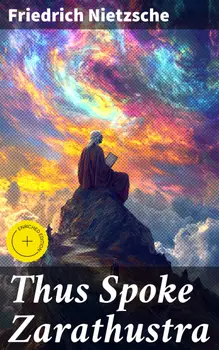
Thus Spoke Zarathustra : Enriched edition. The Magnum Opus of the World's Most Influential Philosopher & Revolutionary Thinker

In "Thus Spoke Zarathustra," Friedrich Nietzsche presents a profound philosophical narrative that intertwines poetry, prose, and prophetic discourse. The book follows the journey of Zarathustra, a sage who descends from the mountains to impart his wisdom on humanity. Through a series of parables and aphorisms, Nietzsche explores themes of the √úbermensch (Overman), the eternal recurrence, and the reevaluation of morality. The work is stylistically innovative, characterized by its lyrical language and rhetorical flourishes, challenging traditional philosophical conventions and reflecting the tumultuous intellectual landscape of the late 19th century. Nietzsche's text not only serves as a philosophical treatise but also as a critique of contemporary cultural and religious values, thereby establishing itself as a cornerstone of existential and modernist thought. Friedrich Nietzsche, a German philosopher known for his radical ideas and critique of religion, was deeply influenced by existential concerns and the perceived moral decay of society. His personal struggles with health and his fascination with ancient philosophical texts shaped his ideological framework. "Thus Spoke Zarathustra" emerged from Nietzsche's belief in the necessity of a new framework for understanding human existence, one that transcended conventional Christian morality and ventured into self-creation and individualism. This seminal work is highly recommended for readers interested in philosophy, literature, and the human condition. Nietzsche's eloquent prose and unsettling ideas provoke critical reflection and engage readers in a dialogue about the nature of existence and the potential for personal transformation. Its impact on 20th-century thought makes it an essential read for anyone seeking to understand contemporary existential philosophy.

In this enriched edition, we have carefully created added value for your reading experience:

- A succinct Introduction situates the work's timeless appeal and themes.

- The Synopsis outlines the central plot, highlighting key developments without spoiling critical twists.

- A detailed Historical Context immerses you in the era's events and influences that shaped the writing.

- An Author Biography reveals milestones in the author's life, illuminating the personal insights behind the text.

- A thorough Analysis dissects symbols, motifs, and character arcs to unearth underlying meanings.

- Reflection questions prompt you to engage personally with the work's messages, connecting them to modern life.

- Hand‐picked Memorable Quotes shine a spotlight on moments of literary brilliance.

- Interactive footnotes clarify unusual references, historical allusions, and archaic phrases for an effortless, more informed read.

Om denne boken

In "Thus Spoke Zarathustra," Friedrich Nietzsche presents a profound philosophical narrative that intertwines poetry, prose, and prophetic discourse. The book follows the journey of Zarathustra, a sage who descends from the mountains to impart his wisdom on humanity. Through a series of parables and aphorisms, Nietzsche explores themes of the √úbermensch (Overman), the eternal recurrence, and the reevaluation of morality. The work is stylistically innovative, characterized by its lyrical language and rhetorical flourishes, challenging traditional philosophical conventions and reflecting the tumultuous intellectual landscape of the late 19th century. Nietzsche's text not only serves as a philosophical treatise but also as a critique of contemporary cultural and religious values, thereby establishing itself as a cornerstone of existential and modernist thought. Friedrich Nietzsche, a German philosopher known for his radical ideas and critique of religion, was deeply influenced by existential concerns and the perceived moral decay of society. His personal struggles with health and his fascination with ancient philosophical texts shaped his ideological framework. "Thus Spoke Zarathustra" emerged from Nietzsche's belief in the necessity of a new framework for understanding human existence, one that transcended conventional Christian morality and ventured into self-creation and individualism. This seminal work is highly recommended for readers interested in philosophy, literature, and the human condition. Nietzsche's eloquent prose and unsettling ideas provoke critical reflection and engage readers in a dialogue about the nature of existence and the potential for personal transformation. Its impact on 20th-century thought makes it an essential read for anyone seeking to understand contemporary existential philosophy.

In this enriched edition, we have carefully created added value for your reading experience:

- A succinct Introduction situates the work's timeless appeal and themes.

- The Synopsis outlines the central plot, highlighting key developments without spoiling critical twists.

- A detailed Historical Context immerses you in the era's events and influences that shaped the writing.

- An Author Biography reveals milestones in the author's life, illuminating the personal insights behind the text.

- A thorough Analysis dissects symbols, motifs, and character arcs to unearth underlying meanings.

- Reflection questions prompt you to engage personally with the work's messages, connecting them to modern life.

- Hand‐picked Memorable Quotes shine a spotlight on moments of literary brilliance.

- Interactive footnotes clarify unusual references, historical allusions, and archaic phrases for an effortless, more informed read.

Kom i gang med denne boken i dag for 0 kr

  • Få full tilgang til alle bøkene i appen i prøveperioden
  • Ingen forpliktelser, si opp når du vil
Prøv gratis nå
Mer enn 52 000 personer har gitt Nextory 5 stjerner på App Store og Google Play.

  1. 20. okt.

    Slik talte Zarathustra

    Friedrich Nietzsche

  2. 4.0

    3500 Final Quotes

    Marcus Aurelius, Jane Austen, Beaumarchais, Napoleon Bonaparte, Buddha, Winston Churchill, Cicero, Confucius, Nicolas de Chamfort, Charles de Gaulle, Antoine de Saint-Exupéry, Denis Diderot, Fyodor Dostoevsky, Albert Einstein, Ralph Waldo Emerson, Anne Frank, Mahatma Gandhi, Immanuel Kant, Søren Kierkegaard, Martin Luther King, Georg Christoph Lichtenberg, Abraham Lincoln, Montesquieu, Friedrich Nietzsche, Plato, Marcel Proust, Arthur Schopenhauer, William Shakespeare, Socrates, Baruch Spinoza, Henry David Thoreau, Leonardo da Vinci, Voltaire, Oscar Wilde, Laozi

  3. Beyond Good and Evil : Prelude to a Philosophy of the Future

    Friedrich Nietzsche

  4. 4.0

    Thus Spoke Zarathustra

    Friedrich Nietzsche

  5. Thus Spoke Zarathustra : A Book for Everyone and No One

    Friedrich Nietzsche

  6. 4.0

    Existentialism: Philosophical and Literary Works : Notes from Underground. Fear and Trembling. Ecce Homo. The Metamorphosis and others

    Fyodor Dostoevsky, Soren Kierkegaard, Friedrich Nietzsche, Rainer Maria Rilke, Franz Kafka

  7. Friedrich Nietzsche Collection: Beyond Good and Evil, Thus Spoke Zarathustra, and The Antichrist :

    Friedrich Nietzsche

  8. 4.5

    Thus Spoke Zarathustra

    Friedrich Nietzsche

  9. Die Meisterwerke der Weltliterature : Bereicherte Ausgabe. 100 Klassiker die man kennen muss

    Johann Wolfgang von Goethe, Jules Verne, Gustave Flaubert, Franz Kafka, Lewis Carroll, Selma Lagerlöf, Sigmund Freud, Johanna Spyri, Theodor Storm, Rainer Maria Rilke, Charles Dickens, Stefan Zweig, Heinrich Heine, Honoré de Balzac, Theodor Fontane, Karl May, Gottfried Keller, Mark Twain, Heinrich Mann, Else Lasker-Schüler, Robert Musil, Walt Whitman, Oscar Wilde, Annette von Droste-Hülshoff, Arthur Schopenhauer, Robert Louis Stevenson, Gustav Freytag, James Fenimore Cooper, Edgar Allan Poe, Heinrich von Kleist, William Shakespeare, Dante Alighieri, Charlotte Brontë, Emily Brontë, Jack London, Arthur Conan Doyle, Joseph Conrad, Jane Austen, Herman Melville, Guy De Maupassant, Walter Scott, Jonathan Swift, Jacob Grimm, Wilhelm Grimm, Alexandre Dumas, Rudyard Kipling, Nathaniel Hawthorne, Homer, O.Henry, Voltaire, Lew Wallace, John Galsworthy, E T A Hoffmann, Marcus Aurelius, Hans Christian Andersen, Anton Pawlowitsch Tschechow, Platon, Friedrich Nietzsche, Iwan Sergejewitsch Turgenew, Tacitus, Nikolai Gogol, Miguel de Cervantes, Mary Shelley, Thomas Wolfe, Emile Zola, Fjodor Michailowitsch Dostojewski, Leo Tolstoi, Joseph Roth, Joseph von Eichendorff, Kurt Tucholsky, Iwan Alexandrowitsch Gontscharow, Oswald Spengler, Moliere, Alfred Adler, Sophie von La Roche, Klaus Mann, Rumi

  10. 2.0

    50 Clásicos que Debes Leer Antes de Morir: Tu Pasaporte a los Tesoros de la Literatura Universal

    Dante Alighieri, Aristóteles, Jane Austen, Charles Baudelaire, Giovanni Boccaccio, Anne Brontë, C. Collodi, James Fenimore Cooper, Fedor Mikhaïlovitch Dostoïevski, Arthur Conan Doyle, Alexandre Dumas, José de Espronceda, Gustave Flaubert, Sigmund Freud, Benito Pérez Galdós, Kahlil Gibran, Johann Wolfgang Goethe, Johann Wolfgang von Goethe, Victor Hugo, Thomas Hardy, Nathaniel Hawthorne, Vicente Blasco Ibáñez, Washington Irving, James Joyce, Mariano José de Larra, Jack London, Federico García Lorca, H.P. Lovecraft, Antonio Machado, Gustav Meyrink, John Stuart Mill, Amado Nervo, Friedrich Nietzsche, Solomon Northup, Alexander Sergeyevich Pushkin, Francisco de Quevedo, Walter Scott, William Shakespeare, Robert Louis Stevenson, Harriet Beecher Stowe, Jonathan Swift, Mark Twain, Miguel De Unamuno, Ramón María del Valle-Inclán, Julio Verne, Virginia Woolf

  11. Beyond Good and Evil

    Friedrich Nietzsche