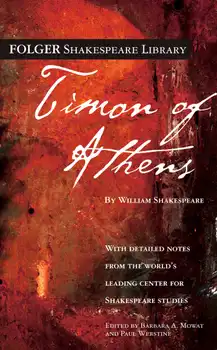
Timon of Athens

The real Timon of Athens lived there in the fifth century BCE, making him a contemporary of Socrates and Pericles. Shakespeare presents Timon as a figure who suffers such profound disillusionment that he becomes a misanthrope, or man-hater. This makes him a more interesting character than the caricature he had become to Shakespeare’s contemporaries, for whom “Timonist” was a slang term for an unsociable man.

Shakespeare’s play includes the wealthy, magnificent, and extravagantly generous figure of Timon before his transformation. Timon expects that, having received as gifts all that he owned, his friends will be equally generous to him.

Once his creditors clamor for repayment, Timon finds that his idealization of friendship is an illusion. He repudiates his friends, abandons Athens, and retreats to the woods. Yet his misanthropy arises from the destruction of an admirable illusion, from which his subsequent hatred can never be entirely disentangled.

The authoritative edition of Timon of Athens from The Folger Shakespeare Library, the trusted and widely used Shakespeare series for students and general readers, includes:

-Freshly edited text based on the best early printed version of the play

-Full explanatory notes conveniently placed on pages facing the text of the play

-Scene-by-scene plot summaries

-A key to the play’s famous lines and phrases

-An introduction to reading Shakespeare’s language

-An essay by a leading Shakespeare scholar providing a modern perspective on the play

-Fresh images from the Folger Shakespeare Library’s vast holdings of rare books

-An annotated guide to further reading

Essay by Coppélia Kahn

The Folger Shakespeare Library in Washington, DC, is home to the world’s largest collection of Shakespeare’s printed works, and a magnet for Shakespeare scholars from around the globe. In addition to exhibitions open to the public throughout the year, the Folger offers a full calendar of performances and programs. For more information, visit Folger.edu.

Om denne boken

The real Timon of Athens lived there in the fifth century BCE, making him a contemporary of Socrates and Pericles. Shakespeare presents Timon as a figure who suffers such profound disillusionment that he becomes a misanthrope, or man-hater. This makes him a more interesting character than the caricature he had become to Shakespeare’s contemporaries, for whom “Timonist” was a slang term for an unsociable man.

Shakespeare’s play includes the wealthy, magnificent, and extravagantly generous figure of Timon before his transformation. Timon expects that, having received as gifts all that he owned, his friends will be equally generous to him.

Once his creditors clamor for repayment, Timon finds that his idealization of friendship is an illusion. He repudiates his friends, abandons Athens, and retreats to the woods. Yet his misanthropy arises from the destruction of an admirable illusion, from which his subsequent hatred can never be entirely disentangled.

The authoritative edition of Timon of Athens from The Folger Shakespeare Library, the trusted and widely used Shakespeare series for students and general readers, includes:

-Freshly edited text based on the best early printed version of the play

-Full explanatory notes conveniently placed on pages facing the text of the play

-Scene-by-scene plot summaries

-A key to the play’s famous lines and phrases

-An introduction to reading Shakespeare’s language

-An essay by a leading Shakespeare scholar providing a modern perspective on the play

-Fresh images from the Folger Shakespeare Library’s vast holdings of rare books

-An annotated guide to further reading

Essay by Coppélia Kahn

The Folger Shakespeare Library in Washington, DC, is home to the world’s largest collection of Shakespeare’s printed works, and a magnet for Shakespeare scholars from around the globe. In addition to exhibitions open to the public throughout the year, the Folger offers a full calendar of performances and programs. For more information, visit Folger.edu.
Kom i gang med denne boken i dag for 0 kr

  • Få full tilgang til alle bøkene i appen i prøveperioden
  • Ingen forpliktelser, si opp når du vil
Prøv gratis nå
Mer enn 52 000 personer har gitt Nextory 5 stjerner på App Store og Google Play.

  1. 5.0

    Romeo and Juliet (lättläst)

    William Shakespeare

  2. 50 Masterpieces you have to read before you die

    Frances Hodgson Burnett, Homer, Charles Dickens, Lyman Frank Baum, Nathaniel Hawthorne, Thomas Hardy, Robert Louis Stevenson, Henry Haggard, Wilkie Collins, H.G. Wells, Sir Walter Scott, Lucy Maud Montgomery, Louisa May Alcott, Henry Fielding, Mary Shelley, Arthur Conan Doyle, Leo Tolstoy, Euripides, Fyodor Dostoevsky, Alexander Pushkin, James Fenimore Cooper, Daniel Defoe, Joseph Conrad, Jonathan Swift, William Shakespeare, Oscar Wilde, John Bunyan, Charles Darwin, Alfred Tennyson, Bram Stoker, James Joyce, Dante Alighieri, Howard Pyle, Jane Austen, Emily Bronte, Giovanni Boccaccio, Rudyard Kipling

  3. 2.5

    Othello

    William Shakespeare

  4. Patrick Stewart Performs the Complete Sonnets of William Shakespeare : With Original Commentary by Patrick Stewart

    William Shakespeare, Patrick Stewart

  5. 5.0

    Hamlet

    William Shakespeare

  6. 10 Masterpieces You Have to Read Before You Die, Vol. 3

    Edgar Allan Poe, William Shakespeare, H.P. Lovecraft, Mary W. Shelley, Osamu Dazai, Jack London, Fyodor Dostoyevsky, Nathaniel Hawthorne, Frances Hodgson Burnett, Robert Louis Stevenson

  7. 3.0

    Romeo and Juliet - Audiobook

    William Shakespeare

  8. A Comedy Of Errors : Full Cast Drama

    William Shakespeare

  9. The Plays of William Shakespeare: Romeo and Juliet, Macbeth, Hamlet, and Othello :

    William Shakespeare

  10. 4.4

    Romeo and Juliet

    William Shakespeare

  11. The Santa's Great Treasure Chest: 450+ Christmas Novels, Tales, Carols & Legends : A Christmas Carol, Silent Night, The Gift of the Magi, Christmas-Tree Land, The Three Kings…

    Bjørnstjerne Bjørnson, Selma Lagerlöf, Charles Dickens, Mark Twain, Harriet Beecher Stowe, Martin Luther, Robert Louis Stevenson, William Shakespeare, Henry Wadsworth Longfellow, Max Brand, William Wordsworth, Carolyn Wells, Charles Mackay, John Addington Symonds, Sophie May, Louisa May Alcott, Henry van Dyke, Arthur Conan Doyle, Frances Hodgson Burnett, Andrew Lang, Frances Ridley Havergal, Alphonse Daudet, William John Locke, Walter Scott, Gustavo Adolfo Bécquer, John Leighton, Booth Tarkington, Ralph Henry Barbour, Benito Pérez Galdós, Ruth McEnery Stuart, Alice Duer Miller, Elizabeth Cleghorn Gaskell, Armando Palacio Valdés, William Morris, Anthony Trollope, Marcel Prévost, Rudyard Kipling, Beatrix Potter, Robert Herrick, Mary Hartwell Catherwood, Emily Dickinson, Bret Harte, Hamilton Wright Mabie, Meredith Nicholson, Lucas Malet, Ellis Parker Butler, Washington Irving, Isaac Watts, James Russell Lowell, Willa Cather, Nathaniel Hawthorne, James Whitcomb Riley, Thomas Nelson Page, O.Henry, Phillips Brooks, Saki, Cyrus Townsend Brady, William Makepeace Thackeray, Mary Stewart Cutting, Sarah Orne Jewett, François Coppée, Oliver Bell Bunce, Susan Coolidge, Samuel McChord Crothers, Maud Lindsay, Alice Hale Burnett, Walter Crane, André Theuriet, Amy Ella Blanchard, Isabel Cecilia Williams, Evaleen Stein, Nell Speed, Amanda M. Douglas), Edgar Wallace, George Wither, Booker T. Washington, Olive Thorne Miller, Margaret Sidney, William Douglas O'Connor, Vernon Lee, Anne Hollingsworth Wharton, Henry Vaughan, Eliza Cook, Kate Upson Clark, Ben Jonson, Ernest Ingersoll, Frank Samuel Child, Willis Boyd Allen, Georgianna M. Bishop, Edward Thring, F. L. Stealey, James Selwin Tait, Tudor Jenks, L. Frank Baum, C.N. Williamson, A.M. Williamson, J.M. Barrie, Eleanor H. Porter, Annie F. Johnston, Jacob A. Riis, S. Weir Mitchell, Elbridge S. Brooks, Edward A. Rand, W. H. H. H Murray, Florence L. Barclay, E. T. A. A Hoffmann, Harrison S. Morris, Robert E. Howard, Marjorie L. C. C Pickthall, Sarah P. Doughty, Hans Christian Andersen, William Butler Yeats, Richard Watson Gilder, Lucy Maud Montgomery, Anton Chekhov, Mary Elizabeth Braddon, Mary Louisa Molesworth, Leo Tolstoy, Fyodor Dostoevsky, Cecil Frances Alexander, Mary E. Wilkins Freeman, Margaret Deland, William Drummond, Robert Southwell, Reginald Heber, Alfred Lord Tennyson, George MacDonald, A. S. Boyd, Maxime Du Camp, Mary Austin, Juliana Horatia Ewing, Guy De Maupassant, Brothers Grimm, Clement Moore, Susan Anne Livingston, Ridley Sedgwick, Nora A. Smith, Phebe A. Curtiss, Nellie C. King, Lucy Wheelock, Aunt Hede, Frederick E. Dewhurst, Jay T. Stocking, Anna Robinson, Florence M. Kingsley, M. A. L. L Lane, Elizabeth Harkison, Raymond Mcalden, F. E. Mann, Winifred M. Kirkland, Katherine Pyle, Grace Margaret Gallaher, Elia W. Peattie, F. Arnstein, James Weber Linn, Antonio Maré, Pedro A. De Alarcón, Jules Simon, Marion Clifford, E. Hale, Georg Schuster, Matilda Betham Edwards, Angelo J. Lewis, William Francis Dawson, Christopher North, Alfred Domett, Dinah Maria Mulock, James S. Park, Edmund Hamilton Sears, Edmund Bolton, C.s. Stone, Harriet F. Blodgett, John G. Whittier, Christian Burke, Emily Huntington Miller, Cyril Winterbotham, Enoch Arnold Bennett, John Punnett Peters, Laura Elizabeth Richards

  12. Die Meisterwerke der Weltliterature : Bereicherte Ausgabe. 100 Klassiker die man kennen muss

    Johann Wolfgang von Goethe, Jules Verne, Gustave Flaubert, Franz Kafka, Lewis Carroll, Selma Lagerlöf, Sigmund Freud, Johanna Spyri, Theodor Storm, Rainer Maria Rilke, Charles Dickens, Stefan Zweig, Heinrich Heine, Honoré de Balzac, Theodor Fontane, Karl May, Gottfried Keller, Mark Twain, Heinrich Mann, Else Lasker-Schüler, Robert Musil, Walt Whitman, Oscar Wilde, Annette von Droste-Hülshoff, Arthur Schopenhauer, Robert Louis Stevenson, Gustav Freytag, James Fenimore Cooper, Edgar Allan Poe, Heinrich von Kleist, William Shakespeare, Dante Alighieri, Charlotte Brontë, Emily Brontë, Jack London, Arthur Conan Doyle, Joseph Conrad, Jane Austen, Herman Melville, Guy De Maupassant, Walter Scott, Jonathan Swift, Jacob Grimm, Wilhelm Grimm, Alexandre Dumas, Rudyard Kipling, Nathaniel Hawthorne, Homer, O.Henry, Voltaire, Lew Wallace, John Galsworthy, E T A Hoffmann, Marcus Aurelius, Hans Christian Andersen, Anton Pawlowitsch Tschechow, Platon, Friedrich Nietzsche, Iwan Sergejewitsch Turgenew, Tacitus, Nikolai Gogol, Miguel de Cervantes, Mary Shelley, Thomas Wolfe, Emile Zola, Fjodor Michailowitsch Dostojewski, Leo Tolstoi, Joseph Roth, Joseph von Eichendorff, Kurt Tucholsky, Iwan Alexandrowitsch Gontscharow, Oswald Spengler, Moliere, Alfred Adler, Sophie von La Roche, Klaus Mann, Rumi