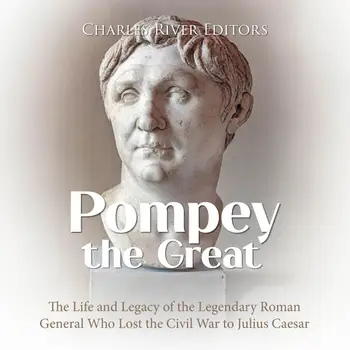
Pompey the Great: The Life and Legacy of the Legendary Roman General Who Lost the Civil War to Julius Caesar

Thanks to Caesar’s victory in the civil war, Pompey is mostly remembered not for being one of Rome’s greatest generals, but for being defeated by Caesar and then ignominiously murdered after he fled to Egypt, where the boy pharaoh Ptolemy XIII decapitated Pompey and offered his head to Caesar as a gift. Although Caesar was there chasing Pompey’s men, he quickly became involved in Egypt’s own civil war. As a consequence of Ptolemy’s barbarity, Caesar impulsively decided to side with his sister Cleopatra in her bid for the throne of Egypt, escalating what was rapidly becoming an all-out civil war.

Of course, before the civil war, Pompey was one of the most powerful men in Rome. Gnaeus Pompeius was born on September 29, 106 BCE and went on to become regarded as one of the greatest statesmen and generals of the late Roman Republic. He was given the title “the Great” by his troops in Africa in 82 BCE and assumed the cognomen Magnus after 81 BCE. Pompey belonged to the senatorial nobility, the Pompeii, and the family had its first consul in 141 BCE. He loved all things Greek and spoke the language fluently. He gained much of his early military experience working on the staff of his father Pompeius Strabo, and the family base was in Picenum in eastern Italy. Strabo had significantly increased the family’s clients when he was consul in 88 BCE.

In time, Pompey played a role in defeating many of Rome’s enemies across the world, from Africa to Spain, and he even helped put down Spartacus’ uprising. He had built his military power and acumen by participating in Rome’s previous civil war between Gaius Marius and Sulla, sharpening both his political and military skills, and he used them to great effect for decades during one of ancient Rome’s most chaotic – and important – periods. Perhaps just as importantly, following his successes in Africa, he demanded a triumph and refused to disband his army.
Kom igång med den här boken idag för 0 kr

  • Få full tillgång till alla böcker i appen under provperioden
  • Ingen bindningstid, avsluta när du vill
Prova gratis nu
Mer än 52 000 personer har gett Nextory 5 stjärnor i App Store och på Google Play.

  1. Ny

    The Hellenization of the Near East: The History of the Spread of Greek Culture to the Region under Alexander the Great and His Successors

    Charles River Editors

  2. Ny

    The Early Persecution of Christians: The History of the Roman Empire’s Efforts to Stamp Out Christianity

    Charles River Editors

  3. Ny

    Dieppe and D-Day: The Controversial History of the Allies’ Amphibious Operations across the English Channel

    Charles River Editors

  4. 5.0

    The Top 5 Greatest Artists : Leonardo, Michelangelo, Raphael, Vincent Van Gogh, and Pablo Picasso

    Charles River Editors

  5. Ny

    Cryptography in World War I: The History of the Efforts to Make and Break Secret Codes during the Great War

    Charles River Editors

  6. Ny

    California: The History and Legacy of the Land Before and After It Joined the United States

    Charles River Editors

  7. Ny

    World War II in 1942: The History of the Year the Allies Turned the Tide Against the Axis

    Charles River Editors

  8. Ny

    The Clovis Culture: The History and Legacy of the Prehistoric Paleoamericans

    Charles River Editors

  9. Ny

    NASA Programs in the 1970s: The History and Legacy of the Space Agency’s Missions to Mars and Beyond

    Charles River Editors

  10. Ny

    Cryptography and the World Wars: The History of Codemaking and Codebreaking during Both Global Conflicts

    Charles River Editors

  11. Ny

    World War II in 1940: The History of the Fighting that Culminated with the German Conquest of Western Europe and the Battle of Britain

    Charles River Editors

  12. Ny

    Admiral David Farragut: The Life and Legacy of the American Civil War’s Most Famous Naval Officer

    Charles River Editors