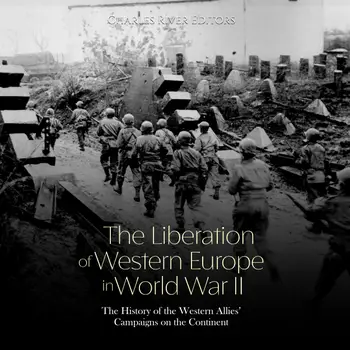
The Liberation of Western Europe in World War II: The History of the Western Allies’ Campaigns on the Continent

During World War II, the free world literally hung in the balance, with the Axis and Allies engaging in warfare on an unprecedented scale. Although Hitler’s Nazi Germany had overrun much of the European continent by 1940, the Allies began to reverse the momentum in 1942. By the end of 1943, with Allied forces firmly established in Italy and the Soviets on the verge of turning the tide in Russia, the British and Americans began to plot the invasion that would liberate Europe from the Nazis.

During the first half of 1944, the Americans and British commenced a massive buildup of men and resources in the United Kingdom, while Allied Supreme Commander Dwight D. Eisenhower and military brass planned the details of an enormous and complex amphibious invasion of Europe. Though the Allies used misinformation to try deceiving the Germans, the most obvious place for an invasion was just across the narrow English Channel, and the Germans had built coastal fortifications throughout France to protect against just such an invasion.

The invasion across the Channel came in the early morning hours of June 6, 1944. That day, forever known as D-Day, the Allies commenced Operation Overlord by staging the largest and most complex amphibious invasion in human history. After the successful amphibious invasion on D-Day in June 1944, the Allies began racing east toward Germany and liberating France along the way. The Allies had landed along a 50 mile stretch of French coast, and despite suffering 8,000 casualties on D-Day, over 100,000 still began the march across the western portion of the continent.

After resisting the German attack, the Allied armies began advancing, and with that, the race to Berlin was truly on. While much has been written of the Battle of the Bulge, Okinawa, Midway, Stalingrad, and many other conflicts of the Second World War, the Battle for Berlin has remained in the shadows for many historians.

Kom igång med den här boken idag för 0 kr

  • Få full tillgång till alla böcker i appen under provperioden
  • Ingen bindningstid, avsluta när du vill
Prova gratis nu
Mer än 52 000 personer har gett Nextory 5 stjärnor i App Store och på Google Play.

  1. Ny

    The Hellenization of the Near East: The History of the Spread of Greek Culture to the Region under Alexander the Great and His Successors

    Charles River Editors

  2. Ny

    Dieppe and D-Day: The Controversial History of the Allies’ Amphibious Operations across the English Channel

    Charles River Editors

  3. Ny

    The Early Persecution of Christians: The History of the Roman Empire’s Efforts to Stamp Out Christianity

    Charles River Editors

  4. 5.0

    The Top 5 Greatest Artists : Leonardo, Michelangelo, Raphael, Vincent Van Gogh, and Pablo Picasso

    Charles River Editors

  5. Ny

    A History of Some of China’s Most Famous Landmarks

    Charles River Editors

  6. Ny

    The Most Famous Silent Film Actors: The History of the Actors Who Helped Shape Hollywood in the Roaring Twenties

    Charles River Editors

  7. Ny

    The Dissolution of Czechoslovakia: The History of the Central European Nation from Its Founding to Its Breakup

    Charles River Editors

  8. Ny
    3.5

    The Soviet Union during the Brezhnev Era: The History of the USSR Under Leonid Brezhnev

    Charles River Editors

  9. Ny

    Narcissa Whitman: The Life and Legacy of the Missionary Killed by Native Americans in the Pacific Northwest

    Charles River Editors

  10. Ny
    4.0

    The Knights Hospitaller: The History and Legacy of the Medieval Catholic Military Order

    Charles River Editors

  11. Ny

    The Stanford Prison Experiment: The History of the Notorious Psychological Experiment on Guards’ Treatment of Prisoners

    Charles River Editors

  12. Ny

    Simon Magus: The Life of the Samaritan Who Converted to Christianity and Confronted Peter the Apostle in the 1st Century

    Charles River Editors, Gustavo Vazquez-Lozano