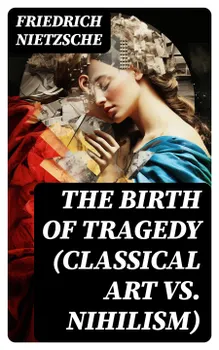
Über dieses Buch

In "The Birth of Tragedy," Friedrich Nietzsche explores the profound interplay between the Apollonian and Dionysian elements of art, positing that the synthesis of these opposing forces gives rise to the true genius of Greek tragedy. With its rich stylistic tapestry, the work oscillates between philosophical discourse and poetic reflection, inviting readers to contemplate the aesthetic experience as a conduit for existential meaning. Nietzsche critiques the decline of art and culture in his contemporary society, linking it to a broader philosophical nihilism that he perceives as threatening the very foundations of Western civilization. Friedrich Nietzsche, a pivotal figure in 19th-century philosophy, grapples with the implications of art and culture against the backdrop of burgeoning nihilism and the crisis of European thought. His experiences in the shadow of Romanticism, combined with a deep engagement with ancient Greek culture, motivated him to articulate a vision that champions tragedy as an essential cultural expression. This work serves as both a celebration and a lamentation, offering glimpses into Nietzsche's complex relationship with art, beauty, and the human condition. This seminal text is essential for readers interested in philosophy, literature, and the evolution of Western thought. Nietzsche's provocative insights challenge us to rethink the role of art in confronting life's inherent pain and chaos, making "The Birth of Tragedy" a timeless exploration of the depths of human experience.

In this enriched edition, we have carefully created added value for your reading experience:

- A succinct Introduction situates the work's timeless appeal and themes.

- The Synopsis outlines the central plot, highlighting key developments without spoiling critical twists.

- A detailed Historical Context immerses you in the era's events and influences that shaped the writing.

- An Author Biography reveals milestones in the author's life, illuminating the personal insights behind the text.

- A thorough Analysis dissects symbols, motifs, and character arcs to unearth underlying meanings.

- Reflection questions prompt you to engage personally with the work's messages, connecting them to modern life.

- Hand‐picked Memorable Quotes shine a spotlight on moments of literary brilliance.

- Interactive footnotes clarify unusual references, historical allusions, and archaic phrases for an effortless, more informed read.

Starte noch heute mit diesem Buch für € 0

  • Hole dir während der Testphase vollen Zugriff auf alle Bücher in der App
  • Keine Verpflichtungen, jederzeit kündbar
Jetzt kostenlos testen
Mehr als 52 000 Menschen haben Nextory im App Store und auf Google Play 5 Sterne gegeben.

  1. 50 Meisterwerke der Philosophie : Metaphysik, Das Gastmahl, Bhagavadgita, Tractatus logico-philosophicus, Kritik der reinen Vernunft, Also sprach Zarathustra, Selbstbetrachtungen von Marcus Aurelius

    Ludwig Wittgenstein, Edmund Husserl, Karl Marx, Søren Kierkegaard, Friedrich Nietzsche, Ralph Waldo Emerson, John Stuart Mill, Georg Wilhelm Hegel, Friedrich Schelling, Johann Gottlieb Fichte, Immanuel Kant, John Locke, Montesquieu, Jean-Jacques Rousseau, David Hume, Gottfried Wilhelm Leibniz, Baruch Spinoza, - Konfuzius, Lao Tse, Platon, Xenophon, - Aristoteles, Marcus Tullius Cicero, Seneca, Epiktet, Marc Aurel, Plotin, Thomas von Aquin, Nicolaus von Cues, - Erasmus von Rotterdam, Niccolò Machiavelli, Tommaso Campanella, Martin Luther, Giordano Bruno, Samuel von Pufendorf, Abbé Castel Saint-Pierre, Michel de Montaigne, René Descartes, Francis Bacon, Blaise Pascal

  2. Der Antichrist

    Friedrich Nietzsche

  3. Also sprach Zarathustra

    Friedrich Nietzsche

  4. Neu

    Ecce homo

    Friedrich Nietzsche

  5. Neu

    The Essential Ancient Wisdom Library : 10 Timeless Classics of Stoicism, Philosophy, Strategy and Self-Mastery

    Marcus Aurelius, Seneca, Epictetus, Laozi, Plato, Sun Tzu, Miyamoto Musashi, Niccolò Machiavelli, Friedrich Nietzsche, James Allen

  6. Neu

    The Essential Ancient Wisdom Library : 10 Timeless Classics of Stoicism, Philosophy, Strategy and Self-Mastery

    Marcus Aurelius, Seneca, Epictetus, Laozi, Plato, Sun Tzu, Miyamoto Musashi, Niccolò Machiavelli, Friedrich Nietzsche, James Allen

  7. Neu

    The Essential Ancient Wisdom Library : 10 Classics of Philosophy, Strategy and Self-Mastery

    Marcus Aurelius, Seneca, Epictetus, Laozi, Plato, Sun Tzu, Miyamoto Musashi, Niccolò Machiavelli, Friedrich Nietzsche, James Allen

  8. 3.5

    Beyond Good and Evil

    Friedrich Nietzsche

  9. Neu

    Ausgewählte Briefe. Ein Grundlagenwerk der Philosophie. : Hörbuchzeit: Klassiker der Weltliteratur

    Hörbuchzeit, Friedrich Nietzsche

  10. 50 Clásicos que Debes Leer Antes de Morir : Un viaje literario por los tesoros de la literatura universal

    Dante Alighieri, Aristóteles, Jane Austen, Charles Baudelaire, Giovanni Boccaccio, Anne Brontë, C. Collodi, James Fenimore Cooper, Fedor Mikhaïlovitch Dostoïevski, Arthur Conan Doyle, Alexandre Dumas, José de Espronceda, Gustave Flaubert, Sigmund Freud, Benito Pérez Galdós, Kahlil Gibran, Johann Wolfgang Goethe, Victor Hugo, Thomas Hardy, Nathaniel Hawthorne, Vicente Blasco Ibáñez, Washington Irving, James Joyce, Mariano José Larra, Jack London, Federico García Lorca, H.P. Lovecraft, Antonio Machado, Gustav Meyrink, John Stuart Mill, Amado Nervo, Friedrich Nietzsche, Solomon Northup, Alexander Sergeyevich Pushkin, Francisco de Quevedo, Walter Scott, William Shakespeare, Robert Louis Stevenson, Harriet Beecher Stowe, Jonathan Swift, Mark Twain, Miguel De Unamuno, Ramón María Valle-Inclán, Julio Verne, Virginia Woolf

  11. Schopenhauer als Erzieher : Unzeitgemäße Betrachtungen, Drittes Stück

    Friedrich Nietzsche

  12. Vom Nutzen und Nachteil der Historie für das Leben : Unzeitgemäße Betrachtungen, Zweites Stück

    Friedrich Nietzsche