À propos de ce livre

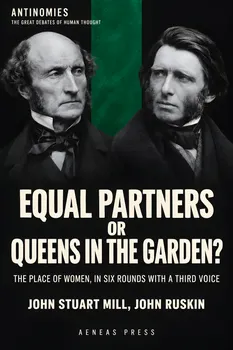
Is a woman's place fixed by nature? Is marriage a partnership or a rule? Who should vote, and who should decide? This book stages a Victorian quarrel as a debate in six rounds. John Stuart Mill, with the essay of Harriet Taylor Mill, argues for equality in law. John Ruskin argues for woman's queenly office in the home and the state. A third voice, the satirical journalist Eliza Lynn Linton, mocks the claims of "advanced" women and defends a traditional womanliness. The texts are given whole: Mill's The Subjection of Women (1869) and his Autobiography chapter on Harriet Taylor, her Enfranchisement of Women (1851), Ruskin's Of Queens' Gardens and Of Kings' Treasuries (1864) with his footnotes, a lecture of The Ethics of the Dust, and ten essays by Linton. Mill and Ruskin never answer each other; the editors' apparatus sets them side by side and gives no verdict.
Commencez ce livre dès aujourd'hui pour 0 €

  • Accédez à tous les livres de l'app pendant la période d'essai
  • Sans engagement, annulez à tout moment
Essayer gratuitement
Plus de 52 000 personnes ont noté Nextory 5 étoiles sur l'App Store et Google Play.

  1. Nouveau

    Duty or Happiness? : The foundation of morals, in eight rounds

    John Stuart Mill, Immanuel Kant

  2. Nouveau

    Autobiography

    John Stuart Mill

  3. Nouveau

    The Subjection of Women

    John Stuart Mill

  4. Nouveau

    The Contest in America

    John Stuart Mill

  5. Nouveau

    On Liberty

    John Stuart Mill

  6. Nouveau
    3.0

    Utilitarianism

    John Stuart Mill

  7. On Liberty : The Limits of the Power of Society Over the Individual

    John Stuart Mill

  8. On Liberty : The Limits of the Power of Society Over the Individual

    John Stuart Mill

  9. Harvard Classics : The Five-Foot Shelf of Books

    Aesop, Dante Alighieri, Hans Christian Andersen, Augustine of Hippo, Marcus Aurelius, Jane Austen, Francis Bacon, Honoré de Balzac, Francis Beaumont, Bjørnstjerne Bjørnson, Thomas Browne, Robert Browning, John Bunyan, EDMUND BURKE, Robert Burns, Lord Byron, Thomas Carlyle, Benvenuto Cellini, Miguel de Cervantes, Marcus Tullius Cicero, Richard Henry Jr., Charles Darwin, Alphonse Daudet, Thomas Dekker, Charles Dickens, Fyodor Dostoevsky, John Dryden, Charles W. Eliot, George Eliot, Ralph Waldo Emerson, Epictetus, John Fletcher, Theodor Fontane, Benjamin Franklin, Johann Wolfgang Goethe, Oliver Goldsmith, Jacob Grimm, Edward Everett Hale, Bret Harte, Nathaniel Hawthorne, Homer, Victor Hugo, Washington Irving, Henry James, Ben Jonson, Gottfried Keller, Thomas à Kempis, Alexander L. Kielland, Martin Luther, Niccolò Machiavelli, Alessandro Manzoni, Christopher Marlowe, Philip Massinger, Guy De Maupassant, John Stuart Mill, John Milton, Thomas More, William Morris, Alfred de Musset, William Allan Neilson, William Penn, Plato, Pliny the Younger, Plutarch, George Sand, Percy Bysshe Shelley, Richard Brinsley Sheridan, Adam Smith, Laurence Sterne, Theodor Storm, William Makepeace Thackeray, Leo Tolstoy, Ivan Turgenev, Mark Twain, Juan Valera, Virgil, Izaak Walton, John Webster, John Woolman

  10. On liberty

    John Stuart Mill

  11. On Liberty

    John Stuart Mill