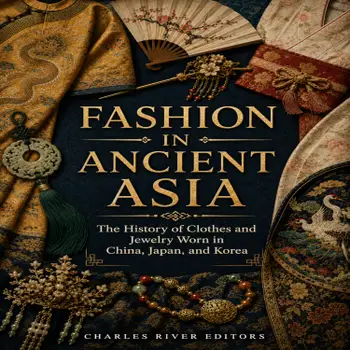

For most of recorded history, the peoples of East Asia dressed themselves according to a single elegant idea. They did not cut cloth to the shape of the body and stitch it close, the way the tailors of Europe learned to do. They wrapped the body instead, taking long panels of woven silk or hemp, crossing one over the other at the breast, and binding the whole with a sash so that a person stood inside their clothing rather than inside a set of fitted seams. From that one idea, repeated and refined across 3,000 years, came some of the most beautiful garments the world has ever produced.
It's tempting to imagine that China, Korea, and Japan all dressed alike, and a casual glance can make the mistake seem reasonable. All three favored the wrapped robe and prized silk above every other fiber. All three treated fashion as a moral and cosmological statement rather than a matter of private taste. But the differences are as real as the family resemblance, and they run deep. China gave the region the wrapped robe, the cross-collar, and the loom itself, and its court dress radiated outward for 2,000 years like heat from a fire. Korea took the same starting materials and built something no one could mistake for Chinese, a short jacket riding above a great bell of a skirt. Japan borrowed the Chinese court wholesale in its early centuries, then shut the door on the mainland and spent 300 years turning the borrowed robe into a national art of layered color, out of which the kimono was eventually born.
In all of these places, societies were determining how a civilized person should cover their body, but the answers eventually varied considerably. The answers ranged from silk to hemp and ramie, curved hems and straight ones, the exact direction in which a collar crossed the chest, the number of robes a noblewoman layered against the winter, and the precise shade of yellow that only an emperor was allowed to wear. None of it was casual.