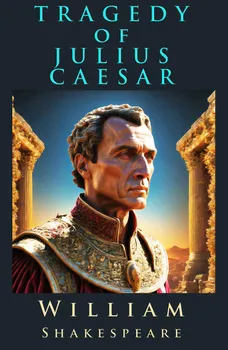
The Tragedy of Julius Caesar

The Tragedy of Julius Caesar is a tragedy by William Shakespeare, believed to have been written in 1599. It portrays the 44 BC conspiracy against the Roman dictator Julius Caesar, his assassination and the defeat of the conspirators at the Battle of Philippi. It is one of several plays written by Shakespeare based on true events from Roman history, which also include Coriolanus and Antony and Cleopatra.

Although the title is Julius Caesar, Julius Caesar is not the most visible character in its action; he appears in only five scenes. Marcus Brutus speaks more than four times as many lines, and the central psychological drama is his struggle between the conflicting demands of honor, patriotism, and friendship.

Characters & Synopsis:

Marcus Brutus is Caesar's close friend and a Roman praetor. Brutus allows himself to be cajoled into joining a group of conspiring senators because of a growing suspicion—implanted by Caius Cassius—that Caesar intends to turn republican Rome into a monarchy under his own rule.

The early scenes deal mainly with Brutus's arguments with Cassius and his struggle with his own conscience. The growing tide of public support soon turns Brutus against Caesar (this public support was actually faked; Cassius wrote letters to Brutus in different handwritings over the next month in order to get Brutus to join the conspiracy). A soothsayer warns Caesar to "beware the Ides of March", which he ignores, culminating in his assassination at the Capitol by the conspirators that day, despite being warned by the soothsayer and Artemidorus, one of Caesar's supporters at the entrance of the Capitol.

Caesar's assassination is one of the most famous scenes of the play, occurring in Act 3 (the other is Marc Antony's oration "Friends, Romans, countrymen.") After ignoring the soothsayer as well as his wife's own premonitions, Caesar comes to the Senate. The conspirators create a superficial motive for the assassination by means of a petition brought by Metellus Cimber, pleading on behalf of his banished brother. As Caesar, predictably, rejects the petition, Casca grazes Caesar in the back of his neck, and the others follow in stabbing him; Brutus is last. At this point, Caesar utters the famous line "Et tu, Brute?" ("And you, Brutus?", i.e. "You too, Brutus?"). Shakespeare has him add, "Then fall, Caesar," suggesting that Caesar did not want to survive such treachery, therefore becoming a hero.

À propos de ce livre

The Tragedy of Julius Caesar is a tragedy by William Shakespeare, believed to have been written in 1599. It portrays the 44 BC conspiracy against the Roman dictator Julius Caesar, his assassination and the defeat of the conspirators at the Battle of Philippi. It is one of several plays written by Shakespeare based on true events from Roman history, which also include Coriolanus and Antony and Cleopatra.

Although the title is Julius Caesar, Julius Caesar is not the most visible character in its action; he appears in only five scenes. Marcus Brutus speaks more than four times as many lines, and the central psychological drama is his struggle between the conflicting demands of honor, patriotism, and friendship.

Characters & Synopsis:

Marcus Brutus is Caesar's close friend and a Roman praetor. Brutus allows himself to be cajoled into joining a group of conspiring senators because of a growing suspicion—implanted by Caius Cassius—that Caesar intends to turn republican Rome into a monarchy under his own rule.

The early scenes deal mainly with Brutus's arguments with Cassius and his struggle with his own conscience. The growing tide of public support soon turns Brutus against Caesar (this public support was actually faked; Cassius wrote letters to Brutus in different handwritings over the next month in order to get Brutus to join the conspiracy). A soothsayer warns Caesar to "beware the Ides of March", which he ignores, culminating in his assassination at the Capitol by the conspirators that day, despite being warned by the soothsayer and Artemidorus, one of Caesar's supporters at the entrance of the Capitol.

Caesar's assassination is one of the most famous scenes of the play, occurring in Act 3 (the other is Marc Antony's oration "Friends, Romans, countrymen.") After ignoring the soothsayer as well as his wife's own premonitions, Caesar comes to the Senate. The conspirators create a superficial motive for the assassination by means of a petition brought by Metellus Cimber, pleading on behalf of his banished brother. As Caesar, predictably, rejects the petition, Casca grazes Caesar in the back of his neck, and the others follow in stabbing him; Brutus is last. At this point, Caesar utters the famous line "Et tu, Brute?" ("And you, Brutus?", i.e. "You too, Brutus?"). Shakespeare has him add, "Then fall, Caesar," suggesting that Caesar did not want to survive such treachery, therefore becoming a hero.

Commencez ce livre dès aujourd'hui pour 0 €

  • Accédez à tous les livres de l'app pendant la période d'essai
  • Sans engagement, annulez à tout moment
Essayer gratuitement
Plus de 52 000 personnes ont noté Nextory 5 étoiles sur l'App Store et Google Play.

  1. Patrick Stewart Performs the Complete Sonnets of William Shakespeare : With Original Commentary by Patrick Stewart

    William Shakespeare, Patrick Stewart

  2. 3.8

    Roméo et Juliette - Livre Audio

    William Shakespeare, Livres audio en français

  3. 3.5

    Hamlet

    William Shakespeare

  4. Othello

    William Shakespeare

  5. 4.0

    Romeo et Juliette (Romeo and Juliet in French)

    William Shakespeare

  6. 13 nov.

    Dramer II. Strö lycka, féer : Komiska förväxlingar, Så tuktas en argbigga, Två gentlemän från Verona, Kärleks möda är förgäves, En midsommarnattsdröm, Muntra fruarna i Windsor.

    William Shakespeare

  7. Nouveau

    The Big Book of Christmas

    Louisa May Alcott, O.Henry, Mark Twain, Beatrix Potter, Charles Dickens, William Shakespeare, Harriet Beecher Stowe, Emily Dickinson, Robert Louis Stevenson, Rudyard Kipling

  8. Nouveau

    William Shakespeare: Hamlet. A drama. : Unabridged version with stage directions

    William Shakespeare

  9. Nouveau

    William Shakespeare: The Complete Works (Illustrated)

    William Shakespeare

  10. Nouveau
    3.0

    50 Masterpieces you have to read before you die vol: 2

    Lewis Carroll, Mark Twain, Jules Verne, Oscar Wilde, Arthur Conan Doyle, Louisa May Alcott, Jane Austen, G.K. Chesterton, Wilkie Collins, Charles Dickens, Fyodor Dostoyevsky, Alexandre Dumas, F. Scott Fitzgerald, E. M. Forster, Thomas Hardy, Hermann Hesse, James Joyce, Jack London, H.P. Lovecraft, Lucy Maud Montgomery, Edgar Allan Poe, Marcel Proust, William Shakespeare, Robert Louis Stevenson, H.G. Wells, Virginia Woolf, Rudyard Kipling, D. H. Lawrence, Thomas Mann, William Somerset Maugham, Herman Melville, George Sand, Mary Shelley, Walter Scott, Leo Tolstoy, Bram Stoker

  11. Nouveau
    2.5

    Othello

    William Shakespeare

  12. Nouveau
    3.3

    Romeo and Juliet

    William Shakespeare