3.0(3)

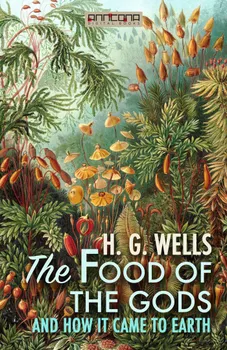
The Food of the Gods, and How It Came to Earth

The Food of the Gods, and How It Came to Earth is a science fiction novel by H. G. Wells, first published in 1904.

Wells called it "a fantasia on the change of scale in human affairs. . . . I had hit upon [the idea] while working out the possibilities of the near future in a book of speculations called Anticipations (1901)."

The novel is about a group of scientists who invent a food that accelerates the growth of children and turns them into giants when they become adults.

Mr. Bensington and Professor Redwood have invented a substance that causes living things to grow - and grow - and grow! As their experiments progress, the substance quickly gets out of control and the fun begins as insects and plants receive the benefit of the Food of the Gods.

Surely nobody would dream of feeding such a thing to a human child… would they?

In this little-known science fiction satire, Wells takes potshots at every member of society: scientists, ministers, charitable heiresses, revolutionaries, and everyone in between. Yet in the end, Wells shows his faith both in humanity and its never-ceasing progress.

There have been various B-movie adaptations.

Herbert George "H. G." Wells (1866-1946) was an English writer, now best known for his work in the science fiction genre. He was also a prolific writer in many other genres, including contemporary novels, history, politics and social commentary, even writing textbooks and rules for war games.

Wells is one person sometimes called "The Father of Science Fiction", as are Jules Verne and Hugo Gernsback. His most notable science fiction works include The War of the Worlds, The Time Machine, The Invisible Man and The Island of Doctor Moreau.


Tietoa kirjasta

The Food of the Gods, and How It Came to Earth is a science fiction novel by H. G. Wells, first published in 1904.

Wells called it "a fantasia on the change of scale in human affairs. . . . I had hit upon [the idea] while working out the possibilities of the near future in a book of speculations called Anticipations (1901)."

The novel is about a group of scientists who invent a food that accelerates the growth of children and turns them into giants when they become adults.

Mr. Bensington and Professor Redwood have invented a substance that causes living things to grow - and grow - and grow! As their experiments progress, the substance quickly gets out of control and the fun begins as insects and plants receive the benefit of the Food of the Gods.

Surely nobody would dream of feeding such a thing to a human child… would they?

In this little-known science fiction satire, Wells takes potshots at every member of society: scientists, ministers, charitable heiresses, revolutionaries, and everyone in between. Yet in the end, Wells shows his faith both in humanity and its never-ceasing progress.

There have been various B-movie adaptations.

Herbert George "H. G." Wells (1866-1946) was an English writer, now best known for his work in the science fiction genre. He was also a prolific writer in many other genres, including contemporary novels, history, politics and social commentary, even writing textbooks and rules for war games.

Wells is one person sometimes called "The Father of Science Fiction", as are Jules Verne and Hugo Gernsback. His most notable science fiction works include The War of the Worlds, The Time Machine, The Invisible Man and The Island of Doctor Moreau.
Aloita kirja saman tien hintaan 0 €

  • Kokeilujakson aikana käytössäsi on kaikki sovelluksen kirjat
  • Ei sitoumusta, voit perua milloin vain
Kokeile nyt ilmaiseksi
Yli 52 000 ihmistä on antanut Nextorylle viisi tähteä App Storessa ja Google Playssä.

  1. 4.0

    Maailmojen sota

    H.G. Wells

  2. 3.4

    Näkymätön mies

    H.G. Wells

  3. 3.0

    50 Masterpieces you have to read before you die vol: 1 (2020 Edition) : Included: Little Women, The Richest Man in Babylon Emma, The Call Of The Wild ....

    Louisa May Alcott, Dante Alighieri, Marcus Aurelius, Jane Austen, L. Frank Baum, Charlotte Brontë, Emily Brontë, Anne Brontë, Miguel de Cervantes, Agatha Christie, George S. Clason, Arthur Conan Doyle, Joseph Conrad, Charles Dickens, Fyodor Dostoyevsky, Alexandre Dumas, George Eliot, G.K. Chesterton, G.K. Chesterton, Zane Grey, Nathaniel Hawthorne, Napoleon Hill, Homer, Victor Hugo, Frances Hodgson Burnett, Washington Irving, Henry James, Franz Kafka, Rudyard Kipling, Jack London, Leo Tolstoy, H.P. Lovecraft, Lucy Maud Montgomery, Joseph Murphy, Robert Louis Stevenson, Edgar Allan Poe, Marcel Proust, Publius, Mary Shelley, Bram Stoker, Mark Twain, Sun Tzu, Lew Wallace, Wallace D. Wattles, H.G. Wells

  4. Uni

    H.G. Wells

  5. 3.0

    Kauhun saari

    H.G. Wells

  6. 3.6

    The Island of Doctor Moreau

    H.G. Wells

  7. 4.0

    Classic Science Fiction Short Stories from the Greats

    Philip K Dick, Frank Herbert, H.G. Wells, Ray Bradbury, Murray Leinster, Robert Sheckley

  8. Lost Sci-Fi Books 121 thru 140

    Ray Bradbury, Philip K Dick, George O. Smith, Frank Belknap Long, Isaac Asimov, Robert Sheckley, H.G. Wells, Paul Ernst, Clifford D. Simak, Robert Silverberg, Arthur C. Clarke, Edward W. Ludwig, Jack Vance, Harry Harrison

  9. The Time Machine :

    H.G. Wells

  10. The Book of Shadows

    Arthur Quiller-Couch, Robert W. Chambers, H.G. Wells, Mary E. Wilkins Freeman, E Nesbit, Barry Pain, E F Benson, D. H. Lawrence, Thomas Burke

  11. The Essential Classics Collection : 1984; Great Expectations; The Brothers Karamazov; Pride and Prejudice; & The War of the Worlds

    George Orwell, Fyodor Dostoyevsky, Charles Dickens, Jane Austen, H.G. Wells

  12. 4.0

    The Red Room :

    H.G. Wells