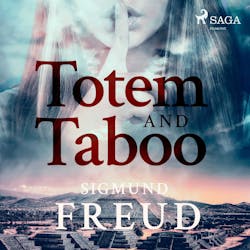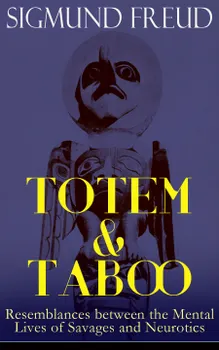
TOTEM & TABOO : Psychoanalytic explorations of taboo, totemism, magic, and the origins of religion

This carefully crafted ebook: "TOTEM AND TABOO: Resemblances between the Mental Lives of Savages and Neurotics" is formatted for your eReader with a functional and detailed table of contents.

Totem and Taboo: Resemblances Between the Mental Lives of Savages and Neurotics is a book by Sigmund Freud in four parts: "The Horror of Incest", "Taboo and Emotional Ambivalence", "Animism, Magic and the Omnipotence of Thoughts" and "The Return of Totemism in Childhood". In these volumes, Freud applies psychoanalysis to the fields of archaeology, anthropology and the study of religion. Totem and Taboo has been seen as one of the classics of anthropology, considered by psychoanalysts and anthropologists as one of the great landmarks in the history of anthropology.

Sigmund Freud (1856-1939) was an Austrian neurologist and the father of psychoanalysis, a clinical method for treating psychopathology through dialogue between a patient and a psychoanalyst. In creating psychoanalysis, Freud developed therapeutic techniques such as the use of free association and discovered transference, establishing its central role in the analytic process. Freud's redefinition of sexuality to include its infantile forms led him to formulate the Oedipus complex as the central tenet of psychoanalytical theory. His analysis of dreams as wish-fulfillments provided him with models for the clinical analysis of symptom formation and the mechanisms of repression as well as for elaboration of his theory of the unconscious.

Tietoa kirjasta

This carefully crafted ebook: "TOTEM AND TABOO: Resemblances between the Mental Lives of Savages and Neurotics" is formatted for your eReader with a functional and detailed table of contents.

Totem and Taboo: Resemblances Between the Mental Lives of Savages and Neurotics is a book by Sigmund Freud in four parts: "The Horror of Incest", "Taboo and Emotional Ambivalence", "Animism, Magic and the Omnipotence of Thoughts" and "The Return of Totemism in Childhood". In these volumes, Freud applies psychoanalysis to the fields of archaeology, anthropology and the study of religion. Totem and Taboo has been seen as one of the classics of anthropology, considered by psychoanalysts and anthropologists as one of the great landmarks in the history of anthropology.

Sigmund Freud (1856-1939) was an Austrian neurologist and the father of psychoanalysis, a clinical method for treating psychopathology through dialogue between a patient and a psychoanalyst. In creating psychoanalysis, Freud developed therapeutic techniques such as the use of free association and discovered transference, establishing its central role in the analytic process. Freud's redefinition of sexuality to include its infantile forms led him to formulate the Oedipus complex as the central tenet of psychoanalytical theory. His analysis of dreams as wish-fulfillments provided him with models for the clinical analysis of symptom formation and the mechanisms of repression as well as for elaboration of his theory of the unconscious.

Aloita kirja saman tien hintaan 0 €

  • Kokeilujakson aikana käytössäsi on kaikki sovelluksen kirjat
  • Ei sitoumusta, voit perua milloin vain
Kokeile nyt ilmaiseksi
Yli 52 000 ihmistä on antanut Nextorylle viisi tähteä App Storessa ja Google Playssä.

  1. 4.0

    The Psychopathology of Everyday Life

    Sigmund Freud

  2. Introduction to Psychoanalysis

    Sigmund Freud

  3. Psykoanalys: Förstå din inre värld

    Sigmund Freud

  4. Krigstrauma

    Sigmund Freud

  5. 3.0

    On Dreams

    Sigmund Freud

  6. The Ego and the ID : (An Introduction & Sigmund Freud Biography Added)

    Sigmund Freud

  7. Three contributions to the theory of sex

    Sigmund Freud

  8. Totem and Taboo

    Sigmund Freud

  9. 4.4

    200 Quotes on Psychoanalysis

    Sigmund Freud, Carl Jung

  10. Three Essays on the Theory of Sexuality

    Sigmund Freud

  11. 33 Human Science Masterpieces You Must Read Before You Die. Illustrated : The Art of Public Speaking, The Meditations, The Kama Sutra and other masterpieces

    Edwin A. Abbott, Aristotle, Dale Carnegie, Gilbert Chesterton, René Descartes, Epictetus, Marcus Aurelius Antoninus, Sigmund Freud, Hermann Hesse, David Hume, Lao Tzu, Confucius, Swami Abhedananda, Anonimous, David Herbert Lawrence, Niccolò Machiavelli, Benedictus de Spinoza, John Mill, Prentice Mulford, Thomas More, Friedrich Nietzsche, J. Allanson Picton, Plato, Sun Tzu, Vatsyayana, Voltaire, H.G. Wells, Frances Bacon

  12. 33 Masterpieces of Philosophy and Science to Read Before You Die (Illustrated) : Utopia, The Meditations, The Art of War, The Kama Sutra, Candide

    Thomas More, Marcus Aurelius Antoninus, Sun Tzu, Vatsyayana, Voltaire, Edwin A. Abbott, Aristotle, Dale Carnegie, Gilbert Keith Chesterton, René Descartes, Epictetus, Sigmund Freud, Hermann Hesse, David Hume, Lao Tzu, David Herbert Lawrence, Niccolò Machiavelli, John Mill, Prentice Mulford, Friedrich Nietzsche, Plato, Bertrand Russell, H.G. Wells, Frances Bacon