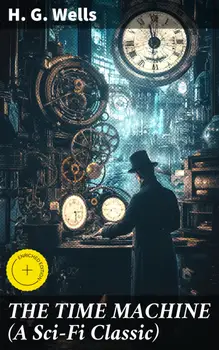
THE TIME MACHINE (A Sci-Fi Classic) : Enriched edition. A Journey Through Time and Evolution

In "The Time Machine," H. G. Wells crafts a pioneering narrative that explores the complexities of time travel through the eyes of an unassailable scientist known as the Time Traveller. The novella is rich with Victorian gothic elements and vividly imaginative prose, set against the backdrop of the industrial revolution'—a period bursting with scientific optimism yet tinged with existential anxiety. Wells employs a frame narrative style, intertwining the protagonist's bold expedition into the distant future with philosophical musings on the nature of humanity, class struggles, and the evolutionary implications of technology. This exploration reveals a chilling perspective on future societies, represented by the Eloi and Morlocks, that continues to resonate in contemporary discourse on socio-economic disparities and technological ethics. H. G. Wells, often hailed as the father of science fiction, was a man deeply influenced by the socio-political climates of the late 19th century. His background in natural science and education, coupled with his engagement in socialist thought, inspired him to use speculative fiction as a means to critique societal norms and provoke critical reflection. "The Time Machine" reflects his urgent concerns regarding the direction of humanity's progress and the potential consequences of ignoring social inequities. This seminal work is highly recommended for anyone interested in the intersections of science fiction, philosophy, and social commentary. With its imaginative narrative and profound themes, "The Time Machine" not only engenders a thrilling adventure through time but also invites readers to ponder their own societal trajectory, making it an essential read for students of literature, philosophy, and history alike.

In this enriched edition, we have carefully created added value for your reading experience:

- A succinct Introduction situates the work's timeless appeal and themes.

- The Synopsis outlines the central plot, highlighting key developments without spoiling critical twists.

- A detailed Historical Context immerses you in the era's events and influences that shaped the writing.

- An Author Biography reveals milestones in the author's life, illuminating the personal insights behind the text.

- A thorough Analysis dissects symbols, motifs, and character arcs to unearth underlying meanings.

- Reflection questions prompt you to engage personally with the work's messages, connecting them to modern life.

- Hand‐picked Memorable Quotes shine a spotlight on moments of literary brilliance.

- Interactive footnotes clarify unusual references, historical allusions, and archaic phrases for an effortless, more informed read.

À propos de ce livre

In "The Time Machine," H. G. Wells crafts a pioneering narrative that explores the complexities of time travel through the eyes of an unassailable scientist known as the Time Traveller. The novella is rich with Victorian gothic elements and vividly imaginative prose, set against the backdrop of the industrial revolution'—a period bursting with scientific optimism yet tinged with existential anxiety. Wells employs a frame narrative style, intertwining the protagonist's bold expedition into the distant future with philosophical musings on the nature of humanity, class struggles, and the evolutionary implications of technology. This exploration reveals a chilling perspective on future societies, represented by the Eloi and Morlocks, that continues to resonate in contemporary discourse on socio-economic disparities and technological ethics. H. G. Wells, often hailed as the father of science fiction, was a man deeply influenced by the socio-political climates of the late 19th century. His background in natural science and education, coupled with his engagement in socialist thought, inspired him to use speculative fiction as a means to critique societal norms and provoke critical reflection. "The Time Machine" reflects his urgent concerns regarding the direction of humanity's progress and the potential consequences of ignoring social inequities. This seminal work is highly recommended for anyone interested in the intersections of science fiction, philosophy, and social commentary. With its imaginative narrative and profound themes, "The Time Machine" not only engenders a thrilling adventure through time but also invites readers to ponder their own societal trajectory, making it an essential read for students of literature, philosophy, and history alike.

In this enriched edition, we have carefully created added value for your reading experience:

- A succinct Introduction situates the work's timeless appeal and themes.

- The Synopsis outlines the central plot, highlighting key developments without spoiling critical twists.

- A detailed Historical Context immerses you in the era's events and influences that shaped the writing.

- An Author Biography reveals milestones in the author's life, illuminating the personal insights behind the text.

- A thorough Analysis dissects symbols, motifs, and character arcs to unearth underlying meanings.

- Reflection questions prompt you to engage personally with the work's messages, connecting them to modern life.

- Hand‐picked Memorable Quotes shine a spotlight on moments of literary brilliance.

- Interactive footnotes clarify unusual references, historical allusions, and archaic phrases for an effortless, more informed read.
Commencez ce livre dès aujourd'hui pour 0 €

  • Accédez à tous les livres de l'app pendant la période d'essai
  • Sans engagement, annulez à tout moment
Essayer gratuitement
Plus de 52 000 personnes ont noté Nextory 5 étoiles sur l'App Store et Google Play.

  1. 50 Chefs-D'œuvre Que Vous Devez Lire Avant De Mourir : Vol 1 (Golden Deer Classics)

    Mark Twain, Stendhal, Edgar Allan Poe, Victor Hugo, Gustave Flaubert, Alexandre Dumas, Arthur Conan Doyle, René Descartes, Lewis Carroll, Charles Baudelaire, Guillaume Apollinaire, Golden Deer, Alain-Fournier, Jules Amédée d'Aurevilly, Paul Bourget, Charlotte Brontë, Emily Brontë, Pierre Corneille, Nikolai Gogol, Gustave Leroux, Marquis De Sade, Jack London, Sinclair Lewis, Daniel Lesueur, Marcel Proust, Edmond Rostand, Jean-Jacques Rousseau, Mary Shelley, Bram Stoker, Sun Tzu, Rodolphe Töpffer, Vatsyayana, Jules Verne, Voltaire, H.G. Wells, Oscar Wilde, Emile Zola

  2. 50 Chefs-D'œuvre Que Vous Devez Lire Avant De Mourir: Vol 2

    Honoré de Balzac, Alphonse Daudet, Arthur Conan Doyle, Alexandre Dumas, Gustave Flaubert, Francis Scott Fitzgerald, Nikolai Gogol, Victor Hugo, Maurice Leblanc, Jack London, Madame de La Fayette, Guy De Maupassant, Friedrich Nietzsche, Jean-Jacques Rousseau, Robert Louis Stevenson, Jules Verne, H.G. Wells, Michel de Montaigne, Golden Deer Classics

  3. Les nouvelles fantastiques de H.G. WELLS : 26 nouvelles en texte intégral par le père de la science-fiction contemporaine

    H.G. Wells, Herbert George Wells

  4. 5.0

    La guerre des Mondes

    H.G. Wells

  5. 3.5

    La Guerre des mondes - Livre Audio

    H.G. Wells

  6. 4.5

    La Machine à explorer le temps - Livre Audio

    H.G. Wells, Livres audio en français

  7. 5.0

    La Machine à explorer le temps

    H.G. Wells

  8. 3.8

    L'Île du Docteur Moreau

    H.G. Wells

  9. 3.0

    The First Men in the Moon

    H.G. Wells

  10. 5.0

    L'Homme invisible

    H.G. Wells

  11. 3.0

    50 Masterpieces you have to read before you die vol: 2

    Lewis Carroll, Mark Twain, Jules Verne, Oscar Wilde, Arthur Conan Doyle, Louisa May Alcott, Jane Austen, G.K. Chesterton, Wilkie Collins, Charles Dickens, Fyodor Dostoyevsky, Alexandre Dumas, F. Scott Fitzgerald, E. M. Forster, Thomas Hardy, Hermann Hesse, James Joyce, Jack London, H.P. Lovecraft, Lucy Maud Montgomery, Edgar Allan Poe, Marcel Proust, William Shakespeare, Robert Louis Stevenson, H.G. Wells, Virginia Woolf, Rudyard Kipling, D. H. Lawrence, Thomas Mann, William Somerset Maugham, Herman Melville, George Sand, Mary Shelley, Walter Scott, Leo Tolstoy, Bram Stoker

  12. 3.6

    The Island of Doctor Moreau

    H.G. Wells