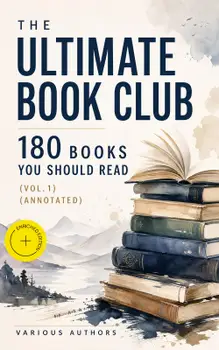







The Ultimate Book Club: 180 Books You Should Read (Vol.1) gathers an extraordinary cross-section of world literature, philosophy, adventure, social critique, psychological inquiry, and speculative imagination. Its range extends from ancient dialogues and classical drama to Victorian realism, Gothic terror, modernist experimentation, children's fantasy, detective fiction, and political reflection. The volume's significance lies in its capacious vision of reading as a conversation across genres, nations, and centuries. The contributors represent many of the defining currents of literary and intellectual history: Enlightenment satire, Romantic introspection, nineteenth-century realism, fin-de-siècle aestheticism, imperial adventure, early science fiction, modernist fragmentation, and moral philosophy. European, American, Russian, Japanese, and other traditions meet here, bringing together voices shaped by revolution, industrialization, empire, reform, spiritual searching, and artistic innovation. Collectively, they illuminate how literature has addressed freedom, identity, desire, justice, faith, imagination, and the human condition. This volume is highly recommended for readers seeking a rich, structured entry into the global canon. It offers the rare opportunity to encounter many essential perspectives and styles within a single collection, encouraging comparison as much as appreciation. For students, book clubs, and lifelong readers, it provides both education and pleasure, fostering a lively dialogue among works that continue to define literary culture.
This enriched edition has been carefully crafted to add value to your reading experience.
- An Introduction draws the threads together, discussing why these diverse authors and texts belong in one collection.
- Historical Context explores the cultural and intellectual currents that shaped these works, offering insight into the shared (or contrasting) eras that influenced each writer.
- A combined Synopsis (Selection) briefly outlines the key plots or arguments of the included pieces, helping readers grasp the anthology's overall scope without giving away essential twists.
- A collective Analysis highlights common themes, stylistic variations, and significant crossovers in tone and technique, tying together writers from different backgrounds.
- Reflection questions encourage readers to compare the different voices and perspectives within the collection, fostering a richer understanding of the overarching conversation.