Évaluation de 3.0 sur 5, basée sur 1 avis
Livre audio

À propos de ce livre

While airplanes had never before appeared above the field of war, other aerial vehicles had already been in use for decades, and balloons had carried soldiers above the landscape for centuries to provide a high observation point superior to most geological features. The French used a balloon for this purpose at the Battle of Fleurus in 1794, and by the American Civil War, military hydrogen balloons saw frequent use, filled from wagons generating hydrogen from iron filings and sulfuric acid.

In fact, with advances in dirigible technology, many military thinkers and even aeronautical enthusiasts believed that blimps would remain the chief military aerial asset for the foreseeable future. These men thought airplanes would play a secondary role at best and might even prove a uselessly expensive gimmick soon to fade back into obscurity, leaving the majestic bulk of the dirigible as sole master of the skies.

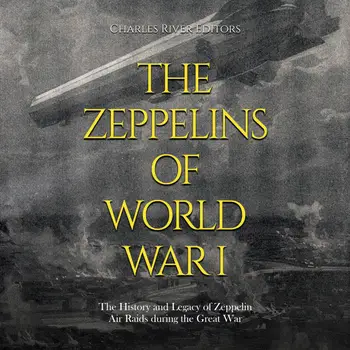
The Zeppelins, slow and large as they were, proved to be easy targets for fire from the ground, so they were too vulnerable for reconnaissance in the warzone. Instead, they were used for the task of bombing targets. Bombs were dropped on Paris in August 1914, and Zeppelins bombed Belgian forces as the Germans advanced on Liège. The Germans also used them to bomb England’s eastern ports and London in an attempt to disrupt military supplies. On the other side, British pilots destroyed a Zeppelin on the ground at Düsseldorf.

This was bombing at its simplest; the explosives were kept on hooks on the side of the machines and dropped by a crew member by hand. These small forays into aerial bombardment barely even hinted at the bombing campaigns to come, but Zeppelin raids on Britain would continue for nearly four years, killing more than 500 people and injuring 1,300. These raids and the attempts to stop them would be carried out at the cutting edge of new technology.
Commencez ce livre dès aujourd'hui pour 0 €

  • Accédez à tous les livres de l'app pendant la période d'essai
  • Sans engagement, annulez à tout moment
Essayer gratuitement
Plus de 52 000 personnes ont noté Nextory 5 étoiles sur l'App Store et Google Play.

  1. The Monterey International Pop Festival: The History and Legacy of the First Major Rock Festival in the 1960s

    Charles River Editors

  2. The 332nd Fighter Group: The History of the Tuskegee Airmen’s Fighter Unit during World War II

    Charles River Editors

  3. 5.0

    NASA’s Space Race Programs: The History and Legacy of NASA Missions in the 1950s and 1960s

    Charles River Editors

  4. 3.3

    Modern Latvia: The History and Legacy of Latvia’s Struggle for Independence in the 20th Century

    Charles River Editors

  5. 4.0

    The Eureka Rebellion: The History and Legacy of the Gold Miners’ Uprising against the British in Australia

    Charles River Editors

  6. 3.5

    Patrice Lumumba: The Life and Legacy of the Pan-African Politician Who Became Congo's First Prime Minister

    Charles River Editors

  7. 3.7

    Mustafa Kemal Atatürk and the Republic of Turkey: The History of the Ottoman Empire’s Collapse and the Establishment of a New State

    Charles River Editors

  8. 4.5

    Dagestan: The History and Legacy of Russia’s Most Ethnically Diverse Republic

    Charles River Editors

  9. 1.0

    Buzz Aldrin: The Life and Legacy of the Second Astronaut to Walk on the Moon

    Charles River Editors

  10. 4.0

    The French Mandate for Syria and the Lebanon: The History and Legacy of France’s Administration of the Levant after World War I

    Charles River Editors

  11. 4.0

    The Sandinistas: The Controversial History and Legacy of the Socialist Party’s Revolution, Civil War, and Politics in Nicaragua

    Charles River Editors

  12. The 20th Century’s Most Influential Artists: The Lives and Art of Pablo Picasso, Salvador Dali, Andy Warhol, and Jackson Pollock

    Charles River Editors