À propos de ce livre

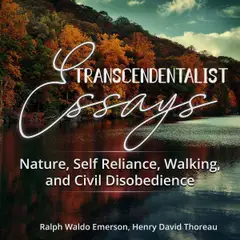
A collection of famous transcendentalist essays from Ralph Waldo Emerson and Henry David Thoreau.

Nature, Self Reliance, Walking, and Civil Disobedience.

In Nature, Emerson put forth the foundation of transcendentalism, a belief system that espouses a non-traditional appreciation of nature. Transcendentalism suggests that the divine, or God, suffuses nature, and suggests that reality can be understood by studying nature.

Self Reliance contains the most thorough statement of one of Emerson's recurrent themes: the need for each individual to avoid conformity and false consistency, and follow their own instincts and ideas.

Walking is a Transcendental essay in which Thoreau talks about the importance of nature to mankind, and how people cannot survive without nature, physically, mentally, and spiritually, yet we seem to be spending more and more time entrenched by society. For Thoreau walking is a self-reflective spiritual act that occurs only when you are away from society, that allows you to learn about who you are, and find other aspects of yourself that have been chipped away by society. "Walking" is an important canon in the transcendental movement that would lay the foundation for his best known work, Walden. It has become one of the most important essays in the Transcendentalist movement.

In Civil Disobedience, Thoreau argues that individuals should not permit governments to overrule or atrophy their consciences, and that they have a duty to avoid allowing such acquiescence to enable the government to make them the agents of injustice. Thoreau was motivated in part by his disgust with slavery and the Mexican-American War.
Commencez ce livre dès aujourd'hui pour 0 €

  • Accédez à tous les livres de l'app pendant la période d'essai
  • Sans engagement, annulez à tout moment
Essayer gratuitement
Plus de 52 000 personnes ont noté Nextory 5 étoiles sur l'App Store et Google Play.

  1. 3500 citations ultimes

    Marc Aurèle, Jane Austen, Beaumarchais, Napoléon Bonaparte, Bouddha, Winston Churchill, Cicéron, Confucius, Nicolas de Chamfort, Charles de Gaulle, Antoine de Saint-Exupéry, Léonard de Vinci, Denis Diderot, Fiodor Dostoïevski, Albert Einstein, Ralph Waldo Emerson, Anne Frank, Mahatma Gandhi, Emmanuel Kant, Søren Kierkegaard, Martin Luther King, Georg Christoph Lichtenberg, Abraham Lincoln, Montesquieu, Friedrich Nietzsche, Platon, Marcel Proust, Arthur Schopenhauer, William Shakespeare, – Socrate, Baruch Spinoza, Henry David Thoreau, Lao Tseu, Voltaire, Oscar Wilde

  2. De la simplicité !

    Henry David Thoreau

  3. 4.0

    Désobéir (La désobéissance civile) suivi du Discours de la servitude volontaire d'Etienne de La Boétie : texte intégral

    Henry David Thoreau, Etienne de La Boétie

  4. 1800 Citations de philosophes

    Aristote, Épicure, Platon, Thalès de Milet, – Socrate, Protagoras, Anaximandre, Épictète, Héraclite, Marc Aurèle, René Descartes, Michel de Montaigne, Alexis de Tocqueville, Voltaire, Charles De Montesquieu, Jean-Jacques Rousseau, Emmanuel Kant, Hannah Arendt, Gottfried Wilhelm Leibniz, Georg Wilhelm Friedrich Hegel, Friedrich Nietzsche, Arthur Schopenhauer, David Hume, John Locke, Francis Bacon, Thomas Hobbes, Thomas More, Confucius, Érasme, Lao Tseu, Baruch Spinoza, Søren Kierkegaard, Nicolas Machiavel, Thomas d'Aquin, Henry David Thoreau

  5. 3.6

    La Désobéissance civile

    Henry David Thoreau

  6. 4.5

    Walden, ou la vie dans les bois

    Henry David Thoreau

  7. 1 nov.

    Walden, and Civil Disobedience

    Henry David Thoreau

  8. 3.5

    Walden

    Henry David Thoreau

  9. Walden and On the Duty of Civil Disobedience

    Henry David Thoreau

  10. The Duty of Civil Disobedience

    Henry David Thoreau

  11. 50 citations de Thoreau

    Henry David Thoreau

  12. 5.0

    Comprendre Thoreau

    Henry David Thoreau