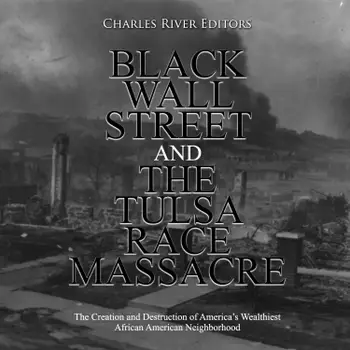
Black Wall Street and the Tulsa Race Massacre: The Creation and Destruction of America’s Wealthiest African American Neighborhood

Overall, Tulsa in 1921 was considered a modern, vibrant city. What had fueled this remarkable growth was oil, specifically the discovery of the Glenn Pool oil field in 1905. Within five years, Tulsa had grown from a rural crossroads town in the former Indian Territory into a boomtown with more than 10,000 citizens, and as word spread of the fortunes that could be made in Tulsa, people of all races poured into the city. By 1920, the greater Tulsa area boasted a population of over 100,000. In turn, Tulsa’s residential neighborhoods were some of the most modern and stylish in the country, and the Tulsa Chamber of Commerce produced postcards and literature boasting of the virtues of life in their modern oil city. However, as a commission report about the Tulsa Riot later pointed out, “What the pamphlets and the picture postcards did not reveal was that, despite of its impressive new architecture and its increasingly urbane affectations, Tulsa was a deeply troubled town. As 1920 turned into 1921, the city would soon face a crossroads that, in the end, would change it forever...Tulsa was, in some ways, not one city but two.”

When they came to Tulsa, many blacks settled in the Greenwood area and established a thriving commercial, cultural, and residential area. Of course, the segregation was forced on these residents, and while they had fled the worst conditions of the Jim Crow South in other areas, they were not able to escape it completely. But in one way, Tulsa was different for African Americans, as black citizens of the city shared in the city’s wealth, albeit not as equally as their white neighbors. The Greenwood district, a 36 square block section of northern Tulsa, was considered the wealthiest African American neighborhood in the country, called the “Black Wall Street” because of the large number of affluent and professional residents.
Kom i gang med denne boken i dag for 0 kr

  • Få full tilgang til alle bøkene i appen i prøveperioden
  • Ingen forpliktelser, si opp når du vil
Prøv gratis nå
Mer enn 52 000 personer har gitt Nextory 5 stjerner på App Store og Google Play.

  1. Across the Silk Road and the Atlantic: The History of Marco Polo and Christopher Columbus’ Groundbreaking Voyages

    Charles River Editors

  2. 4.5

    Project Gemini: The History and Legacy of NASA’s Human Spaceflight Missions Before the Apollo Program

    Charles River Editors

  3. Persepolis and Susa: The History of the Achaemenid Persian Empire’s Capitals

    Charles River Editors

  4. The Dawn of the Age of Exploration: The History of the Initial Expeditions that Led to European Imperialism across the Globe

    Charles River Editors

  5. The Start of the Cold War: The History of the Burgeoning Rivalry Between the United States and Soviet Union

    Charles River Editors

  6. The Holy Temples of Jerusalem: The History of Solomon’s Temple and the Second Temple

    Charles River Editors

  7. The Lavender Scare: The History of the Federal Government’s Persecution of the Gay Community in the 20th Century

    Charles River Editors

  8. The Most Controversial Cases of the Early 20th Century: The Murder of Stanford White, Sacco & Vanzetti, Leopold & Loeb, and the Lindbergh Baby Kidnapping

    Charles River Editors

  9. Laurence Olivier and Richard Burton: The Lives and Careers of Britain’s Most Famous Shakespearean Actors

    Charles River Editors

  10. 5.0

    The Great Schism: The History and Legacy of the Split Between the Catholic and Eastern Orthodox Churches in 1054

    Charles River Editors

  11. Nostradamus and Baba Vanga: The Controversial Lives and Prophecies of the Modern Era’s Most Famous Seers

    Charles River Editors

  12. The Modern Discovery of Australia and New Zealand: The History of the Indigenous Natives and the Initial European Expeditions and Settlements

    Charles River Editors