5.0(1)

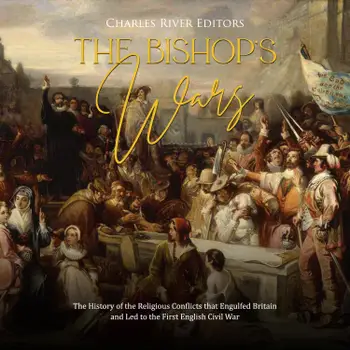
The Bishops’ Wars: The History of the Religious Conflicts that Engulfed Britain and Led to the First English Civil War

England has more often been faced with the claims of competing kings and queens than with a period of no monarch at all. The major exception to that rule came in the 11 years between 1649 and 1660, when England was a republic. Following the disastrous reign of Charles I and the civil wars that led to his execution, Parliament and the army ruled England.

That situation was one that would not have been possible without the Bishops’ Wars that preceded it. In the 1630s, Charles’s high-handed approach to politics caused further trouble north of the border, and not just because of the lands he had taken back from the nobility. The Scots were Presbyterian Protestants, and Charles wanted to enforce the same religious practices on them as he supported in England. His attempt to enforce use of the English Book of Common Prayer led to a rebellion by the Scots in 1639, a rebellion which ultimately became known as the Bishops’ Wars.

The king could make the English Parliament go away, but he could not do the same for the Scottish rebellion. Many Scottish soldiers were veterans of the bitter religious fighting in Europe, which was then in the middle of the Thirty Years War. After they beat the English at the Battle of Newburn on August 28, 1640 and occupied northern England, Charles was forced to make a humiliating peace. Adding insult to injury, he had to summon Parliament to raise money he had promised to the Scots in return for an end to the war. In return for the funds he so desperately needed, Parliament forced Charles to accept measures that prevented him from dissolving Parliament, as well as the execution of one of his key advisors and other measures loathsome to the monarch. Less than two years later, the First English Civil War would commence.

The Bishops’ Wars: The History of the Religious Conflicts that Engulfed Britain and Led to the First English Civil War examines one of the most tumultuous periods in England’s history.

global.banner_device.title.dynamic

  • Få full tilgang til alle bøkene i appen i prøveperioden
  • Ingen forpliktelser, si opp når du vil
Prøv gratis nå
Mer enn 52 000 personer har gitt Nextory 5 stjerner på App Store og Google Play.

  1. Ny

    The Lavender Scare: The History of the Federal Government’s Persecution of the Gay Community in the 20th Century

    Charles River Editors

  2. Ny
    5.0

    The Great Schism: The History and Legacy of the Split Between the Catholic and Eastern Orthodox Churches in 1054

    Charles River Editors

  3. Ny

    The Most Controversial Cases of the Early 20th Century: The Murder of Stanford White, Sacco & Vanzetti, Leopold & Loeb, and the Lindbergh Baby Kidnapping

    Charles River Editors

  4. Ny

    Black Wall Street: The History of the Greenwood District Before the Tulsa Race Riot

    Charles River Editors

  5. Ny

    The Holy Roman Empire’s Conflicts with the Vatican: The History of the Medieval Wars that Fractured Germany and Italy

    Charles River Editors

  6. Ny

    Zoroastrianism: The History and Legacy of One of the World’s Oldest Religions

    Charles River Editors

  7. Ny

    Peter the Hermit and the People’s Crusade: The Controversial History of the First European Army to Head for Jerusalem

    Charles River Editors

  8. Ny

    The Greatest Conquerors of the Middle Ages: Charlemagne, Saladin and Genghis Khan

    Charles River Editors

  9. Ny

    The First Crusade: The History of the Christian Church’s Initial Campaign in the Holy Land

    Charles River Editors

  10. Ny

    America's Forgotten Slaves: The History of Native American Slavery in the New World and the United States

    Charles River Editors

  11. Ny

    The Adams Family: The History of Colonial Boston's Most Important Political Family

    Charles River Editors

  12. Ny
    3.7

    The Milgram Experiment: The History and Legacy of the Controversial Social Psychology Experiment

    Charles River Editors