3.8(4)

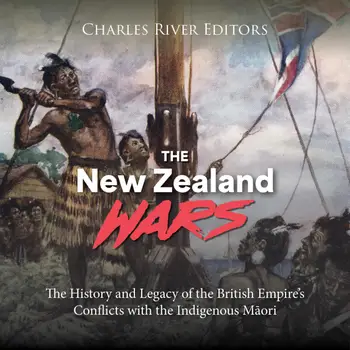
The New Zealand Wars: The History and Legacy of the British Empire’s Conflicts with the Indigenous Māori

In 1769, Captain James Cook’s historic expedition in the region would lead to an English claim on Australia, but before he reached Australia, he sailed near New Zealand and spent weeks mapping part of New Zealand’s coast. Thus, he was also one of the first to observe and take note of the indigenous peoples of the two islands. His instructions from the Admiralty were to endeavor at all costs to cultivate friendly relations with tribes and peoples he might encounter, and to regard any native people as the natural and legal possessors of any land they were found to occupy. Cook, of course, was not engaged on an expedition of colonization, so when he encountered for the first time a war party of Māori, he certainly had no intention of challenging their overlordship of Aotearoa, although he certainly was interested in discovering more about them.

Taking into account similarities of appearance, customs and languages spread across a vast region of scattered islands, it was obvious that the Polynesian race emerged from a single origin, and that origin Cook speculated was somewhere in the Malay Peninsula or the “East Indies.” In this regard, he was not too far from the truth. The origins of the Polynesian race have been fiercely debated since then, and it was only relatively recently, through genetic and linguistic research, that it can now be stated with certainty that the Polynesian race originated on the Chinese mainland and the islands of Taiwan, the Philippines, Malaysia and Indonesia. Oceania was, indeed, the last major region of the Earth to be penetrated and settled by people, and Polynesia was the last region of Oceania to be inhabited. The vehicle of this expansion was the outrigger canoe, and aided by tides and wind patterns, a migration along the Malay Archipelago, and across the wide expanses of the South Pacific, began sometime between 3000 and 1000 BCE, reaching the western Polynesian Islands in about 900 BCE.


Om denne boken

In 1769, Captain James Cook’s historic expedition in the region would lead to an English claim on Australia, but before he reached Australia, he sailed near New Zealand and spent weeks mapping part of New Zealand’s coast. Thus, he was also one of the first to observe and take note of the indigenous peoples of the two islands. His instructions from the Admiralty were to endeavor at all costs to cultivate friendly relations with tribes and peoples he might encounter, and to regard any native people as the natural and legal possessors of any land they were found to occupy. Cook, of course, was not engaged on an expedition of colonization, so when he encountered for the first time a war party of Māori, he certainly had no intention of challenging their overlordship of Aotearoa, although he certainly was interested in discovering more about them.

Taking into account similarities of appearance, customs and languages spread across a vast region of scattered islands, it was obvious that the Polynesian race emerged from a single origin, and that origin Cook speculated was somewhere in the Malay Peninsula or the “East Indies.” In this regard, he was not too far from the truth. The origins of the Polynesian race have been fiercely debated since then, and it was only relatively recently, through genetic and linguistic research, that it can now be stated with certainty that the Polynesian race originated on the Chinese mainland and the islands of Taiwan, the Philippines, Malaysia and Indonesia. Oceania was, indeed, the last major region of the Earth to be penetrated and settled by people, and Polynesia was the last region of Oceania to be inhabited. The vehicle of this expansion was the outrigger canoe, and aided by tides and wind patterns, a migration along the Malay Archipelago, and across the wide expanses of the South Pacific, began sometime between 3000 and 1000 BCE, reaching the western Polynesian Islands in about 900 BCE.

Kom i gang med denne boken i dag for 0 kr

  • Få full tilgang til alle bøkene i appen i prøveperioden
  • Ingen forpliktelser, si opp når du vil
Prøv gratis nå
Mer enn 52 000 personer har gitt Nextory 5 stjerner på App Store og Google Play.

  1. Archaic Humans: The History of the Different Prehistoric Species in the Genus Homo

    Charles River Editors

  2. Recent UFO Sightings: The History and Mysteries of UFO Encounters in the Last 70 Years

    Charles River Editors

  3. Persepolis and Susa: The History of the Achaemenid Persian Empire’s Capitals

    Charles River Editors

  4. The Dawn of the Age of Exploration: The History of the Initial Expeditions that Led to European Imperialism across the Globe

    Charles River Editors

  5. Across the Silk Road and the Atlantic: The History of Marco Polo and Christopher Columbus’ Groundbreaking Voyages

    Charles River Editors

  6. The World’s Most Notorious Serial Killers: The Lives and Crimes of History’s Most Infamous Murderers

    Charles River Editors

  7. 5.0

    The History and Legacy of Asia Minor’s Most Important Ancient Civilizations

    Charles River Editors

  8. The Ottoman Empire’s Most Important Battles: The History and Legacy of the Ottomans’ Biggest Victories and Defeats

    Charles River Editors

  9. Richard Sorge and the Cambridge Five: The History of the Soviet Union’s Most Important Foreign Spies during World War II

    Charles River Editors

  10. Richard Sorge: The Life and Legacy of the German Journalist Who Became the Soviet Union’s Most Effective Spy during World War II

    Charles River Editors

  11. The Battle of the Boyne: The History of the Battle that Ended James II’s Attempt to Reclaim the Throne of England

    Charles River Editors

  12. Sulla and Gaius Marius: The Lives and Legacies of the Leaders Who Fought Rome’s First Civil War

    Charles River Editors