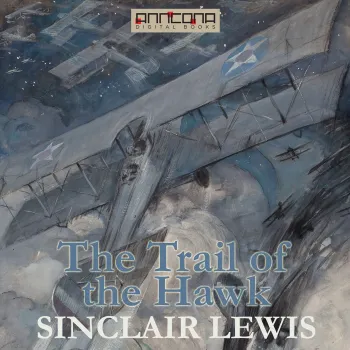
The Trail of the Hawk

The Trail of the Hawk: a Comedy of the Seriousness of Life by Sinclair Lewis was published in 1915.

The Trail of the Hawk, is Sinclair Lewis’ second novel published under his own name. It was not at the time of release a smashing success as his later works, Babbitt, Elmer Gantry, and others, but his style and immense talent are certainly evident.

We travel with The Hawk, or Carl Ericson, son of Norwegian immigrants, born at the end of the 19th century through the first three adventurous periods of the young man’s life. We see him as an adventurous boy, running away with Gertie Cowels, the girl that lives in the big house in the better part of town, only to be rescued by Bone Stillman, a backwoods philosopher and influence on Carl.

We travel with him as he leaves his childhood, Gertie and Joralemon behind, for a short attempt at higher education, then to pursue the hobo life, a Bowery bartender, an engineer in Panama and an aviator. It is during the aviator phase that he becomes Hawk Ericson barnstorming his way across America, an exciting but dangerous lifestyle. Leaving aviation after too many close calls, and the loss of his best friend, he becomes an automobile man, and moves into phase three.

It is in phase three, love adventure, that we find The Hawk in New York, mingling with polite society quite by accident. He is smitten by Ruth Winslow, while riding on a streetcar after a fight with Gertie, and follows Ruth to a party which he crashes.

The listener will enjoy it, a trip into post Victorian, pre Jazz Age America.

Harry Sinclair Lewis (1885-1951) was an American novelist, short-story writer, and playwright.

In 1930, he became the first writer from the United States to receive the Nobel Prize in Literature, which was awarded "for his vigorous and graphic art of description and his ability to create, with wit and humor, new types of characters."

His works are known for their insightful and critical views of American capitalism and materialism between the wars. He is also respected for his strong characterizations of modern working women.

Kom i gang med denne boken i dag for 0 kr

  • Få full tilgang til alle bøkene i appen i prøveperioden
  • Ingen forpliktelser, si opp når du vil
Prøv gratis nå
Mer enn 52 000 personer har gitt Nextory 5 stjerner på App Store og Google Play.

  1. 24. okt.

    Det kan aldri hende her

    Sinclair Lewis

  2. Nobelprisen
    2.5

    It Can't Happen Here

    Sinclair Lewis

  3. 100 Mystery Classics of World Literature

    Josephine Tey, Arthur Conan Doyle, John Buchan, Edgar Allan Poe, G.K. Chesterton, Wilkie Collins, Charles Dickens, Charlotte Brontë, Emily Brontë, Anne Brontë, Frances Hodgson Burnett, Thomas Hardy, Joseph Conrad, Robert Louis Stevenson, Jules Verne, Mark Twain, Henry James, Fyodor Dostoyevsky, Anton Chekhov, Nikolai Gogol, Walter Scott, Daniel Defoe, F. Scott Fitzgerald, Sinclair Lewis, D. H. Lawrence, Oscar Wilde, H.G. Wells, George Orwell, Edgar Wallace, R Austin Freeman, Anna Katharine Green, Ethel Lina White, Sapper, Arthur Morrison, Marie Belloc Lowndes, Robert William Chambers, E. Phillips Oppenheim, J. S. Fletcher, Richard Marsh, Annie Haynes, Alexandre Dumas, Maurice Leblanc, Gaston Leroux, Émile Gaboriau, Bram Stoker, Sheridan Le Fanu, H.P. Lovecraft, William Hope Hodgson, Algernon Blackwood, Guy De Maupassant, Frances Noyes Hart, Theodore Dreiser, Armitage Trail, EW Hornung, Earl Derr Biggers, S. van Dine, Jeffery Farnol

  4. Die größten Klassiker der englischen Literatur (Band 1: Romane) : 50+ Titel in einem Buch

    Virginia Woolf, D. H. Lawrence, R.L. Stevenson, Jane Austen, Charles Dickens, Emily Brontë, Mary Shelley, Charlotte Brontë, Anne Brontë, William Makepeace Thackeray, Bram Stoker, Henry Fielding, George Eliot, Herman Melville, Thomas Wolfe, Joseph Conrad, Sinclair Lewis, Lewis Carrol, Edgar Allan Poe, Edward Bulwer-Lytton, Oscar Wilde, H.G. Wells, Daniel Defoe, James Fenimore Cooper, Lew Wallace, Jonathan Swift, Mark Twain, Walter Scott, Nathaniel Hawthorne, Harriet Beecher Stowe, Laurence Sterne, Frances Hodgson Burnett, Arthur Conan Doyle, Wilkie Collins, Edgar Wallace, Jack London, John Galsworthy, F. Scott Fitzgerald

  5. Die großen Romane der englischen Literatur : 50 Klassiker in einem Band

    Charles Dickens, Mary Shelley, Jack London, Arthur Conan Doyle, Jane Austen, Emily Brontë, Charlotte Brontë, Anne Brontë, William Makepeace Thackeray, Bram Stoker, Henry Fielding, George Eliot, D. H. Lawrence, Herman Melville, Thomas Wolfe, Virginia Woolf, Joseph Conrad, Sinclair Lewis, Lewis Carrol, Edgar Allan Poe, Edward Bulwer-Lytton, Oscar Wilde, H.G. Wells, Daniel Defoe, James Fenimore Cooper, Lew Wallace, Jonathan Swift, Robert Louis Stevenson, Mark Twain, Walter Scott, Nathaniel Hawthorne, Harriet Beecher Stowe, Laurence Sterne, Frances Hodgson Burnett, Wilkie Collins, Edgar Wallace, John Galsworthy, F. Scott Fitzgerald

  6. Nobelprisen
    3.0

    Det kan ikke ske her

    Sinclair Lewis

  7. 100 Amerikanische Klassiker - Meisterwerke, die man kennen muss : Der große Gatsby, Die Abenteuer Tom Sawyers, Kleine Frauen, Zeit der Unschuld, Porträt einer Dame, Der Rabe, Moby-Dick, Wolfsblut...

    Mark Twain, Louisa May Alcott, Jack London, Stephen Crane, L. Frank Baum, Walt Whitman, Herman Melville, Henry David Thoreau, Elbert Hubbard, Ralph Waldo Emerson, Ambrose Bierce, Frances Hodgson Burnett, Lew Wallace, Nathaniel Hawthorne, James Norman Hall, Edgar Allan Poe, O.Henry, H.P. Lovecraft, James Fenimore Cooper, Edward Bellamy, Bret Harte, Max Brand, Zane Grey, Willa Cather, F. Scott Fitzgerald, Kate Chopin, Charlotte Perkins Gilman, Edith Wharton, Margaret Mitchell, Henry James, Theodor Dreiser, Gertrude Stein, Sinclair Lewis, Warwick Deeping, Thomas Wolfe, Harriet Beecher Stowe

  8. Nobelprisen

    Babbitt

    Sinclair Lewis

  9. 100 Meisterwerke der englischen Literatur - Klassiker, die man kennen muss

    George Orwell, Charles Dickens, Jane Austen, Katherine Mansfield, H.P. Lovecraft, William Wordsworth, John Keats, Percy Bysshe Shelley, Robert Burns, John Milton, William Shakespeare, Christopher Marlowe, Geoffrey Chaucer, Laurence Sterne, Henry Fielding, Mary Shelley, Emily Brontë, Charlotte Brontë, Anne Brontë, William Makepeace Thackeray, George Eliot, D. H. Lawrence, Herman Melville, Thomas Wolfe, Virginia Woolf, Joseph Conrad, Sinclair Lewis, Walt Whitman, Edgar Allan Poe, Oscar Wilde, Jerome K Jerome, Washington Irving, Bram Stoker, H.G. Wells, Daniel Defoe, Lew Wallace, James Fenimore Cooper, Jonathan Swift, Robert Louis Stevenson, Mark Twain, Lewis Carrol, Edward Bulwer-Lytton, F. Scott Fitzgerald, Arthur Conan Doyle, Jack London, Henry David Thoreau, G.K. Chesterton, Edith Wharton, Henry James, Thomas Hardy, Margaret Mitchell, Kate Chopin, Willa Cather, Charlotte Perkins Gilman, James Joyce, John Galsworthy, Francis Hodgson Burnett, Lucy Maud Montgomery, Louisa May Alcott, Rudyard Kipling

  10. Nobelprisen

    Babbit

    Sinclair Lewis

  11. Die größten Heldinnen der Literatur (50 Romane in einem Band)

    Charlotte Brontë, Jane Austen, Louisa May Alcott, Leo Tolstoi, Virginia Woolf, Thomas Hardy, Sinclair Lewis, Hedwig Dohm, Charlotte Perkins Gilman, Elizabeth Burgoyne Corbett, Daniel Defoe, Anne Brontë, L.M. Montgomery, Victor Hugo, Wilhelmine von Hillern, Adalbert Stifter, Luise Ahlborn, George Eliot, Lou Andreas-Salomé, Stefan Zweig, D. H. Lawrence, Henry James, Margaret Mitchell, Edith Wharton, Miles Franklin, Willa Cather, Elizabeth Gaskell, Nikolai Semjonowitsch Leskow, Theodore Dreiser, Elizabeth von Arnim, Colette, Honoré de Balzac, William Makepeace Thackeray, Gustave Flaubert, Emile Zola, Theodor Fontane, Ada Langworthy Collier, Joseph Sheridan Le Fanu, Johanna Schopenhauer, Nathaniel Hawthorne, Charles Dickens

  12. Die Rebellinnen der Literatur - Klassiker, die man kennen muss

    George Sand, D. H. Lawrence, Leo Tolstoi, Elizabeth Gaskell, Charlotte Brontë, Virginia Woolf, Thomas Hardy, Sinclair Lewis, Hedwig Dohm, Charlotte Perkins Gilman, Daniel Defoe, Louisa May Alcott, Jane Austen, L.M. Montgomery, Victor Hugo, George Eliot, Stefan Zweig, Henry James, Edith Wharton, Elizabeth von Arnim, Colette, Honoré de Balzac, Gustave Flaubert, Emile Zola, Theodor Fontane, Charles Dickens, William Makepeace Thackeray, Johanna Schopenhauer, Joseph Sheridan Le Fanu