Tietoa kirjasta

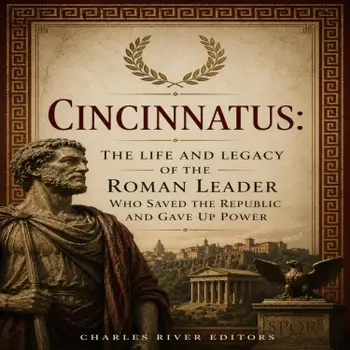
Among the figures of early Roman history, few stand out quite like Lucius Quinctius Cincinnatus, a man who to his contemporaries stood as the very image of the Roman Vir Bous (the Good Man). His life, whether viewed through the lens of ancient writers or treated as something of a foundational myth, has shaped Western thought surrounding civic duty and the restraint of power for more than 2,000 years.

Cincinnatus lived during the precarious infancy of the Roman Republic, a time when the people had recently overthrown the monarchy and created a new system designed to balance power between competing interests. Naturally, the fear of an oppressive or incompetent monarchy had not yet fully diminished, and to make things worse, the period was plagued by the existential threat of invasions at the hands of neighboring Italic tribes. Internally, the Republic was not entirely stable, because its institutions were still in a process of evolution and social tensions between the patrician elite and the plebeian population often resulted in disorder. At any moment, the pressure might have forced the Republic itself to collapse.

Despite the tensions, or because of them, it was within this atmosphere of uncertainty that the core ideals of Rome started to take shape: personal sacrifice, duty to the state, and an unwavering commitment to the common good. These are the very traits that Cincinnatus came to embody as a citizen-soldier who took up arms in defense of the state, and once the danger had passed, he returned without complaint to his modest life. In the 5th century BCE, he is described as toiling away on a small plot of land after a series of personal misfortunes drew him away from public life, and it was from this setting that he was summoned when a great crisis struck Rome. The Republic, left with no other option, turned to Cincinnatus and appointed him dictator.
Aloita kirja saman tien hintaan 0 €

  • Kokeilujakson aikana käytössäsi on kaikki sovelluksen kirjat
  • Ei sitoumusta, voit perua milloin vain
Kokeile nyt ilmaiseksi
Yli 52 000 ihmistä on antanut Nextorylle viisi tähteä App Storessa ja Google Playssä.

  1. The Pancho Villa Expedition: The History of the U.S. Army’s Attempt to Capture Mexico’s Most Famous Revolutionary

    Charles River Editors

  2. Monterey and Woodstock: The History and Legacy of the Rock Festivals that Defined an Era

    Charles River Editors

  3. 5.0

    The Orphan Train Movement : The History of the Program that Relocated Homeless Children Across America

    Charles River Editors

  4. 4.3

    The Rape of Nanking : The History and Legacy of the Notorious Massacre during the Second Sino-Japanese War

    Charles River Editors

  5. 3.0

    Native American Tribes : The History and Culture of the Navajo

    Charles River Editors

  6. Albert Fish and the Son of Sam: The Lives and Crimes of New York City’s Most Notorious Serial Killers

    Charles River Editors

  7. Albert Fish: The Notorious Life and Legacy of the Brooklyn Vampire

    Charles River Editors

  8. The Counter-Reformation: The History of the Catholic Church’s Response to the Protestant Reformation

    Charles River Editors

  9. 4.0

    The Maccabean Revolt: The History and Legacy of the Jewish Uprising against the Seleucid Empire that Restored Judea’s Religious Freedom

    Charles River Editors

  10. Slavery and the Law: The History of the Legal Systems and Cases that Enabled Slavery in the United States

    Charles River Editors

  11. Ernest Shackleton and Robert Falcon Scott: The History of the British Explorers’ Notorious Rivalry during the Heroic Age of Antarctic Exploration

    Charles River Editors

  12. The Roman Empire and Byzantine Empire : The History and Legacy of Europe’s Most Important Empire and Its Successor

    Charles River Editors