Tietoa kirjasta

What can we control, and how should we live when so much remains beyond our control?

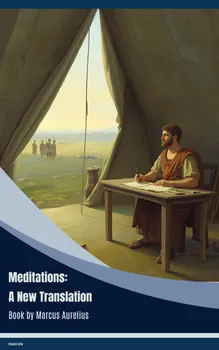
Meditations: A New Translation presents the personal philosophical reflections of Marcus Aurelius, the Roman emperor and one of the most influential voices of ancient Stoicism.

Written as a series of private reflections rather than a conventional philosophical treatise, Meditations explores how to develop self-discipline, resilience, rational thought, humility, and inner strength while facing the challenges of everyday life.

Marcus Aurelius repeatedly returns to the Stoic idea that although we cannot control everything that happens to us, we can control how we respond. His reflections encourage readers to focus on their own character, accept what lies beyond their power, fulfill their responsibilities, and remain guided by reason and virtue.

The work addresses timeless subjects including anger, adversity, death, ambition, relationships, duty, happiness, self-control, impermanence, and the nature of human existence. Its emphasis on practical wisdom makes it as relevant to modern readers as it was to the Roman emperor who wrote it nearly two thousand years ago.

For readers interested in Stoic philosophy, ancient wisdom, personal development, mindfulness, resilience, and philosophical reflection, Meditations offers a powerful source of ideas to revisit throughout life.

Discover the enduring wisdom of Marcus Aurelius. Read Meditations: A New Translation today and explore one of history's greatest works on Stoicism, self-mastery, resilience, and the art of living well.
Aloita kirja saman tien hintaan 0 €

  • Kokeilujakson aikana käytössäsi on kaikki sovelluksen kirjat
  • Ei sitoumusta, voit perua milloin vain
Kokeile nyt ilmaiseksi
Yli 52 000 ihmistä on antanut Nextorylle viisi tähteä App Storessa ja Google Playssä.

  1. 4.2

    The Meditations of Marcus Aurelius

    Marcus Aurelius

  2. 4.2

    Meditations

    Marcus Aurelius

  3. 3.0

    50 Masterpieces you have to read before you die vol: 1 (2020 Edition) : Included: Little Women, The Richest Man in Babylon Emma, The Call Of The Wild ....

    Louisa May Alcott, Dante Alighieri, Marcus Aurelius, Jane Austen, L. Frank Baum, Charlotte Brontë, Emily Brontë, Anne Brontë, Miguel de Cervantes, Agatha Christie, George S. Clason, Arthur Conan Doyle, Joseph Conrad, Charles Dickens, Fyodor Dostoyevsky, Alexandre Dumas, George Eliot, G.K. Chesterton, G.K. Chesterton, Zane Grey, Nathaniel Hawthorne, Napoleon Hill, Homer, Victor Hugo, Frances Hodgson Burnett, Washington Irving, Henry James, Franz Kafka, Rudyard Kipling, Jack London, Leo Tolstoy, H.P. Lovecraft, Lucy Maud Montgomery, Joseph Murphy, Robert Louis Stevenson, Edgar Allan Poe, Marcel Proust, Publius, Mary Shelley, Bram Stoker, Mark Twain, Sun Tzu, Lew Wallace, Wallace D. Wattles, H.G. Wells

  4. The Meditations Of Marcus Aurelius

    Marcus Aurelius

  5. 4.0

    Meditations

    Marcus Aurelius

  6. 5.0

    The Complete Harvard Classics 2021 Edition - ALL 71 Volumes : The Five Foot Shelf & The Shelf of Fiction: The Famous Anthology of the Greatest Works of World Literature

    Charles W. Eliot, Benjamin Franklin, John Woolman, Plato, Epictetus, Marcus Aurelius, Francis Bacon, John Milton, Thomas Browne, Robert Burns

  7. Yhteenveto

    Meditations - Stoic philosophy Wisdom :

    Marcus Aurelius

  8. The Essential Ancient Wisdom Library : 10 Timeless Works of Stoicism, Philosophy, Strategy and the Art of Living

    Marcus Aurelius, Seneca, Epictetus, Laozi, Plato, Sun Tzu, Musashi Miyamoto, Niccolò Machiavelli, Friedrich Wilhelm Nietzsche, James Allen

  9. 4.1

    Meditations of Marcus Aurelius

    Marcus Aurelius

  10. Meditations

    Marcus Aurelius

  11. 10 Masterpieces You Have to Read Before You Die, Vol.5 : The Odyssey, The Republic, Meditations, The Divine Comedy, Faust and others

    Homer, Plato, Aristotle, Marcus Aurelius, Niccolo Machiavelli, Dante Alighieri, Johann Wolfgang von Goethe, Leo Tolstoy

  12. The Stoics : The Philosophy of Seneca, Epictetus and Marcus Aurelius

    Marcus Aurelius, Epicurus Epicurus, Seneca Seneca