Mussolini has rarely been taken seriously as a totalitarian dictator; Hitler and Stalin have always cast too long a shadow. But what was a negative judgement on the Duce, considered innocuous and ineffective, has begun to work to his advantage. As has occurred with many other European dictators, present-day popular memory of Mussolini is increasingly indulgent; in Italy and elsewhere he is remembered as a strong, decisive leader. Mussolini in Myth and Memory argues against this rehabilitation, documenting the inefficiencies, corruption, and violence of a highly repressive regime and exploding the myths of fascist good government. But this short study does not limit itself to setting the record straight; it seeks also to answer the question of why there is nostalgia for dictatorial rule. Linking past history and present memory, Corner's analysis constructs a picture of the realities of the Italian regime and examines the more general problem of why, in a moment of evident crisis of western democracy, people look for strong leadership and take refuge in the memory of past dictatorships. If, in this book, Fascism is placed in its totalitarian context and Mussolini emerges firmly in the company of his fellow dictators, the study also shows how a memory of the past, formed through reliance on illusion and myth, can affect the politics of the present.
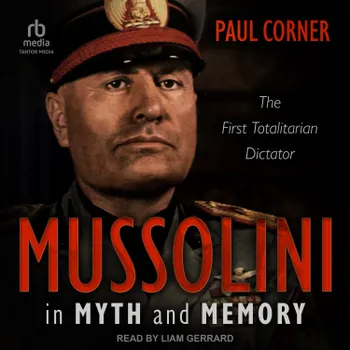
Mussolini in Myth and Memory : The First Totalitarian Dictator
Tietoa kirjasta
Mussolini has rarely been taken seriously as a totalitarian dictator; Hitler and Stalin have always cast too long a shadow. But what was a negative judgement on the Duce, considered innocuous and ineffective, has begun to work to his advantage. As has occurred with many other European dictators, present-day popular memory of Mussolini is increasingly indulgent; in Italy and elsewhere he is remembered as a strong, decisive leader. Mussolini in Myth and Memory argues against this rehabilitation, documenting the inefficiencies, corruption, and violence of a highly repressive regime and exploding the myths of fascist good government. But this short study does not limit itself to setting the record straight; it seeks also to answer the question of why there is nostalgia for dictatorial rule. Linking past history and present memory, Corner's analysis constructs a picture of the realities of the Italian regime and examines the more general problem of why, in a moment of evident crisis of western democracy, people look for strong leadership and take refuge in the memory of past dictatorships. If, in this book, Fascism is placed in its totalitarian context and Mussolini emerges firmly in the company of his fellow dictators, the study also shows how a memory of the past, formed through reliance on illusion and myth, can affect the politics of the present.
Aloita tämä kirja jo tänään, hintaan 0€
- Kokeilujakson aikana käytössäsi on kaikki sovelluksen kirjat
- Ei sitoumusta, voit perua milloin vain
Kirjailija:
Lukija:
Kieli:
englanti
Muoto:

Benito Mussolini: My Autobiography

Pekka Sallinen: Kertomus 1808-9 v. sodasta. Juhani herttuan hovissa: Historiallinen kertomus : Sotaromaani Suomen itsenäistymisen ajoilta

The Boy on the Beach: My Family's Escape from Syria and Our Hope for a New Home

How Leaders Decide : A Timeless Guide to Making Tough Choices

Decoy

Sverige vid avgrunden 1808-1814

The Only Plane in the Sky : An Oral History of September 11, 2001

Germany's High Seas Fleet in the WW1 : Historical Account of Naval Warfare in the WWI

21 Secrets of Million-Dollar Sellers: America's Top Earners Reveal the Keys to Sales Success

Don't Fall For It : A Short History of Financial Scams

Elämän loiste ja hurjuus : Kertomuksia entisaikojen Helsingistä ja Viaporista

Mussolini and Hitler : The Forging of the Fascist Alliance