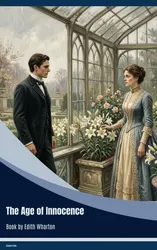
Edith Wharton's "The Age of Innocence" offers a meticulous exploration of the constraints of societal norms in Gilded Age New York, deftly illustrating the interplay between individual desires and the rigid expectations of upper-class society. Wharton employs a rich, descriptive prose style that captures the opulence and stagnation of the era, creating a vivid tableau of characters navigating their fates within an intricate web of tradition and propriety. The novel's exploration of themes such as love, hypocrisy, and the struggle for authenticity in a conformist society resonates deeply, situating it within the canon of American realism, while also reflecting the author's incisive observations of her own social milieu. Edith Wharton, a Pulitzer Prize-winning novelist, was born into the very society she critiques, providing her an intimate understanding of its mores and artistry. Her own experiences as a member of Old New York's elite, coupled with her desire to break free from such restrictive conventions, are the impetus behind this work. Wharton was profoundly interested in the moral conflicts arising from the human experience, which is why she so compellingly illustrates the dualities of aspiration and obligation. Readers seeking a profound and poignant examination of societal expectations and personal sacrifice will find "The Age of Innocence" to be an enlightening engagement with both the historical and the timeless. Wharton's masterful storytelling invites reflection on the complexities of love and duty, making it an essential read for anyone interested in the intersection of personal and social identity.
In this enriched edition, we have carefully created added value for your reading experience:
- A comprehensive Introduction outlines these selected works' unifying features, themes, or stylistic evolutions.
- The Author Biography highlights personal milestones and literary influences that shape the entire body of writing.
- A Historical Context section situates the works in their broader era—social currents, cultural trends, and key events that underpin their creation.
- A concise Synopsis (Selection) offers an accessible overview of the included texts, helping readers navigate plotlines and main ideas without revealing critical twists.
- A unified Analysis examines recurring motifs and stylistic hallmarks across the collection, tying the stories together while spotlighting the different work's strengths.
- Reflection questions inspire deeper contemplation of the author's overarching message, inviting readers to draw connections among different texts and relate them to modern contexts.
- Lastly, our hand‐picked Memorable Quotes distill pivotal lines and turning points, serving as touchstones for the collection's central themes.