3.3(3)

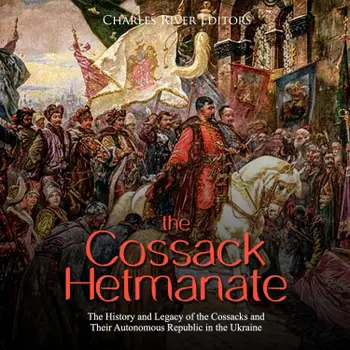
The Cossack Hetmanate: The History and Legacy of the Cossacks and Their Autonomous Republic in the Ukraine

“Had I just 10,000 Cossacks, I would have conquered the whole world.” – Napoleon Bonaparte

The history of Ukraine is a fascinating story of how cultures, political systems, religions, and power have met, intersected, morphed, and expanded. The region was relatively sparsely populated for much of ancient history, a wilderness of rivers, forests, and steppes, but that does not detract from the rich historical development of the region. A huge area, Ukraine is wedged between the continents of Asia and Europe, and its position as a crossroads ensured there was fierce competition for influence there. Historians have called the formation of Ukraine the “establishment of a unity among three zones…the ports of Crimea and the coast, the rich steppe heartland, and the forests,” based around the themes of “geography, ecology and culture.”

After various cultures helped develop the region, the legendary Cossacks arrived during the early modern period and dominated the region for several centuries, forming an independent republic that helped forge Ukrainian identity to this day. The modern myth of the Cossack presents striking images of a stern warrior mounted on horseback, with a long woolen coat, papakha (distinctive tall fur cap ) and fur-lined cloak, with bandoliers holding large-caliber bullets crisscrossing his chest. The warrior is armed with a mixture of rifle, lance, daggers and pistols, but he always has his signature weapons: the shashka (a single-edged, guard-less, slightly curved saber originally designed by the Circassian foes) and the nagyka (short, thick whip of braided leather with a heavy weight worked into the end originally designed for fighting off wolves but more commonly used in later years against enemies of the state in the streets of Moscow or Odessa). As enemies conjured up the Cossack as semi-tamed steppe barbarian, a dog of the state, and the fist of the Czar, it’s no surprise they were terrified.

Tietoa kirjasta

“Had I just 10,000 Cossacks, I would have conquered the whole world.” – Napoleon Bonaparte

The history of Ukraine is a fascinating story of how cultures, political systems, religions, and power have met, intersected, morphed, and expanded. The region was relatively sparsely populated for much of ancient history, a wilderness of rivers, forests, and steppes, but that does not detract from the rich historical development of the region. A huge area, Ukraine is wedged between the continents of Asia and Europe, and its position as a crossroads ensured there was fierce competition for influence there. Historians have called the formation of Ukraine the “establishment of a unity among three zones…the ports of Crimea and the coast, the rich steppe heartland, and the forests,” based around the themes of “geography, ecology and culture.”

After various cultures helped develop the region, the legendary Cossacks arrived during the early modern period and dominated the region for several centuries, forming an independent republic that helped forge Ukrainian identity to this day. The modern myth of the Cossack presents striking images of a stern warrior mounted on horseback, with a long woolen coat, papakha (distinctive tall fur cap ) and fur-lined cloak, with bandoliers holding large-caliber bullets crisscrossing his chest. The warrior is armed with a mixture of rifle, lance, daggers and pistols, but he always has his signature weapons: the shashka (a single-edged, guard-less, slightly curved saber originally designed by the Circassian foes) and the nagyka (short, thick whip of braided leather with a heavy weight worked into the end originally designed for fighting off wolves but more commonly used in later years against enemies of the state in the streets of Moscow or Odessa). As enemies conjured up the Cossack as semi-tamed steppe barbarian, a dog of the state, and the fist of the Czar, it’s no surprise they were terrified.

Aloita kirja saman tien hintaan 0 €

  • Kokeilujakson aikana käytössäsi on kaikki sovelluksen kirjat
  • Ei sitoumusta, voit perua milloin vain
Kokeile nyt ilmaiseksi
Yli 52 000 ihmistä on antanut Nextorylle viisi tähteä App Storessa ja Google Playssä.

  1. 5.0

    The Evolution of Modern Mathematics: The Lives of Influential Mathematicians Who Helped Bring Math into the Computer Age Kindle

    Charles River Editors

  2. 5.0

    The Rise and Fall of the Third Reich: The History and Legacy of Nazi Germany under Adolf Hitler

    Charles River Editors

  3. Persepolis and Susa: The History of the Achaemenid Persian Empire’s Capitals

    Charles River Editors

  4. Indian Removal: The History of the Battles and Policies that Displaced Native Americans East of the Mississippi River

    Charles River Editors

  5. Kublai Khan and Marco Polo: The History of a Unique Partnership at the Court of the Mongol Empire

    Charles River Editors

  6. Zoroastrianism and Manichaeism: The History of Ancient Persia’s Influential Religions

    Charles River Editors

  7. The Byzantines and Ottomans: The History of the Medieval Middle East’s Most Influential Empires

    Charles River Editors

  8. 3.0

    Operation Speedy Express: The History and Legacy of One of the Vietnam War’s Most Controversial Campaigns

    Charles River Editors

  9. 4.0

    The Rise and Fall of the Banate of Bosnia: The History of Bosnia’s Struggle for Independence in the Middle Ages

    Charles River Editors

  10. The Armenian Empire: The History and Legacy of the Ancient Kingdom of Greater Armenia

    Charles River Editors

  11. Nostradamus and Baba Vanga: The Controversial Lives and Prophecies of the Modern Era’s Most Famous Seers

    Charles River Editors

  12. 4.0

    The Siege of Vienna (1529): The History and Legacy of the Decisive Battle that Prevented the Ottoman Empire’s Expansion into Western Europe

    Charles River Editors