5.0(1)

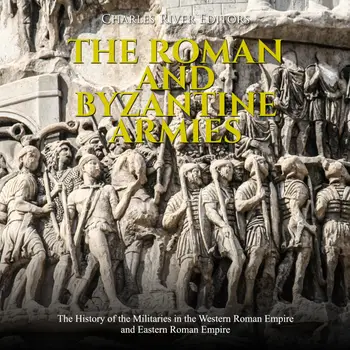
The Roman and Byzantine Armies: The History of the Militaries in the Western Roman Empire and Eastern Roman Empire

The Roman army is one of the most famous fighting forces in history. Through its power and prowess, a once obscure Italian city forged an empire that encircled the Mediterranean and covered half of Europe. The physical remains of its presence can be traced from the mountainous borders of Scotland to the arid deserts of Egypt, but its legacy is far greater and more enduring, as Rome's influence continues to shape the political, legal, and cultural landscape of Europe to this very day.

While the Roman army is rightly famed as an institution, the image of the individual legionary is also an iconic one. The uniformed, disciplined soldier of the late Republic and early Empire is one of the first things many people imagine when they think of Rome. They are the ultimate image of the ancient soldier, their arms and armor instantly recognizable. Their abilities, not only as warriors but also as engineers and administrators, have made them role models for other soldiers through the centuries. In the same vein, their commanders are still celebrated and studied, and generals the world over have tried to emulate the likes of Julius Caesar.

The Byzantine Empire was the heir to two great cultures that cradled and nurtured European civilization: Greece and Rome. Constantinople, now called Istanbul, became a center of power, culture, trade, and technology poised on the edges of Europe and Asia, and its influence was felt not only throughout Europe but the Middle East, Africa, Central Asia, and the Far East. In reality, Byzantium was a strong, organized, highly effective and adaptable civilization for most of its long history. It owed its success in no small part to its military, which, in contrast to the feudal armies of Western Europe and the tribally based forces of the Middle East, operated with a high level of discipline, strategic prowess, efficiency, and organization.
Tietoa kirjasta

The Roman army is one of the most famous fighting forces in history. Through its power and prowess, a once obscure Italian city forged an empire that encircled the Mediterranean and covered half of Europe. The physical remains of its presence can be traced from the mountainous borders of Scotland to the arid deserts of Egypt, but its legacy is far greater and more enduring, as Rome's influence continues to shape the political, legal, and cultural landscape of Europe to this very day.

While the Roman army is rightly famed as an institution, the image of the individual legionary is also an iconic one. The uniformed, disciplined soldier of the late Republic and early Empire is one of the first things many people imagine when they think of Rome. They are the ultimate image of the ancient soldier, their arms and armor instantly recognizable. Their abilities, not only as warriors but also as engineers and administrators, have made them role models for other soldiers through the centuries. In the same vein, their commanders are still celebrated and studied, and generals the world over have tried to emulate the likes of Julius Caesar.

The Byzantine Empire was the heir to two great cultures that cradled and nurtured European civilization: Greece and Rome. Constantinople, now called Istanbul, became a center of power, culture, trade, and technology poised on the edges of Europe and Asia, and its influence was felt not only throughout Europe but the Middle East, Africa, Central Asia, and the Far East. In reality, Byzantium was a strong, organized, highly effective and adaptable civilization for most of its long history. It owed its success in no small part to its military, which, in contrast to the feudal armies of Western Europe and the tribally based forces of the Middle East, operated with a high level of discipline, strategic prowess, efficiency, and organization.
Aloita kirja saman tien hintaan 0 €

  • Kokeilujakson aikana käytössäsi on kaikki sovelluksen kirjat
  • Ei sitoumusta, voit perua milloin vain
Kokeile nyt ilmaiseksi
Yli 52 000 ihmistä on antanut Nextorylle viisi tähteä App Storessa ja Google Playssä.

  1. The Dutch Golden Age: The Rise of the Netherlands as a Global Power in the 17th Century

    Charles River Editors

  2. 3.4

    Mustafa Kemal Atatürk and the Republic of Turkey: The History of the Ottoman Empire’s Collapse and the Establishment of a New State

    Charles River Editors

  3. The Ancient Kingdoms of Africa: The History and Legacy of the African Continent’s Most Prominent Kingdoms in Antiquity

    Charles River Editors

  4. 5.0

    The Rise and Fall of the Third Reich: The History and Legacy of Nazi Germany under Adolf Hitler

    Charles River Editors

  5. Uusi

    The Women of Athens and Sparta: The History of Women’s Lives and Social Roles in Ancient Greece’s Most Powerful City-States

    Charles River Editors

  6. The Counter-Reformation: The History of the Catholic Church’s Response to the Protestant Reformation

    Charles River Editors

  7. The Iranian Revolution and Iran Hostage Crisis: The History of the Events that Broke American Relations with Iran

    Charles River Editors

  8. Kublai Khan and Marco Polo: The History of a Unique Partnership at the Court of the Mongol Empire

    Charles River Editors

  9. 5.0

    The Evolution of Modern Mathematics: The Lives of Influential Mathematicians Who Helped Bring Math into the Computer Age Kindle

    Charles River Editors

  10. 3.0

    Flat Earth and Hollow Earth Theories: A History of Strange Tales and Bizarre Beliefs about the Planet

    Charles River Editors

  11. Persia and Islam: The History of the Islamic Empires that have Ruled Persia Since the Middle Ages

    Charles River Editors

  12. 3.4

    Albert Speer and Germania: The History of Nazi Germany’s Lead Architect and His Plans for a Future German Capital

    Charles River Editors