ou

Trouvez une histoire immédiatement

  1. 50 Chefs-D'œuvre Que Vous Devez Lire Avant De Mourir : Vol 1 (Golden Deer Classics)

    Mark Twain, Stendhal, Edgar Allan Poe, Victor Hugo, Gustave Flaubert, Alexandre Dumas, Arthur Conan Doyle, René Descartes, Lewis Carroll, Charles Baudelaire, Guillaume Apollinaire, Golden Deer, Alain-Fournier, Jules Amédée d'Aurevilly, Paul Bourget, Charlotte Brontë, Emily Brontë, Pierre Corneille, Nikolai Gogol, Gustave Leroux, Marquis De Sade, Jack London, Sinclair Lewis, Daniel Lesueur, Marcel Proust, Edmond Rostand, Jean-Jacques Rousseau, Mary Shelley, Bram Stoker, Sun Tzu, Rodolphe Töpffer, Vatsyayana, Jules Verne, Voltaire, H.G. Wells, Oscar Wilde, Emile Zola

  2. 3.5

    Du contrat social

    Jean-Jacques Rousseau

  3. 50 Chefs-D'œuvre Que Vous Devez Lire Avant De Mourir: Vol 2

    Honoré de Balzac, Alphonse Daudet, Arthur Conan Doyle, Alexandre Dumas, Gustave Flaubert, Francis Scott Fitzgerald, Nikolai Gogol, Victor Hugo, Maurice Leblanc, Jack London, Madame de La Fayette, Guy De Maupassant, Friedrich Nietzsche, Jean-Jacques Rousseau, Robert Louis Stevenson, Jules Verne, H.G. Wells, Michel de Montaigne, Golden Deer Classics

  4. 5.0

    Du contrat social ou Principes du droit politique : Un traité de philosophie politique de Jean-Jacques Rousseau (texte intégral)

    Jean-Jacques Rousseau

  5. Les rêveries du promeneur solitaire

    Jean-Jacques Rousseau

  6. 4.0

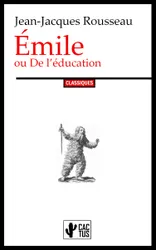
    Émile, ou De l'éducation

    Jean-Jacques Rousseau

  7. Nouveau

    Emile

    Jean-Jacques Rousseau

  8. Discours sur l’origine et les fondements de l’inégalité parmi les hommes : Avec notes

    Jean-Jacques Rousseau

  9. Émile : ou De l’éducation | Avec notes

    Jean-Jacques Rousseau

  10. Les Confessions : Livres I à XII

    Jean-Jacques Rousseau

  11. Les rêveries du promeneur solitaire

    Jean-Jacques Rousseau

  12. Du contrat social ou Principes du droit politique

    Jean-Jacques Rousseau

À propos de ce livre

Jean-Jacques Rousseau's 'EMILE' is a revolutionary treatise on education and human development, published in 1762 during the Enlightenment era. The book follows the life of Emile, a young boy raised in nature by his tutor, exploring themes of individualism, freedom, and the corrupting influence of society. Rousseau's literary style is philosophical and didactic, employing a narrative framework to convey his ideas on the importance of allowing natural growth and nurturing human potential. 'EMILE' challenged traditional educational methods and emphasized the need for personalized education to cultivate virtue and morality in individuals. Rousseau's work is a cornerstone of modern educational philosophy, influencing thinkers such as John Dewey and Maria Montessori. Through 'EMILE,' Rousseau presents a thought-provoking analysis of the human condition and the role of education in shaping society. Readers interested in exploring the foundations of educational theory and the philosophy of childhood will find 'EMILE' a profound and enlightening read.