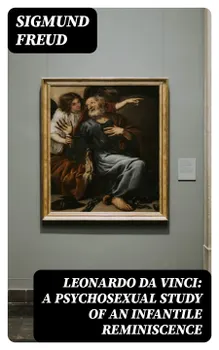
Leonardo da Vinci: A Psychosexual Study of an Infantile Reminiscence

In "Leonardo da Vinci: A Psychosexual Study of an Infantile Reminiscence," Sigmund Freud delves into the intricacies of the artist's psyche through the lens of psychoanalysis. Freud explores the symbolic significance of da Vinci's memories, particularly his purported recollection of being nourished by a bird, interpreting this as a manifestation of his relationship with his mother and the complexities of his sexual identity. Employing a rigorous psychoanalytic framework, the text weaves together art, memory, and desire, thereby positioning da Vinci's oeuvre within the broader context of Renaissance humanism and psychological conflict. Freud's distinctive literary style combines erudition with accessible prose, inviting readers to engage with his innovative theories on art and sexuality. Sigmund Freud, the father of psychoanalysis, developed his groundbreaking theories amidst a cultural milieu marked by rapid scientific and artistic change. His work on da Vinci reflects Freud's fascination with the intersection of psychology and creativity, shaped by his early experiences and professional aspirations in neurology and the burgeoning field of psychoanalysis. The study exemplifies his belief in the profound connection between art and the unconscious, encouraging readers to consider how personal history informs artistic expression. This book is an essential read for scholars of psychoanalysis, art history, and those intrigued by the depths of human creativity. Freud's insights not only illuminate da Vinci's genius but also challenge us to contemplate our own psychological landscapes. "Leonardo da Vinci" invites sophisticated discourse on the relationship between creative expression and the psyche, making it a noteworthy contribution to both psychological and artistic studies.

À propos de ce livre

In "Leonardo da Vinci: A Psychosexual Study of an Infantile Reminiscence," Sigmund Freud delves into the intricacies of the artist's psyche through the lens of psychoanalysis. Freud explores the symbolic significance of da Vinci's memories, particularly his purported recollection of being nourished by a bird, interpreting this as a manifestation of his relationship with his mother and the complexities of his sexual identity. Employing a rigorous psychoanalytic framework, the text weaves together art, memory, and desire, thereby positioning da Vinci's oeuvre within the broader context of Renaissance humanism and psychological conflict. Freud's distinctive literary style combines erudition with accessible prose, inviting readers to engage with his innovative theories on art and sexuality. Sigmund Freud, the father of psychoanalysis, developed his groundbreaking theories amidst a cultural milieu marked by rapid scientific and artistic change. His work on da Vinci reflects Freud's fascination with the intersection of psychology and creativity, shaped by his early experiences and professional aspirations in neurology and the burgeoning field of psychoanalysis. The study exemplifies his belief in the profound connection between art and the unconscious, encouraging readers to consider how personal history informs artistic expression. This book is an essential read for scholars of psychoanalysis, art history, and those intrigued by the depths of human creativity. Freud's insights not only illuminate da Vinci's genius but also challenge us to contemplate our own psychological landscapes. "Leonardo da Vinci" invites sophisticated discourse on the relationship between creative expression and the psyche, making it a noteworthy contribution to both psychological and artistic studies.

Commencez ce livre dès aujourd'hui pour 0 €

  • Accédez à tous les livres de l'app pendant la période d'essai
  • Sans engagement, annulez à tout moment
Essayer gratuitement
Plus de 52 000 personnes ont noté Nextory 5 étoiles sur l'App Store et Google Play.

  1. Introduction à la psychanalyse

    Sigmund Freud

  2. Psychopathologie de la vie quotidienne : Application de la psychanalyse à l'interprétation des actes de la vie quotidienne

    Sigmund Freud

  3. 5.0

    Le malaise dans la culture

    Sigmund Freud

  4. Psychopathologie de la vie quotidienne

    Sigmund Freud

  5. 5.0

    Freud : la sexualité féminine

    Sigmund Freud

  6. Psychopathologie de la vie quotidienne

    Sigmund Freud

  7. Leonardo da Vinci

    Sigmund Freud

  8. 50 Clásicos que debes leer antes de morir : Las Obras Inmortales de la Literatura Universal en un Solo Volumen

    Dante Alighieri, Aristóteles, Jane Austen, Charles Baudelaire, Giovanni Boccaccio, Anne Brontë, C. Collodi, James Fenimore Cooper, Fedor Mikhaïlovitch Dostoïevski, Arthur Conan Doyle, Alexandre Dumas, José de Espronceda, Gustave Flaubert, Sigmund Freud, Benito Pérez Galdós, Kahlil Gibran, Johann Wolfgang Goethe

  9. Le Mot d'esprit et sa relation à l'inconscient

    Sigmund Freud

  10. Introduction à la psychanalyse : Tome I et II

    Sigmund Freud

  11. Totem et Tabou : Interprétation par la psychanalyse de la vie sociale des peuples primitifs (Nouvelle édition en larges caractères)

    Sigmund Freud

  12. 100 Obras Maestras de la Literatura Universal : Edición enriquecida. Viaje intertemporal por iconos mundiales y el diálogo cultural histórico

    Johann Wolfgang von Goethe, Gustave Flaubert, Franz Kafka, Lewis Carroll, Sigmund Freud, Henrik Ibsen, Charles Dickens, Honoré de Balzac, Mark Twain, Immanuel Kant, Friedrich Schiller, Harriet Beecher Stowe, Oscar Wilde, Robert Louis Stevenson, Edgar Allan Poe, William Shakespeare, Dante Alighieri, Giovanni Boccaccio, Bram Stoker, Charlotte Brontë, Emily Brontë, Jack London, Henry James, Louisa May Alcott, Victor Hugo, Arthur Conan Doyle, Joseph Conrad, Jane Austen, José Rizal, Edgar Rice Burroughs, Herman Melville, Jonathan Swift, Gustavo Adolfo Bécquer, Vicente Blasco Ibáñez, Benito Pérez Galdós, Jean-Jacques Rousseau, Daniel Defoe, Pedro Calderón de la Barca, Virginia Woolf, Washington Irving, Juan Valera, Horacio Quiroga, Nathaniel Hawthorne, Charles Baudelaire, Wilkie Collins, William Makepeace Thackeray, Voltaire, Apuleius, Leopoldo Alas, John Milton, José Martí, Lope de Vega, Emilio Salgari, Francisco de Quevedo, Rubén Darío, Antonio Machado, José Zorrilla, Tirso de Molina, Emilia Pardo Bazán, Fernando de Rojas, L. Frank Baum, H.G. Wells, J.M. Barrie, H. Rider Haggard, H.P. Lovecraft, Seneca, Hans Christian Andersen, Friedrich Nietzsche, Mary Shelley, Baltasar Gracián, Sófocles, Sun Tzu, Fiódor Dostoyevski, Antón Chéjov, León Tolstoi, Tomás Moro, San Agustín, Nikolái Gógol, Julio Verne, Homero, Platón, Alejandro Dumas, Aristóteles, Hermanos Grimm, Jorge Isaacs, Ignacio De Loyola, Nicolás Maquiavelo, Miguel Cervantes, Teresa de Jesús, Alejandro Dumas hijo, Mijaíl Bakunin, Miguel De Unamuno, Duque de Rivas, Ramón María del Valle-Inclán, Federico García Lorca, Gibrán Jalil Gibrán