Faust

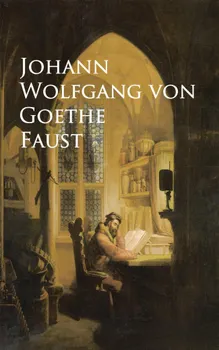
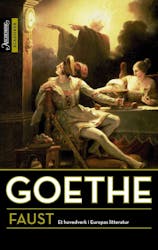
Faust is a tragic play in two parts by Johann Wolfgang von Goethe, usually known in English as Faust, Part One and Faust, Part Two. Although rarely staged in its entirety, it is the play with the largest audience numbers on German-language stages. Faust is considered by many to be Goethe's magnum opus and the greatest work of German literature.

The earliest forms of the work, known as the Urfaust, were developed between 1772 and 1775; however, the details of that development are not entirely clear. Urfaust has twenty-two scenes, one in prose, two largely prose and the remaining 1,441 lines in rhymed verse. The manuscript is lost, but a copy was discovered in 1886.

The first appearance of the work in print was Faust, a Fragment, published in 1790. Goethe completed a preliminary version of what is now known as Part One in 1806. Its publication in 1808 was followed by the revised 1828–29 edition, the last to be edited by Goethe himself.

Goethe finished writing Faust Part Two in 1831; it was published posthumously the following year. In contrast to Faust Part One, the focus here is no longer on the soul of Faust, which has been sold to the devil, but rather on social phenomena such as psychology, history and politics, in addition to mystical and philosophical topics. The second part formed the principal occupation of Goethe's last years.

Om denne boken

Faust is a tragic play in two parts by Johann Wolfgang von Goethe, usually known in English as Faust, Part One and Faust, Part Two. Although rarely staged in its entirety, it is the play with the largest audience numbers on German-language stages. Faust is considered by many to be Goethe's magnum opus and the greatest work of German literature.

The earliest forms of the work, known as the Urfaust, were developed between 1772 and 1775; however, the details of that development are not entirely clear. Urfaust has twenty-two scenes, one in prose, two largely prose and the remaining 1,441 lines in rhymed verse. The manuscript is lost, but a copy was discovered in 1886.

The first appearance of the work in print was Faust, a Fragment, published in 1790. Goethe completed a preliminary version of what is now known as Part One in 1806. Its publication in 1808 was followed by the revised 1828–29 edition, the last to be edited by Goethe himself.

Goethe finished writing Faust Part Two in 1831; it was published posthumously the following year. In contrast to Faust Part One, the focus here is no longer on the soul of Faust, which has been sold to the devil, but rather on social phenomena such as psychology, history and politics, in addition to mystical and philosophical topics. The second part formed the principal occupation of Goethe's last years.

Kom i gang med denne boken i dag for 0 kr

  • Få full tilgang til alle bøkene i appen i prøveperioden
  • Ingen forpliktelser, si opp når du vil
Prøv gratis nå
Mer enn 52 000 personer har gitt Nextory 5 stjerner på App Store og Google Play.

  1. 4.3

    Den unge Werthers lidelser

    Johann Wolfgang von Goethe

  2. 4.7

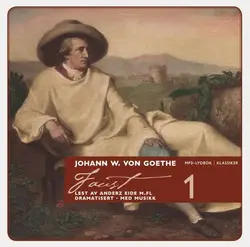
    Faust : 1

    Johann Wolfgang von Goethe

  3. 10 Masterpieces You Have to Read Before You Die, Vol.5 : The Odyssey, The Republic, Meditations, The Divine Comedy, Faust and others

    Homer, Plato, Aristotle, Marcus Aurelius, Niccolo Machiavelli, Dante Alighieri, Johann Wolfgang von Goethe, Leo Tolstoy

  4. Faust : en tragedie

    Johann Wolfgang von Goethe

  5. 50 Capolavori Da Leggere Prima Di Morire: Vol. 1 (Golden Deer Classics)

    Carlo Collodi, Golden Deer Classics, Dante Alighieri, Niccolò Machiavelli, Daniel Defoe, Charlotte Brontë, Nathaniel Hawthorne, Jules Verne, Plato, Edmondo de Amicis, Rudyard Kipling, Voltaire, Homer, Sofocle, Lao Tzu, Jonathan Swift, Friedrich Schiller, Johann Wolfgang von Goethe, Honoré de Balzac, Aleksandr Puškin, Charles Dickens, Edgar Allan Poe, Fëdor Dostoevskij, Fyodor Dostoevsky, Herman Melville, Henry David Thoreau, Harriet Beecher Stowe, Lewis Carroll, Iginio Ugo Tarchetti, Arthur Schopenhauer, Friedrich Nietzsche, Emilio De Marchi, Gabriele D’Annunzio, Giovanni Verga, Jerome Klapka Jerome, Anatole France, Émile Zola, Oscar Wilde, J.M. Barrie, Matilde Serao, Grazia Deledda, Gilbert K. Chesterton, Italo Svevo, Luigi Pirandello, Augusto de Angelis, Stendhal, Alessandro Manzoni

  6. Unge Werther

    Johann Wolfgang von Goethe

  7. Faust

    Johann Wolfgang von Goethe

  8. 9. aug.

    Zum Schäkespears Tag. Eine Rede auf William Shakespeare. : Hörbuchzeit: Klassiker der Weltliteratur

    Hörbuchzeit, Johann Wolfgang von Goethe

  9. Ny

    Faust I - live! Aus Studio 14 - Erzählbuch (Ungekürzt)

    Meike Rötzer, Johann Wolfgang von Goethe

  10. Lyrikalische Bibliothek

    Heinrich Heine, Annette von Droste-Hülshoff, Charles Baudelaire, John Keats, Rainer Maria Rilke, Georg Heym, Wilhelm Busch, Arno Holz, Johann Wolfgang von Goethe, Christian Morgenstern, Joachim Ringelnatz, Georg Trakl, Ludwig Tieck, Stefan Zweig, Hugo von Hoffmannsthal, Edgar Allan Poe, Frank Wedekind, Franz Werfel, Wolfgang Borchert, Karl Kraus, Kurt Tucholsky, Friedrich Nietzsche, Else Lasker-Schüler, Ludwig Kalisch, Jakob van Hoddis, Joseph von Eichendorff, Gotthold Ephraim Lessing

  11. Novelle. Eine Novelle. : Hörbuchzeit: Klassiker der Weltliteratur

    Hörbuchzeit, Johann Wolfgang von Goethe