Om denne boken

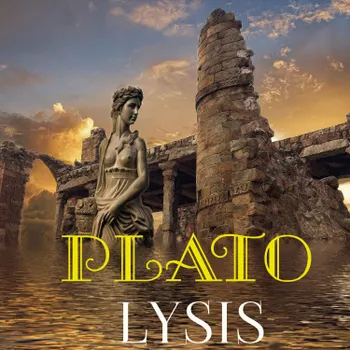
Lysis is a dialogue of Plato which discusses the nature often translated as friendship, while the word's original content was of a much larger and more intimate bond. It is generally classified as an early dialogue.

The main characters are Socrates, the boys Lysis and Menexenus who are friends, as well as Hippothales, who is in unrequited love with Lysis and therefore, after the initial conversation, hides himself behind the surrounding listeners. Socrates proposes four possible notions regarding the true nature of loving friendship as:

Friendship between people who are similar, interpreted by Socrates as friendship between good men.

Friendship between men who are dissimilar.

Friendship between men who are neither good nor bad and good men.

Gradually emerging: friendship between those who are relatives (οἰκεῖοι "not kindred") by the nature of their souls.

Of all those options, Socrates thinks that the only logical possibility is the friendship between men who are good and men who are neither good nor bad.

In the end, Socrates seems to discard all these ideas as wrong, although his para-logical refutations have strong hints of irony about them.

Kom i gang med denne boken i dag for 0 kr

  • Få full tilgang til alle bøkene i appen i prøveperioden
  • Ingen forpliktelser, si opp når du vil
Prøv gratis nå
Mer enn 52 000 personer har gitt Nextory 5 stjerner på App Store og Google Play.

  1. 4.0

    Sokrates' forsvarstale

    Plato

  2. 4.0

    3500 Final Quotes

    Marcus Aurelius, Jane Austen, Beaumarchais, Napoleon Bonaparte, Buddha, Winston Churchill, Cicero, Confucius, Nicolas de Chamfort, Charles de Gaulle, Antoine de Saint-Exupéry, Denis Diderot, Fyodor Dostoevsky, Albert Einstein, Ralph Waldo Emerson, Anne Frank, Mahatma Gandhi, Immanuel Kant, Søren Kierkegaard, Martin Luther King, Georg Christoph Lichtenberg, Abraham Lincoln, Montesquieu, Friedrich Nietzsche, Plato, Marcel Proust, Arthur Schopenhauer, William Shakespeare, Socrates, Baruch Spinoza, Henry David Thoreau, Leonardo da Vinci, Voltaire, Oscar Wilde, Laozi

  3. 4.5

    The Republic

    Plato

  4. Timaeus : Plato’s Vision of the Cosmos – A Dialogue on Creation, Nature, and the Divine Mind

    Plato, Tim Zengerink

  5. 2.0

    The Republic

    Plato

  6. 10 Masterpieces You Have to Read Before You Die, Vol.5 : The Odyssey, The Republic, Meditations, The Divine Comedy, Faust and others

    Homer, Plato, Aristotle, Marcus Aurelius, Niccolo Machiavelli, Dante Alighieri, Johann Wolfgang von Goethe, Leo Tolstoy

  7. 25+ The Big Book of Ancient Classics : The Odyssey by Homer, Meditations by Marcus Aurelius, The Republic by Plato, Poetics by Aristotle and others

    Aristotle, Aeschylus, Marcus Aurelius, Euripides, Hesiod, Homer, Plato, Sappho -, Sophocles

  8. The Socratic Dialogues. Early Period : The Apology, Crito, Charmides, Laches, Lysis, Menexenus, Ion, Meno

    Plato

  9. Yale Classics (Vol. 1) : Enriched edition. Exploring the Essence of Ancient Wisdom and Literary Brilliance in Western Thought

    Aristotle, Plato, Euripides, Gilbert Murray, Epictetus, Pindar, Theocritus, Homer, Plutarch, Aeschylus, Sophocles, - Aristophanes, Herodotus, Anacreon, Sappho -, Thucydides, Hesiod, Demosthenes, Lysias, Alcaeus, Archilochus, Theognis of Megara, Simonides of Ceos, Bacchylides, Apollonius, Callimachus

  10. 33 Human Science Masterpieces You Must Read Before You Die. Illustrated : The Art of Public Speaking, The Meditations, The Kama Sutra and other masterpieces

    Edwin A. Abbott, Aristotle, Dale Carnegie, Gilbert Chesterton, René Descartes, Epictetus, Marcus Aurelius Antoninus, Sigmund Freud, Hermann Hesse, David Hume, Lao Tzu, Confucius, Swami Abhedananda, Anonimous, David Herbert Lawrence, Niccolò Machiavelli, Benedictus de Spinoza, John Mill, Prentice Mulford, Thomas More, Friedrich Nietzsche, J. Allanson Picton, Plato, Sun Tzu, Vatsyayana, Voltaire, H.G. Wells, Frances Bacon

  11. 33 Masterpieces of Philosophy and Science to Read Before You Die (Illustrated) : Utopia, The Meditations, The Art of War, The Kama Sutra, Candide

    Thomas More, Marcus Aurelius Antoninus, Sun Tzu, Vatsyayana, Voltaire, Edwin A. Abbott, Aristotle, Dale Carnegie, Gilbert Keith Chesterton, René Descartes, Epictetus, Sigmund Freud, Hermann Hesse, David Hume, Lao Tzu, David Herbert Lawrence, Niccolò Machiavelli, John Mill, Prentice Mulford, Friedrich Nietzsche, Plato, Bertrand Russell, H.G. Wells, Frances Bacon

  12. 4.5

    Plato’s Greater Hippias

    Plato