Om denne boken

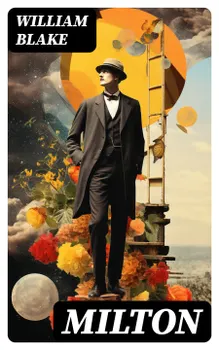
William Blake's "Milton" is a profound exploration of the interplay between myth, imagination, and spiritual awakening. Written in a distinctively visionary style, this long poem articulates Blake's unique cosmology, wherein the figure of John Milton serves as both a historical figure and a mythic archetype. Through his intricate use of symbols and allegory, Blake delves into themes of divine inspiration, the nature of the human soul, and the pursuit of artistic truth, positioning Milton as a prophet and his works as vehicles of profound knowledge and enlightenment. The poem, comprising a rich tapestry of allegorical prose and lyrical verses, reflects Blake's belief in the power of creativity to transcend earthly limitations and connect with the divine. William Blake (1757-1827), a visionary poet and artist, was deeply influenced by both the Enlightenment and the Romantic movement. His radical ideas on art, sexuality, and religion were often considered ahead of his time, which shaped his literary voice. Blake's admiration for Milton, along with his aspiration to express his own mythos, catalyzed the writing of "Milton." This work encapsulates Blake's conviction that art should convey deep spiritual truths, often intertwining his personal insights with broader philosophical questions. "Milton" is an essential read for those interested in understanding the intersection of poetry, spirituality, and the creative impulse. Through Blake's visionary lens, readers will uncover a profound meditation on the nature of artistic creation and the spiritual journey. This book is not merely a poetic endeavor; it is an invitation to explore the infinite possibilities of the human imagination.
Kom i gang med denne boken i dag for 0 kr

  • Få full tilgang til alle bøkene i appen i prøveperioden
  • Ingen forpliktelser, si opp når du vil
Prøv gratis nå
Mer enn 52 000 personer har gitt Nextory 5 stjerner på App Store og Google Play.

Mer av William Blake

  1. The Big Book of Christmas

    Hans Christian Andersen, Charles Dickens, Louisa May Alcott, Lucy Maud Montgomery, Anne Brontë, Willa Cather, G.K. Chesterton, F. Marion Crawford, Fyodor Dostoyevsky, Arthur Conan Doyle, Mary E. Freeman, The Brothers Grimm, Thomas Hardy, Nathaniel Hawthorne, O.Henry, E. T. Hoffmann, Washington Irving, James Joyce, Rudyard Kipling, H.P. Lovecraft, John Milton, Beatrix Potter, Arthur Thomas Quiller-Couch, Walter Scott, Robert Louis Stevenson, Harriet Beecher Stowe, Leo Tolstoy, Anthony Trollope, Mark Twain, Oscar Wilde, Anton Chekhov, L. Frank Baum, William Blake, Samuel Taylor Coleridge, Emily Dickinson, Henry Wadsworth Longfellow, Clement C. Moore, William Shakespeare, Andrew Lang

  2. THE GHOST OF ABEL (With All the Original Illustrations) : Enriched edition. A Revelation In the Visions of Jehovah Seen by William Blake

    William Blake

  3. Ny

    Songs of Innocence and Songs of Experience

    William Blake

  4. 4.7

    The Marriage Of Heaven And Hell

    William Blake

  5. 4.7
    #1

    The Marriage of Heaven and Hell

    William Blake

  6. Laocoon

    William Blake

  7. 3.0

    The Book of Thel

    William Blake

  8. #1

    William Blake Poems

    William Blake

  9. #1

    50 Essential Classics You Must Read - British Literature : The Definitive British Literature Collection from Beowulf to the Romantic Poets

    Anonymous, The Essential Classics Library, William Langland, Jessie L. Weston, Thomas Malory, Thomas More, Christopher Marlowe, Edmund Spenser, John Milton, William Shakespeare, Ben Jonson, Daniel Defoe, Jonathan Swift, Samuel Richardson, Henry Fielding, Frances Burney, Oliver Goldsmith, M.G. Lewis, Mary Shelley, William Beckford, Jane Austen, Charlotte Brontë, Emily Brontë, Charles Dickens, George Eliot, Thomas Hardy, Robert Louis Stevenson, Oscar Wilde, H.G. Wells, H. Rider Haggard, Rudyard Kipling, William Blake, William Wordsworth, John Keats, Percy Bysshe Shelley, Various Authors, Multiple Authors

  10. 2.0

    Songs of Innocence and of Experience

    William Blake

  11. 2.0

    Songs of Innocence and of Experience

    William Blake