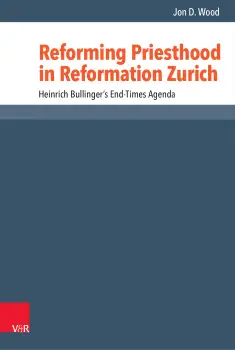
The dramatic task of re-imagining clerical identity proved crucial to the Renaissance and Reformation. Jon Wood brings new light to ways in which that discussion animated reconfigurations of church, state, and early modern populace. End-Times considerations of Christian religion had played a part in upheavals throughout the medieval period, but the Reformation era mobilized that tradition with some new possibilities for understanding institutional leadership. Perceiving dangers of an overweening institution on the one hand and anarchic "priesthood of all believers" on the other hand, early Protestants defended legitimacy of ordained ministry in careful coordination with the state. The early Reformation in Zurich emphatically disestablished traditional priesthood in favour of a state-supported "prophethood" of exegetical-linguistic expertise. The author shows that Heinrich Bullinger's End-Times worldview led him to reclaim for Protestant Zurich a notion of specifically clerical "priesthood," albeit neither in terms of statist bureaucracy nor in terms of the traditional sacramental character that his precursor (Huldrych Zwingli) had dismantled. Clerical priesthood was an extraordinarily fraught subject in the sixteenth century, especially in the Swiss Confederation. Heinrich Bullinger's private manuscripts helpfully supplement his more circumscribed published works on this subject. The argument about reclaiming a modified institutional priesthood of Protestantism also prompts re-assessment of broader Reformation history in areas of church-state coordination and in major theological concepts of "covenant" and "justification" that defined religious/confessional distinctions of that era.
Om denne boken
The dramatic task of re-imagining clerical identity proved crucial to the Renaissance and Reformation. Jon Wood brings new light to ways in which that discussion animated reconfigurations of church, state, and early modern populace. End-Times considerations of Christian religion had played a part in upheavals throughout the medieval period, but the Reformation era mobilized that tradition with some new possibilities for understanding institutional leadership. Perceiving dangers of an overweening institution on the one hand and anarchic "priesthood of all believers" on the other hand, early Protestants defended legitimacy of ordained ministry in careful coordination with the state. The early Reformation in Zurich emphatically disestablished traditional priesthood in favour of a state-supported "prophethood" of exegetical-linguistic expertise. The author shows that Heinrich Bullinger's End-Times worldview led him to reclaim for Protestant Zurich a notion of specifically clerical "priesthood," albeit neither in terms of statist bureaucracy nor in terms of the traditional sacramental character that his precursor (Huldrych Zwingli) had dismantled. Clerical priesthood was an extraordinarily fraught subject in the sixteenth century, especially in the Swiss Confederation. Heinrich Bullinger's private manuscripts helpfully supplement his more circumscribed published works on this subject. The argument about reclaiming a modified institutional priesthood of Protestantism also prompts re-assessment of broader Reformation history in areas of church-state coordination and in major theological concepts of "covenant" and "justification" that defined religious/confessional distinctions of that era.
Kom i gang med denne boken i dag for 0 kr
- Få full tilgang til alle bøkene i appen i prøveperioden
- Ingen forpliktelser, si opp når du vil
Forfatter:
Serie:
Volum 54 i Reformed Historical TheologySpråk:
engelsk
Format:

Calvinus sacrarum literarum interpres : Papers of the International Congress on Calvin Research

Divine Accommodation in John Calvin's Theology : Analysis and Assessment

Calvinus clarissimus theologus : Papers of the Tenth International Congress on Calvin Research

Rights in the Law : The Importance of God's Free Choices in the Thought of Francis Turretin

Britain and the Bestandstwisten : The Causes, Course and Consequences of British Involvement in the Dutch Religious and Political Disputes of the Early Seventeenth Century

The Light of Grace: John Owen on the Authority of Scripture and Christian Faith

Calvinus Pastor Ecclesiae : Papers of the Eleventh International Congress on Calvin Research

Richard Hooker and Reformed Orthodoxy

"A Knot Worth Unloosing" : The Interpretation of the New Heavens and Earth in Seventeenth-Century England

Reformation of the Commonwealth : Thomas Becon and the Politics of Evangelical Change in Tudor England

The Theology of Heinrich Bullinger