Utopia

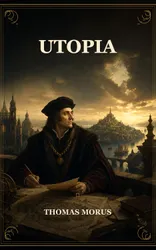
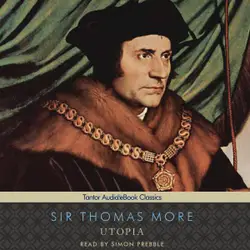
De Optimo Republicae Statu deque Nova Insula Utopia (translated On the Best State of a Republic and on the New Island of Utopia) or more simply Utopia is a 1516 book by Sir (Saint) Thomas More.

The book, written in Latin, is a frame narrative primarily depicting a fictional island society and its religious, social and political customs. The name of the place is derived from the Greek words οὐ u and τόπος tópos , with the topographical suffix -εία eía, hence Οὐτοπεία outopeía (Latinized as Utopia), "no-place land." It also contains a pun, however, because "Utopia" could also be the Latinization of Εὐτοπεία eutopeía, "good-place land," which uses the Greek prefix ευ eu, "good," instead of οὐ. One interpretation holds that this suggests that while Utopia might be some sort of perfected society, it is ultimately unreachable. Despite modern connotations of the word it is widely accepted that the society More describes in this work was not actually his own perfect society Rather he wished to use the contrast between the imaginary unusual political ideas and the chaotic politics of his own day as a platform from which to discuss social issues in Europe.

Om denne boken

De Optimo Republicae Statu deque Nova Insula Utopia (translated On the Best State of a Republic and on the New Island of Utopia) or more simply Utopia is a 1516 book by Sir (Saint) Thomas More.

The book, written in Latin, is a frame narrative primarily depicting a fictional island society and its religious, social and political customs. The name of the place is derived from the Greek words οὐ u and τόπος tópos , with the topographical suffix -εία eía, hence Οὐτοπεία outopeía (Latinized as Utopia), "no-place land." It also contains a pun, however, because "Utopia" could also be the Latinization of Εὐτοπεία eutopeía, "good-place land," which uses the Greek prefix ευ eu, "good," instead of οὐ. One interpretation holds that this suggests that while Utopia might be some sort of perfected society, it is ultimately unreachable. Despite modern connotations of the word it is widely accepted that the society More describes in this work was not actually his own perfect society Rather he wished to use the contrast between the imaginary unusual political ideas and the chaotic politics of his own day as a platform from which to discuss social issues in Europe.

Kom i gang med denne boken i dag for 0 kr

  • Få full tilgang til alle bøkene i appen i prøveperioden
  • Ingen forpliktelser, si opp når du vil
Prøv gratis nå
Mer enn 52 000 personer har gitt Nextory 5 stjerner på App Store og Google Play.

  1. 4.0

    Utopia

    Thomas Morus

  2. Forkortet

    Utopia : Über den besten Zustand des Staates

    Thomas Morus

  3. Trost gegen Leid : Ausgabe in neuer Übersetzung und Rechtschreibung

    Thomas Morus

  4. Fundamentale Texte des Christentums : Erweiterte Ausgabe. Die Bibel, Die Nachfolge Christi, Der kleine und der große Katechismus, Die Bekenntnisse des heiligen Augustinus

    Aurelius Augustinus, Ignatius von Loyola, Thomas von Kempen, Hildegard von Bingen, Thomas von Aquin, Anselm von Canterbury, Bonaventura, Thomas Morus, Tommaso Campanella, Nicolaus von Cues, Philipp Melanchthon, Lew Tolstoi, Martin Luther

  5. Kernschriften des Glaubens : Erweiterte Ausgabe. Die Bibel, Die Apokryphen, Der Weg der Welt, Die Geistlichen Übungen, 95 Thesen, Das Reich Gottes ist in Euch

    Aurelius Augustinus, Ignatius von Loyola, Thomas von Kempen, Hildegard von Bingen, Thomas von Aquin, Anselm von Canterbury, Bonaventura, Thomas Morus, Tommaso Campanella, Nicolaus von Cues, Philipp Melanchthon, Martin Luther, Lew Tolstoi

  6. Essenzielle Klassiker der politischen Philosophie : Der Staat, Der Gesellschaftsvertrag, Der Fürst, Utopia, Manifest der Kommunistischen Partei, Geschichte der Socialdemokratie

    Niccolò Machiavelli, Montesquieu, Friedrich der Große, Platon, - Aristoteles, Marcus Tullius Cicero, Tommaso Campanella, Thomas Morus, Samuel von Pufendorf, Abbé Castel Saint-Pierre, Jean-Jacques Rousseau, Immanuel Kant, Johann Gottlieb Fichte, Karl Marx, Friedrich Engels, Wilhelm von Humboldt, Friedrich Christoph Dahlmann, Franz Mehring, Johann Most, John Henry Mackay, Rosa Luxemburg, Erich Mühsam

  7. Grundwerke der politischen Philosophie : Der Staat, Der Gesellschaftsvertrag, Der Fürst, Utopia, Manifest der Kommunistischen Partei, Geschichte der Socialdemokratie, Parlamentarischer Kretenismus

    Platon, - Aristoteles, Marcus Tullius Cicero, Niccolò Machiavelli, Tommaso Campanella, Thomas Morus, Samuel von Pufendorf, Abbé Castel Saint-Pierre, Jean-Jacques Rousseau, Montesquieu, Immanuel Kant, Friedrich der Große, Johann Gottlieb Fichte, Karl Marx, Friedrich Engels, Wilhelm von Humboldt, Friedrich Christoph Dahlmann, Franz Mehring, Johann Most, John Henry Mackay, Rosa Luxemburg, Erich Mühsam

  8. Geistesgrößen des Glaubens : Meisterwerke des Geistes: Das Leben und Wirken von Augustinus, Thomas More, Thomas von Aquin, Franz von Assisi

    Thomas von Aquin, Aurelius Augustinus, Thomas Morus, Emil Ludwig, Heinrich Thode

  9. Philosophie der Renaissance : Die wichtigsten Werke von Michel de Montaigne, Niccolò Machiavelli, Thomas Morus, Erasmus, Francis Bacon

    Niccolò Machiavelli, Michel de Montaigne, - Erasmus von Rotterdam, Thomas Morus, Francis Bacon, Tommaso Campanella, Martin Luther, Ludwig Kuhlenbeck

  10. Die größten Philosophen der Renaissance : Die Discorsi, Man muß seinen Willen beschränken, Der Fürst, Utopia, Das Lob der Torheit

    - Erasmus von Rotterdam, Niccolò Machiavelli, Thomas Morus, Francis Bacon, Tommaso Campanella, Michel de Montaigne, Nicolaus von Cues, Martin Luther, Ludwig Kuhlenbeck

  11. Lichter des Glaubens : Klassiker der Theologie: Summa theologica, Die Bekenntnisse, Die Nachfolge Christi

    Thomas Morus, Thomas von Aquin, Aurelius Augustinus, Emil Ludwig, Heinrich Thode

  12. Philosophie und Politik : Bereicherte Ausgabe. Die Vielfalt politischer Theorien in literarischen Meisterwerken

    Niccolò Machiavelli, Marcus Tullius Cicero, Platon, Thomas Morus