Om denne boken

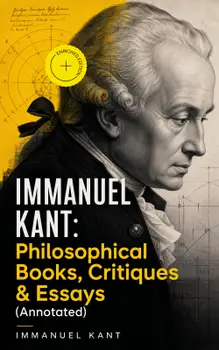
IMMANUEL KANT: Philosophical Books, Critiques & Essays gathers the central writings through which Kant transformed modern philosophy: the critical investigations of reason, morality, judgment, enlightenment, religion, and political hope. Its style is famously rigorous, architectonic, and at times demanding, yet beneath the technical vocabulary lies a sustained effort to define the limits and powers of human understanding. In literary and intellectual context, these works stand at the culmination of the Enlightenment and the threshold of German Idealism. Immanuel Kant (1724–1804), the Königsberg philosopher, lived a life of outward regularity and inward revolution. Trained in rationalist metaphysics and deeply challenged by empiricism, especially Hume's skepticism, Kant sought to rescue science, ethics, and freedom from dogmatism and relativism alike. His writings reflect the intellectual pressures of Newtonian physics, Protestant moral seriousness, Enlightenment public reason, and the political tremors of eighteenth-century Europe. This volume is recommended for readers seeking not merely historical philosophy but a disciplined encounter with the foundations of modern thought. Students, scholars, and serious general readers will find in Kant an exacting guide to knowledge, duty, beauty, autonomy, and human dignity.

This enriched edition has been carefully crafted to add value to your reading experience.

- A succinct Introduction situates the work's timeless appeal and themes.

- The Synopsis outlines the central plot, highlighting key developments without spoiling critical twists.

- A detailed Historical Context immerses you in the era's events and influences that shaped the writing.

- An Author Biography reveals milestones in the author's life, illuminating the personal insights behind the text.

- A thorough Analysis dissects symbols, motifs, and character arcs to unearth underlying meanings.

- Reflection questions prompt you to engage personally with the work's messages, connecting them to modern life.

- Hand‐picked Memorable Quotes shine a spotlight on moments of literary brilliance.

Kom i gang med denne boken i dag for 0 kr

  • Få full tilgang til alle bøkene i appen i prøveperioden
  • Ingen forpliktelser, si opp når du vil
Prøv gratis nå
Mer enn 52 000 personer har gitt Nextory 5 stjerner på App Store og Google Play.

  1. Om pedagogikk

    Immanuel Kant

  2. 12 Masterpieces You Have to Read Before You Die. Philosophy

    Niccolo Machiavelli, Tommaso Campanella, Francis Bacon, Thomas More, John Stuart Mill, Immanuel Kant, Kahlil Gibran, Leo Tolstoy, G.K. Chesterton, Henry David Thoreau

  3. Critique of Judgement

    Immanuel Kant

  4. Critique of Pure Reason

    Immanuel Kant

  5. 3.4

    What is Enlightenment?

    Immanuel Kant

  6. 3.8

    Kant's Foundations of Ethics

    Immanuel Kant

  7. Critique of Practical Reason

    Immanuel Kant

  8. The Critique of Pure Reason

    Immanuel Kant

  9. Lo Bello y Lo Sublime : Ensayo de Estética y Moral

    Immanuel Kant

  10. 100 Clásicos de la Literatura Universal

    Francis Scott Fitzgerald, Mary Shelley, Lyman Frank Baum, Louisa May Alcott, Dante Alighieri, Jane Austen, Ambrose Bierce, Emily Brontë, Edgar Rice Burroughs, Lewis Carroll, Wilkie Collins, René Descartes, Charles Dickens, Emily Dickinson, Alexandre Dumas, Gustave Flaubert, Benito Pérez Galdós, Johann Wolfgang von Goethe, Thomas Hardy, E T A Hoffmann, Washington Irving, Henry James, James Joyce, Franz Kafka, Gaston Leroux, Federico García Lorca, H.P. Lovecraft, Publio Virgilio Marón, Lucy Maud Montgomery, John William Polidori, Marco Polo, Antoine de Saint-Exupéry, Emilio Salgari, Walter Scott, Mark Twain, Jules Verne, Julio Verne, H.G. Wells, Edith Wharton, Mary Wollstonecraft, Stefan Zweig, Sun Tzu, Bram Stoker, - Aristoteles, George Bernard Shaw, Henryk Sienkiewicz, Concepción Arenal, Charlotte Brontë, Miguel de Cervantes, G.K. Chesterton, Daniel Defoe, Fyodor Mikhailovich Dostoyevsky, Arthur Conan Doyle, Sigmund Freud, H. Rider Haggard, Homero, Immanuel Kant, Rudyard Kipling, Molière, Friedrich Nietzsche, Fernando de Rojas, Sófocles, William Makepeace Thackeray, León Tolstói, Voltaire, Ramón María del Valle-Inclán, Oscar Wilde, Virginia Woolf

  11. Grundlegung zur Metaphysik der Sitten

    Immanuel Kant

  12. Beantwortung der Frage: Was ist Aufklärung?

    Immanuel Kant