Om denne boken

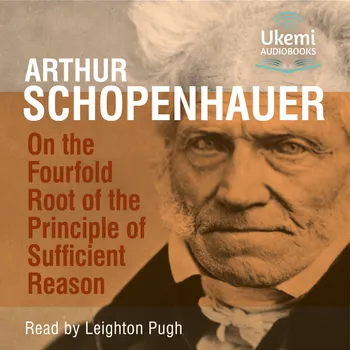
There is a cause, or a reason, behind everything that happens. This is the fundamental view behind the classical proposition the Principle of Sufficient Reason, which, in 1813, Schopenhauer chose as his subject for further examination in his doctoral dissertation On the Fourfold Root of the Principle of Sufficient Reason. He was 25.

In later years Schopenhauer revised this dissertation and republished it in 1847. The original ideas expressed here formed the basis of much of his later works, and therefore it remains an important core text for Schopenhauer studies. He discusses commentaries on the principle by earlier philosophers including Descartes, Spinoza, Wolff and Kant before going on to propose his four ‘classes of objects’ which he feels offer greater clarity and depth of meaning. The four classes of objects are each governed by their own form of the Principle: the Principle of Sufficient Reason of Becoming, the Principle of Sufficient Reason of Knowing, the Principle of Sufficient Reason of Being and the Principle of Sufficient Reason of Willing.

This recording of On the Fourfold Root of the Principle of Sufficient Reason uses the clear, classic translation by Madame Karl Hillebrand (1903).

Leighton Pugh presents it with the same clarity and commitment he has brought to his recording of all three volumes of The World as Will and Idea (Ukemi Audiobooks).
Kom i gang med denne boken i dag for 0 kr

  • Få full tilgang til alle bøkene i appen i prøveperioden
  • Ingen forpliktelser, si opp når du vil
Prøv gratis nå
Mer enn 52 000 personer har gitt Nextory 5 stjerner på App Store og Google Play.

  1. 3.0

    The Wisdom Of Life :

    Arthur Schopenhauer

  2. Aphorismen zur Lebensweisheit

    Arthur Schopenhauer

  3. The Essays of Arthur Schopenhauer; On Human Nature

    Arthur Schopenhauer

  4. 3500 citations ultimes

    Marc Aurèle, Jane Austen, Beaumarchais, Napoléon Bonaparte, Bouddha, Winston Churchill, Cicéron, Confucius, Nicolas de Chamfort, Charles de Gaulle, Antoine de Saint-Exupéry, Léonard de Vinci, Denis Diderot, Fiodor Dostoïevski, Albert Einstein, Ralph Waldo Emerson, Anne Frank, Mahatma Gandhi, Emmanuel Kant, Søren Kierkegaard, Martin Luther King, Georg Christoph Lichtenberg, Abraham Lincoln, Montesquieu, Friedrich Nietzsche, Platon, Marcel Proust, Arthur Schopenhauer, William Shakespeare, – Socrate, Baruch Spinoza, Henry David Thoreau, Lao Tseu, Voltaire, Oscar Wilde

  5. 4.0

    The Art of Controversy : The Art of Being Right

    Arthur Schopenhauer

  6. 50 Meisterwerke Musst Du Lesen, Bevor Du Stirbst (Eireann Press)

    Voltaire, Johann Wolfgang von Goethe, Joseph von Eichendorff, Mary Shelley, Sir Walter Scott, Honoré de Balzac, Jonathan Swift, Stendhal, Franz Kafka, James Fenimore Cooper, Edgar Allan Poe, Nikolai Gogol, Charles Dickens, Charlotte Brontë, Alexandre Dumas, Arthur Schopenhauer, Nathaniel Hawthorne, Eireann Press

  7. Essays of Schopenhauer

    Arthur Schopenhauer, Manor Books

  8. Ny

    Über die Weiber / Die Stachelschweine

    Arthur Schopenhauer

  9. Ny
    #1

    Die Welt als Wille und Vorstellung. : Band I

    Arthur Schopenhauer

  10. Essai sur le libre arbitre

    Arthur Schopenhauer

  11. Le destin de l’individu

    Arthur Schopenhauer

  12. L’art d’avoir toujours raison : version intégrale

    Arthur Schopenhauer