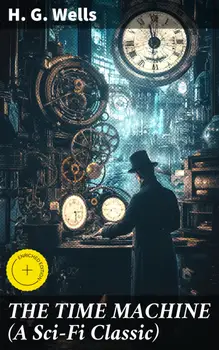
THE TIME MACHINE (A Sci-Fi Classic) : Enriched edition. A Journey Through Time and Evolution

In "The Time Machine," H. G. Wells crafts a pioneering narrative that explores the complexities of time travel through the eyes of an unassailable scientist known as the Time Traveller. The novella is rich with Victorian gothic elements and vividly imaginative prose, set against the backdrop of the industrial revolution'—a period bursting with scientific optimism yet tinged with existential anxiety. Wells employs a frame narrative style, intertwining the protagonist's bold expedition into the distant future with philosophical musings on the nature of humanity, class struggles, and the evolutionary implications of technology. This exploration reveals a chilling perspective on future societies, represented by the Eloi and Morlocks, that continues to resonate in contemporary discourse on socio-economic disparities and technological ethics. H. G. Wells, often hailed as the father of science fiction, was a man deeply influenced by the socio-political climates of the late 19th century. His background in natural science and education, coupled with his engagement in socialist thought, inspired him to use speculative fiction as a means to critique societal norms and provoke critical reflection. "The Time Machine" reflects his urgent concerns regarding the direction of humanity's progress and the potential consequences of ignoring social inequities. This seminal work is highly recommended for anyone interested in the intersections of science fiction, philosophy, and social commentary. With its imaginative narrative and profound themes, "The Time Machine" not only engenders a thrilling adventure through time but also invites readers to ponder their own societal trajectory, making it an essential read for students of literature, philosophy, and history alike.

In this enriched edition, we have carefully created added value for your reading experience:

- A succinct Introduction situates the work's timeless appeal and themes.

- The Synopsis outlines the central plot, highlighting key developments without spoiling critical twists.

- A detailed Historical Context immerses you in the era's events and influences that shaped the writing.

- An Author Biography reveals milestones in the author's life, illuminating the personal insights behind the text.

- A thorough Analysis dissects symbols, motifs, and character arcs to unearth underlying meanings.

- Reflection questions prompt you to engage personally with the work's messages, connecting them to modern life.

- Hand‐picked Memorable Quotes shine a spotlight on moments of literary brilliance.

- Interactive footnotes clarify unusual references, historical allusions, and archaic phrases for an effortless, more informed read.

Om denne boken

In "The Time Machine," H. G. Wells crafts a pioneering narrative that explores the complexities of time travel through the eyes of an unassailable scientist known as the Time Traveller. The novella is rich with Victorian gothic elements and vividly imaginative prose, set against the backdrop of the industrial revolution'—a period bursting with scientific optimism yet tinged with existential anxiety. Wells employs a frame narrative style, intertwining the protagonist's bold expedition into the distant future with philosophical musings on the nature of humanity, class struggles, and the evolutionary implications of technology. This exploration reveals a chilling perspective on future societies, represented by the Eloi and Morlocks, that continues to resonate in contemporary discourse on socio-economic disparities and technological ethics. H. G. Wells, often hailed as the father of science fiction, was a man deeply influenced by the socio-political climates of the late 19th century. His background in natural science and education, coupled with his engagement in socialist thought, inspired him to use speculative fiction as a means to critique societal norms and provoke critical reflection. "The Time Machine" reflects his urgent concerns regarding the direction of humanity's progress and the potential consequences of ignoring social inequities. This seminal work is highly recommended for anyone interested in the intersections of science fiction, philosophy, and social commentary. With its imaginative narrative and profound themes, "The Time Machine" not only engenders a thrilling adventure through time but also invites readers to ponder their own societal trajectory, making it an essential read for students of literature, philosophy, and history alike.

In this enriched edition, we have carefully created added value for your reading experience:

- A succinct Introduction situates the work's timeless appeal and themes.

- The Synopsis outlines the central plot, highlighting key developments without spoiling critical twists.

- A detailed Historical Context immerses you in the era's events and influences that shaped the writing.

- An Author Biography reveals milestones in the author's life, illuminating the personal insights behind the text.

- A thorough Analysis dissects symbols, motifs, and character arcs to unearth underlying meanings.

- Reflection questions prompt you to engage personally with the work's messages, connecting them to modern life.

- Hand‐picked Memorable Quotes shine a spotlight on moments of literary brilliance.

- Interactive footnotes clarify unusual references, historical allusions, and archaic phrases for an effortless, more informed read.

Kom i gang med denne boken i dag for 0 kr

  • Få full tilgang til alle bøkene i appen i prøveperioden
  • Ingen forpliktelser, si opp når du vil
Prøv gratis nå
Mer enn 52 000 personer har gitt Nextory 5 stjerner på App Store og Google Play.

  1. 3.0

    50 Masterpieces you have to read before you die vol: 1 (2020 Edition) : Included: Little Women, The Richest Man in Babylon Emma, The Call Of The Wild ....

    Louisa May Alcott, Dante Alighieri, Marcus Aurelius, Jane Austen, L. Frank Baum, Charlotte Brontë, Emily Brontë, Anne Brontë, Miguel de Cervantes, Agatha Christie, George S. Clason, Arthur Conan Doyle, Joseph Conrad, Charles Dickens, Fyodor Dostoyevsky, Alexandre Dumas, George Eliot, G.K. Chesterton, G.K. Chesterton, Zane Grey, Nathaniel Hawthorne, Napoleon Hill, Homer, Victor Hugo, Frances Hodgson Burnett, Washington Irving, Henry James, Franz Kafka, Rudyard Kipling, Jack London, Leo Tolstoy, H.P. Lovecraft, Lucy Maud Montgomery, Joseph Murphy, Robert Louis Stevenson, Edgar Allan Poe, Marcel Proust, Publius, Mary Shelley, Bram Stoker, Mark Twain, Sun Tzu, Lew Wallace, Wallace D. Wattles, H.G. Wells

  2. 3.9

    Klodenes kamp

    H.G. Wells

  3. 3.7
    #55

    The War of the Worlds

    H.G. Wells

  4. World's Greatest Short Stories

    Daniel Defoe, Benjamin Franklin, Washington Irving, Mateo Falcone, Charlotte Bronte, Mary Shelley, Nathaniel Hawthorne, Nikolai Gogol, Edgar Allan Poe, Fyodor Dostoyevsky, Charles Dickens, Herman Melville, Mark Twain, Guy De Maupassant, Oscar Wilde, Leo Tolstoy, H.G. Wells, Ambrose Bierce, Stephen Crane, Kate Chopin, Jack London, E. M. Forster

  5. 3.5

    Den usynlige mann

    H.G. Wells

  6. 3.8

    Tidsmaskinen

    H.G. Wells

  7. Ny

    The Time Machine : One Machine, Eight Hundred Thousand Years, and the End of Humanity

    H.G. Wells

  8. Ny

    The World Set Free : The 1914 Novel That Named the Atomic Bomb

    H.G. Wells

  9. A Modern Utopia

    H.G. Wells

  10. 4.2

    The Time Machine

    H.G. Wells

  11. 4.2

    The Time Machine

    H.G. Wells

  12. Fallen Worlds : Timeless Stories of Survival, Collapse, and Hope

    Ben Bova, Frederik Pohl, Robert Abernathy, Alan E. Nourse, Jack Sharkey, Philip K Dick, Herbert D. Kastle, Alfred Bester, G. Peyton Wertenbaker, Harlan Ellison, William F. Nolan, Lynn Venable, Edward W. Ludwig, Miguel Hidalgo, Robert Sheckley, H.G. Wells, Dean Evans, Donald E. Westlake, William Oberfield, Fritz Leiber, E. M. Forster, William Brittain, Robert Silverberg, Paul Macnamara, Morrison Colladay, Frank Lillie Pollock, John W. Campbell, Lester del Rey