
Selections from Parerga and Paralipomena : Volume 2

Volume 2 of Parerga and Paralipomena has a very different character from Volume 1.

There are, in total, 31 Essays, 24 of which are presented here. The range of topics is very varied, opening with 'On Philosophy and Its Method' and including 'On Pantheism', 'On Ethics', 'On Jurisprudence', 'On Men of Learning', 'On Thinking for Oneself', 'On Religion' and 'The Vanity of Existence'.

Quite a few open windows on to the personality of Schopenhauer himself - for example, he praises dogs as companions, argues that animals should be chloroformed before slaughter: animal welfare was very much in his sights. He inveighs against useless indulgence in luxury: 'the most effective way of alleviating human misery would be to diminish luxury, or even abolish it altogether.'

A thinker at home with his thoughts, he remarks with a touch of resigned humour: 'The pen is to thought what the stick is to walking, but one walks most easily without a stick, and thinks most perfectly when no pen is at hand. It is only when a man begins to get old that he likes to make use of a stick and his pen.'

His writings range widely over the international intellectual and cultural spectrum. There are numerous references to Eastern thought - especially Buddhism and Brahmanism as translations into European languages from Pali and Sanskrit gathered force during Schopenhauer's active life. He clearly found himself comfortable in this body of thought, often comparing it favourably with the Western Judaic-Christian heritage. As always he makes liberal use of quotations and footnotes and these have been translated and incorporated into the main text for this recording.

For Leighton Pugh, who has now recorded the main body of Schopenhauer's work for Ukemi Audiobooks, spending many days in the studio with this hugely influential figure has been like 'training at altitude.' He remarked that the time spent with the varied and accessible essays in Parerga and Paralipomena Volume 2 proved to be among the most enjoyable.

Translations by T Bailey Saunders, Ernest Belfort Bax, Walter Jekyll and Charles Joséfé.

Starte noch heute mit diesem Buch für CHF 0

  • Hole dir während der Testphase vollen Zugriff auf alle Bücher in der App
  • Keine Verpflichtungen, jederzeit kündbar
Jetzt kostenlos testen
Mehr als 52 000 Menschen haben Nextory im App Store und auf Google Play 5 Sterne gegeben.

  1. Aforismos Sobre el Arte de Saber Vivir : Reflexiones introspectivas para la sabiduría cotidiana y el bienestar

    Arthur Schopenhauer

  2. Notre conduite envers nous-mêmes et envers les autres : Pensées de Schopenhauer

    Arthur Schopenhauer

  3. Aphorismen zur Lebensweisheit. Ein philosophisches Meisterwerk. : Hörbuchzeit: Klassiker der Weltliteratur

    Hörbuchzeit, Arthur Schopenhauer

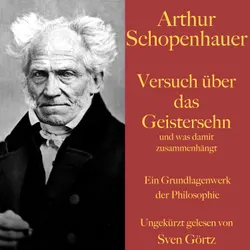
  4. Versuch über das Geistersehn und was damit zusammenhängt. Ein Grundlagenwerk der Philosophie. : Hörbuchzeit: Klassiker der Weltliteratur

    Hörbuchzeit, Arthur Schopenhauer

  5. Die Kunst Recht zu behalten. Ein Grundlagenwerk der Philosophie. : Hörbuchzeit: Klassiker der Weltliteratur

    Hörbuchzeit, Arthur Schopenhauer

  6. La Métaphysique de l’Amour : Pensées de Schopenhauer

    Arthur Schopenhauer

  7. Ce que l’on est, ce que l’on a, et ce que l’on représente : Aphorismes sur la sagesse de la vie

    Arthur Schopenhauer

  8. Sobre el dolor del mundo, el suicidio y la voluntad de vivir

    Arthur Schopenhauer

  9. Parábolas y aforismos

    Arthur Schopenhauer

  10. Sobre la cuádruple raíz del principio de razón suficiente

    Arthur Schopenhauer

  11. Die große Arthur Schopenhauer Hörbuch Box : Aphorismen und Essays: Ein Grundlagenwerk der Philosophie

    Arthur Schopenhauer

  12. 1800 Citations de philosophes

    Aristote, Épicure, Platon, Thalès de Milet, – Socrate, Protagoras, Anaximandre, Épictète, Héraclite, Marc Aurèle, René Descartes, Michel de Montaigne, Alexis de Tocqueville, Voltaire, Charles De Montesquieu, Jean-Jacques Rousseau, Emmanuel Kant, Hannah Arendt, Gottfried Wilhelm Leibniz, Georg Wilhelm Friedrich Hegel, Friedrich Nietzsche, Arthur Schopenhauer, David Hume, John Locke, Francis Bacon, Thomas Hobbes, Thomas More, Confucius, Érasme, Lao Tseu, Baruch Spinoza, Søren Kierkegaard, Nicolas Machiavel, Thomas d'Aquin, Henry David Thoreau