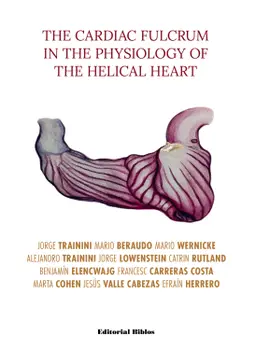
The Cardiac Fulcrum in the Physiology of the Helical Heart

"Since the publication of Fundamentals of the New Cardiac Mechanics: The Suction Pump, ten years ago, there has been a productive succession of studies and research by these brilliant scientists who expanded the knowledge of cardiac mechanics and the myocardial muscle structures and bands. They found the presence of an osseous or cartilaginous tissue, which they called the cardiac fulcrum, where the myocardial bands begin and end, it serves as support for the entire system; they also documented the finding of the lubrication of the entire muscular framework of the heart.

This knowledge enriches our understanding about the anatomy, physiology, and mechanical contraction of the heart, and thanks to the results, better treatments for heart failure are made possible. Until now, cardiologists explained heart contraction and its failures with the Frank-Starling Law (or simply the Starling Law); now, these new concepts of myocardial torsion and detorsion have been introduced, and the consequent protodiastolic suction through the contraction of sectors that contribute to the detorsion and active expansion of the ventricular cavities, generating an aspirating movement of the blood and a three-phase cardiac cycle. Furthermore, they explain the loss of the ventricles' aspirating capacity due to their dilation, when part of the myocardial torsion and detorsion is lost, and consequently, the heart's efficiency as a pump. I am truly convinced that these findings have opened up great lines of research for the future understanding of heart failure" (Dr. Pedro Cossio).

Über dieses Buch

"Since the publication of Fundamentals of the New Cardiac Mechanics: The Suction Pump, ten years ago, there has been a productive succession of studies and research by these brilliant scientists who expanded the knowledge of cardiac mechanics and the myocardial muscle structures and bands. They found the presence of an osseous or cartilaginous tissue, which they called the cardiac fulcrum, where the myocardial bands begin and end, it serves as support for the entire system; they also documented the finding of the lubrication of the entire muscular framework of the heart.

This knowledge enriches our understanding about the anatomy, physiology, and mechanical contraction of the heart, and thanks to the results, better treatments for heart failure are made possible. Until now, cardiologists explained heart contraction and its failures with the Frank-Starling Law (or simply the Starling Law); now, these new concepts of myocardial torsion and detorsion have been introduced, and the consequent protodiastolic suction through the contraction of sectors that contribute to the detorsion and active expansion of the ventricular cavities, generating an aspirating movement of the blood and a three-phase cardiac cycle. Furthermore, they explain the loss of the ventricles' aspirating capacity due to their dilation, when part of the myocardial torsion and detorsion is lost, and consequently, the heart's efficiency as a pump. I am truly convinced that these findings have opened up great lines of research for the future understanding of heart failure" (Dr. Pedro Cossio).

Starte noch heute mit diesem Buch für CHF 0

  • Hole dir während der Testphase vollen Zugriff auf alle Bücher in der App
  • Keine Verpflichtungen, jederzeit kündbar
Jetzt kostenlos testen
Mehr als 52 000 Menschen haben Nextory im App Store und auf Google Play 5 Sterne gegeben.