Über dieses Buch

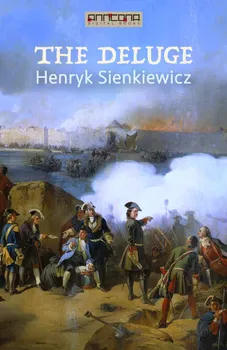
The Deluge is a historical novel by the Polish author Henryk Sienkiewicz, published in 1886. It is the second volume of a three-volume series known to Poles as "The Trilogy," having been preceded by With Fire and Sword (1884) and followed by Fire in the Steppe (1888).

Sienkiewicz combines the adventure novel with the historical love story, setting the action in the huge territory from Silesia to easternmost Ukraine, mostly in military camps, but also at the royal court, in the manors of the nobility, and in local parliaments.

The novel tells a story of a fictional Polish-Lithuanian Commonwealth soldier and noble Andrzej Kmicic and shows a panorama of the Commonwealth during its historical period of the Deluge, which was a part of the Northern Wars.

The novel describes the Swedish invasion of Poland known as The Deluge.

The novel was adapted for the screen by Polish director Jerzy Hoffman in 1974, as The Deluge.

Henryk Sienkiewicz (1846-1916) was a Polish journalist and Nobel Prize-winning novelist. A Polish noble, he was one of the most popular Polish writers at the turn of the 19th and 20th centuries, and received the Nobel Prize in Literature in 1905 for his "outstanding merits as an epic writer."

Many of his novels remain in print. In Poland he is best known for his "Trilogy" of historical novels – With Fire and Sword, The Deluge, and Fire in the Steppe – set in the 17th-century Polish-Lithuanian Commonwealth; internationally he is best known for Quo Vadis, set in Nero's Rome.
Starte noch heute mit diesem Buch für CHF 0

  • Hole dir während der Testphase vollen Zugriff auf alle Bücher in der App
  • Keine Verpflichtungen, jederzeit kündbar
Jetzt kostenlos testen
Mehr als 52 000 Menschen haben Nextory im App Store und auf Google Play 5 Sterne gegeben.

  1. Neu

    Quo Vadis : The Illustrated Gift Edition

    Henryk Sienkiewicz

  2. Neu

    Quo Vadis : A Narrative of the Time of Nero

    Henryk Sienkiewicz

  3. Neu

    Quo vadis : Tome 1

    Henryk Sienkiewicz

  4. Nobelpreis
    3.5

    Quo vadis?

    Henryk Sienkiewicz

  5. 100 Clásicos de la Literatura Universal

    Francis Scott Fitzgerald, Mary Shelley, Lyman Frank Baum, Louisa May Alcott, Dante Alighieri, Jane Austen, Ambrose Bierce, Emily Brontë, Edgar Rice Burroughs, Lewis Carroll, Wilkie Collins, René Descartes, Charles Dickens, Emily Dickinson, Alexandre Dumas, Gustave Flaubert, Benito Pérez Galdós, Johann Wolfgang von Goethe, Thomas Hardy, E T A Hoffmann, Washington Irving, Henry James, James Joyce, Franz Kafka, Gaston Leroux, Federico García Lorca, H.P. Lovecraft, Publio Virgilio Marón, Lucy Maud Montgomery, John William Polidori, Marco Polo, Antoine de Saint-Exupéry, Emilio Salgari, Walter Scott, Mark Twain, Jules Verne, Julio Verne, H.G. Wells, Edith Wharton, Mary Wollstonecraft, Stefan Zweig, Sun Tzu, Bram Stoker, - Aristoteles, George Bernard Shaw, Henryk Sienkiewicz, Concepción Arenal, Charlotte Brontë, Miguel de Cervantes, G.K. Chesterton, Daniel Defoe, Fyodor Mikhailovich Dostoyevsky, Arthur Conan Doyle, Sigmund Freud, H. Rider Haggard, Homero, Immanuel Kant, Rudyard Kipling, Molière, Friedrich Nietzsche, Fernando de Rojas, Sófocles, William Makepeace Thackeray, León Tolstói, Voltaire, Ramón María del Valle-Inclán, Oscar Wilde, Virginia Woolf

  6. QUO VADIS ? : Une passion interdite au cœur de l’incendie de la Rome impériale.

    Henryk Sienkiewicz

  7. #10

    Quo Vadis?

    Henryk Sienkiewicz

  8. Relatos

    Henryk Sienkiewicz

  9. Quo Vadis

    Henryk Sienkiewicz

  10. Nobelpreis

    Med ild og sværd. Bind 1

    Henryk Sienkiewicz

  11. Nobelpreis

    Med ild og sværd. Bind 2

    Henryk Sienkiewicz

  12. Die größten Liebesgeschichten des Mittelalters : Tristan und Isolde, Die neue Heloise, Die Frau Bürgemeisterin, Ivanhoe, Der Glöckner von Notre Dame, Die Prinzessin von Cleves

    Walter Scott, Victor Hugo, Henryk Sienkiewicz, Alexandre Dumas, Gottfried von Straßburg, Jean-Jacques Rousseau, Georg Ebers, Levin Schücking, Karl Bröger, Heinrich von Kleist, Wilhelm Raabe, Christoph Martin Wieland, Julius Wolff, Marie-Madeleine de Fayette, Ludwig Ganghofer, August Sperl, Louise Otto, Friedrich de Fouqué