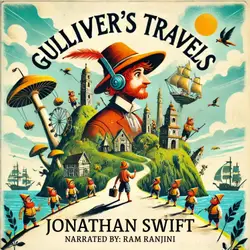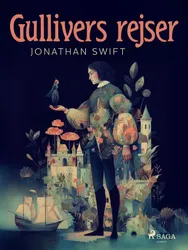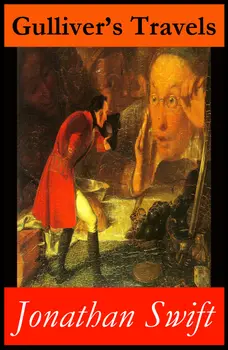
This carefully crafted ebook: "Gulliver's Travels illustrated by Arthur Rackham" is formatted for your eReader with a functional and detailed table of contents. Gulliver's Travels (Original title - Travels into Several Remote Nations of the World. In Four Parts. By Lemuel Gulliver, First a Surgeon, and then a Captain of Several Ships), a misanthropic satire of humanity, was written in 1726 by Jonathan Swift. Like many other authors, Swift uses the journey as the backdrop for his satire. He invents a second author, Captain Lemuel Gulliver, who because of a series of mishaps en route to recognized ports, ends up, instead, on several unknown islands living with people and animals of unusual sizes, behaviors, and philosophies, but who, after each adventure, is somehow able to return to his home in England where he recovers from these unusual experiences and then sets out again on a new voyage. Jonathan Swift (1667 – 1745) was an Anglo-Irish poet, writer and cleric who gained reputation as a great political writer and an essayist. Jonathan, who became Dean of St. Patrick's in Dublin, is also known for his excellence in satire. His most remembered works include Gulliver's Travels, A modest Proposal, An Argument against Abolishing Christianity and A Tale of a Tub.
100 Meisterwerke der englischen Literatur - Klassiker, die man kennen muss
George Orwell, Charles Dickens, Jane Austen, Katherine Mansfield, H.P. Lovecraft, William Wordsworth, John Keats, Percy Bysshe Shelley, Robert Burns, John Milton, William Shakespeare, Christopher Marlowe, Geoffrey Chaucer, Laurence Sterne, Henry Fielding, Mary Shelley, Emily Brontë, Charlotte Brontë, Anne Brontë, William Makepeace Thackeray, George Eliot, D. H. Lawrence, Herman Melville, Thomas Wolfe, Virginia Woolf, Joseph Conrad, Sinclair Lewis, Walt Whitman, Edgar Allan Poe, Oscar Wilde, Jerome K Jerome, Washington Irving, Bram Stoker, H.G. Wells, Daniel Defoe, Lew Wallace, James Fenimore Cooper, Jonathan Swift, Robert Louis Stevenson, Mark Twain, Lewis Carrol, Edward Bulwer-Lytton, F. Scott Fitzgerald, Arthur Conan Doyle, Jack London, Henry David Thoreau, G.K. Chesterton, Edith Wharton, Henry James, Thomas Hardy, Margaret Mitchell, Kate Chopin, Willa Cather, Charlotte Perkins Gilman, James Joyce, John Galsworthy, Francis Hodgson Burnett, Lucy Maud Montgomery, Louisa May Alcott, Rudyard Kipling