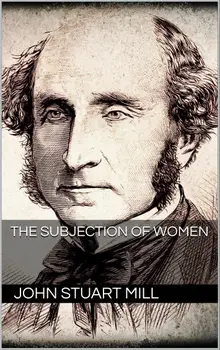
The Subjection of Women

The object of this Essay is to explain as clearly as I am able, the grounds of an opinion which I have held from the very earliest period when I had formed any opinions at all on social or political matters, and which, instead of being weakened or modified, has been constantly growing stronger by the progress of reflection and the experience of life: That the principle which regulates the existing social relations between the two sexes-the legal subordination of one sex to the other-is wrong in itself, and now one of the chief hindrances to human improvement; and that it ought to be replaced by a principle of perfect equality, admitting no power or privilege on the one side, nor disability on the other.

Starte noch heute mit diesem Buch für CHF 0

  • Hole dir während der Testphase vollen Zugriff auf alle Bücher in der App
  • Keine Verpflichtungen, jederzeit kündbar
Jetzt kostenlos testen
Mehr als 52 000 Menschen haben Nextory im App Store und auf Google Play 5 Sterne gegeben.

  1. The Greatest Happiness Principle - Utilitarianism, On Liberty & The Subjection of Women : Liberty, Utilitarianism, and Women's Equality in Three Classic Works
    John Stuart Mill

  2. Neu

    On Liberty

    John Stuart Mill

  3. Neu

    The Subjection of Women

    John Stuart Mill

  4. Neu

    The Contest in America

    John Stuart Mill

  5. Tres ensayos sobre la religión : La naturaleza. La utilidad de la religión. El teísmo

    John Stuart Mill

  6. 50 Clásicos que debes leer antes de morir

    Dante Alighieri, Aristóteles, Jane Austen, Charles Baudelaire, Giovanni Boccaccio, Anne Brontë, C. Collodi, James Fenimore Cooper, Fedor Mikhaïlovitch Dostoïevski, Arthur Conan Doyle, Alexandre Dumas, José de Espronceda, Gustave Flaubert, Sigmund Freud, Benito Pérez Galdós, Kahlil Gibran, Johann Wolfgang Goethe, Johann Wolfgang von Goethe, Victor Hugo, Thomas Hardy, Nathaniel Hawthorne, Vicente Blasco Ibáñez, Washington Irving, James Joyce, Mariano José de Larra, Jack London, Federico García Lorca, H.P. Lovecraft, Antonio Machado, Gustav Meyrink, John Stuart Mill, Amado Nervo, Friedrich Nietzsche, Solomon Northup, Alexander Sergeyevich Pushkin, Francisco de Quevedo, Walter Scott, William Shakespeare, Robert Louis Stevenson, Harriet Beecher Stowe, Jonathan Swift, Mark Twain, Miguel De Unamuno, Ramón María del Valle-Inclán, Julio Verne, Virginia Woolf

  7. 4.5

    Vapaudesta

    John Stuart Mill

  8. Utilitarianism :

    John Stuart Mill

  9. 12 Masterpieces You Have to Read Before You Die. Philosophy

    Niccolo Machiavelli, Tommaso Campanella, Francis Bacon, Thomas More, John Stuart Mill, Immanuel Kant, Kahlil Gibran, Leo Tolstoy, G.K. Chesterton, Henry David Thoreau

  10. 50 Klassiker des Feminismus - Bücher, die man kennen muss
    Kate Chopin, Charlotte Perkins Gilman, Virginia Woolf, Charlotte Brontë, George Sand, Louisa May Alcott, Jane Austen, L.M. Montgomery, Victor Hugo, Daniel Defoe, Nathaniel Hawthorne, Wilhelmine von Hillern, Adalbert Stifter, Luise Ahlborn, George Eliot, Lou Andreas-Salomé, D. H. Lawrence, Henry James, Margaret Mitchell, Edith Wharton, Miles Franklin, Willa Cather, Leo Tolstoi, Henrik Ibsen, Elizabeth Gaskell, Nikolai Semjonowitsch Leskow, Theodore Dreiser, Elizabeth von Arnim, Colette, Emmeline Pankhurst, Louise Aston, Bertha von Suttner, Hedwig Dohm, Mary Wollstonecraft, Elizabeth Cady Stanton, Matilda Joslyn Gage, John Stuart Mill, Thomas Hardy, Sinclair Lewis, Elizabeth Burgoyne Corbett, Anne Brontë

  11. 20 Feministische Klassiker für junge Aktivistinnen : Verteidigung der Rechte der Frau, Ein Zimmer für sich allein, Die gelbe Tapete, Die Bibel der Frau, Das Erwachen, Neue Amazonia, Kleine Frauen

    Virginia Woolf, Rosa Luxemburg, Kate Chopin, Charlotte Perkins Gilman, Mary Wollstonecraft, Elizabeth Cady Stanton, Matilda Joslyn Gage, John Stuart Mill, Louise Otto, Clara Zetkin, Rosa Mayreder, Bertha Pappenheim, Charlotte Brontë, George Sand, Louisa May Alcott, Sinclair Lewis, Henrik Ibsen, Elizabeth Burgoyne Corbett, Miles Franklin

  12. Über die Freiheit : Die Freiheit des Individuums vom Staat - Ausgabe in neuer Übersetzung und Rechtschreibung

    John Stuart Mill