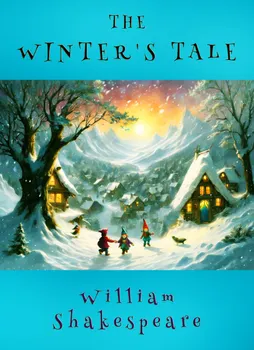
The Winter's Tale : Illustrated

The Winter's Tale is a play by William Shakespeare, originally published in the First Folio of 1623. Although it was grouped among the comedies, some modern editors have relabelled the play as one of Shakespeare's late romances. Some critics consider it to be one of Shakespeare's "problem plays", because the first three acts are filled with intense psychological drama, while the last two acts are comedic and supply a happy ending.

The play has been intermittently popular, revived in productions in various forms and adaptations by some of the leading theatre practitioners in Shakespearean performance history, beginning after a long interval with David Garrick in his adaptation called Florizel and Perdita (first performed in 1754 and published in 1756).

The Winter's Tale was revived again in the 19th century, when the third "pastoral" act was widely popular. In the second half of the 20th century The Winter's Tale in its entirety, and drawn largely from the First Folio text, was often performed, with varying degrees of success.

Short Summary of the Tale:

John Fawcett as Autolycus in "The Winter's Tale" (1828) by Thomas Charles Wageman

Following a brief setup scene the play begins with the appearance of two childhood friends: Leontes, King of Sicilia, and Polixenes, the King of Bohemia. Polixenes is visiting the kingdom of Sicilia, and is enjoying catching up with his old friend. However, after nine months, Polixenes yearns to return to his own kingdom to tend to affairs and see his son. Leontes desperately attempts to get Polixenes to stay longer, but is unsuccessful. Leontes then decides to send his wife, Queen Hermione, to try to convince Polixenes. Hermione agrees and with three short speeches is successful. Leontes is puzzled as to how Hermione convinced Polixenes so easily, and Leontes suddenly goes insane and suspects that his pregnant wife has been having an affair with Polixenes and that the child is a bastard. Leontes orders Camillo, a Sicilian Lord, to poison Polixenes. Camillo instead warns Polixenes and they both flee to Bohemia.

Furious at their escape, Leontes now publicly accuses his wife of infidelity, and declares that the child she is bearing must be illegitimate. He throws her in prison, over the protests of his nobles, and sends two of his lords, Cleomenes and Dion, to the Oracle at Delphi for what he is sure will be confirmation of his suspicions.

Meanwhile, the queen gives birth to a girl, and her loyal friend Paulina takes the baby to the king, in the hopes that the sight of the child will soften his heart. He grows angrier, however, and orders Paulina's husband, Lord Antigonus, to take the child and abandon it in a desolate place.

Cleomenes and Dion return from Delphi with word from the Oracle and find Hermione publicly and humiliatingly put on trial before the king. She asserts her innocence, and asks for the word of the Oracle to be read before the court. The Oracle states categorically that Hermione and Polixenes are innocent, Camillo an honest man, and that Leontes will have no heir until his lost daughter is found. Leontes shuns the news, refusing to believe it as the truth. As this news is revealed, word comes that Leontes' son, Mamillius, has died of a wasting sickness brought on by the accusations against his mother. Hermione, meanwhile, falls in a swoon, and is carried away by Paulina, who subsequently reports the queen's death to her heartbroken and repentant husband. Leontes vows to spend the rest of his days atoning for the loss of his son and his queen.

Starte noch heute mit diesem Buch für CHF 0

  • Hole dir während der Testphase vollen Zugriff auf alle Bücher in der App
  • Keine Verpflichtungen, jederzeit kündbar
Jetzt kostenlos testen
Mehr als 52 000 Menschen haben Nextory im App Store und auf Google Play 5 Sterne gegeben.

  1. 100 Meisterwerke der englischen Literatur - Klassiker, die man kennen muss

    George Orwell, Charles Dickens, Jane Austen, Katherine Mansfield, H.P. Lovecraft, William Wordsworth, John Keats, Percy Bysshe Shelley, Robert Burns, John Milton, William Shakespeare, Christopher Marlowe, Geoffrey Chaucer, Laurence Sterne, Henry Fielding, Mary Shelley, Emily Brontë, Charlotte Brontë, Anne Brontë, William Makepeace Thackeray, George Eliot, D. H. Lawrence, Herman Melville, Thomas Wolfe, Virginia Woolf, Joseph Conrad, Sinclair Lewis, Walt Whitman, Edgar Allan Poe, Oscar Wilde, Jerome K Jerome, Washington Irving, Bram Stoker, H.G. Wells, Daniel Defoe, Lew Wallace, James Fenimore Cooper, Jonathan Swift, Robert Louis Stevenson, Mark Twain, Lewis Carrol, Edward Bulwer-Lytton, F. Scott Fitzgerald, Arthur Conan Doyle, Jack London, Henry David Thoreau, G.K. Chesterton, Edith Wharton, Henry James, Thomas Hardy, Margaret Mitchell, Kate Chopin, Willa Cather, Charlotte Perkins Gilman, James Joyce, John Galsworthy, Francis Hodgson Burnett, Lucy Maud Montgomery, Louisa May Alcott, Rudyard Kipling

  2. 100 Klassiker der Romantik - Meisterwerke, die man kennen muss : Epische Liebesdramen und große Erwartungen in zeitlosen Geschichten

    Jane Austen, Louisa May Alcott, D. H. Lawrence, Fjodor Dostojewski, William Shakespeare, Hedwig Courths-Mahler, Frances Burney, Charlotte Brontë, Alexandre Dumas, Margaret Mitchell, Charles Dickens, L.M. Montgomery, Eugenie Marlitt, Wilhelmine Heimburg, Elisabeth Bürstenbinder, Stendhal, Johann Wolfgang von Goethe, Walter Scott, Guy De Maupassant, Victor Hugo, George Sand, Leo Tolstoi, Gabriele D’Annunzio, Rudyard Kipling, Gustave Flaubert, Nathaniel Hawthorne, Jean-Jacques Rousseau, Bernardin de Saint-Pierre, F. Scott Fitzgerald, Prosper Mérimée, Edith Wharton, Lena Christ, François-René de Chateaubriand, Stefan Zweig, Alexander Sergejewitsch Puschkin, Ida Boy-Ed, Arthur Schnitzler, Anatole France, Johanna Spyri, George Eliot, Gaston Leroux, Nataly von Eschstruth, Gottfried von Straßburg, Sophie Mereau, Caroline von Wolzogen, Benedikte Naubert, Henry De Vere Stacpoole, Levin Schücking

  3. Die größten Klassiker der Lyrik : Die schönsten Gedichte der Weltliteratur: Bhagavadgita, Duineser Elegien, Grashalme, Venus und Adonis, Das verlorene Paradies, West-östlicher Divan

    Lord Byron, Rainer Maria Rilke, Giacomo Leopardi, Walt Whitman, Dschalal ad-Din Muhammad Rumi, Heinrich Heine, William Shakespeare, John Milton, Friedrich Schiller, Percy Bysshe Shelley, Edgar Allan Poe, Johann Wolfgang Goethe, Gottfried von Straßburg, Victor Hugo, Dante Alighieri, William Wordsworth, Homer, Vergil, Ovid, Georg Herwegh, Giosuè Carducci, Omar Chayyām, Alphonse de Lamartine, Stéphane Mallarmé, Christian Morgenstern, Joachim Ringelnatz, Annette von Droste-Hülshoff, Alexander Sergejewitsch Puschkin, Robert Burns, Charles Baudelaire

  4. William Shakespeare: Viel Lärm um nichts : Eine Komödie. Ungekürzt gelesen.

    William Shakespeare

  5. England erzählt : Die große Hörbuch Box der britischen Literatur

    William Shakespeare, Charles Dickens, Arthur Conan Doyle

  6. Le Roi Henri VIII (Henry VIII in French)

    William Shakespeare

  7. 3.8

    The Tempest

    William Shakespeare

  8. 13. Nov.

    Dramer II. Strö lycka, féer : Komiska förväxlingar, Så tuktas en argbigga, Två gentlemän från Verona, Kärleks möda är förgäves, En midsommarnattsdröm, Muntra fruarna i Windsor.

    William Shakespeare

  9. 9. Apr.

    Romeo & Juliet

    William Shakespeare

  10. Neu

    Patrick Stewart Performs the Complete Sonnets of William Shakespeare : With Original Commentary by Patrick Stewart

    William Shakespeare, Patrick Stewart

  11. 4.5

    Hamlet

    William Shakespeare

  12. 4.5

    Otelo

    William Shakespeare