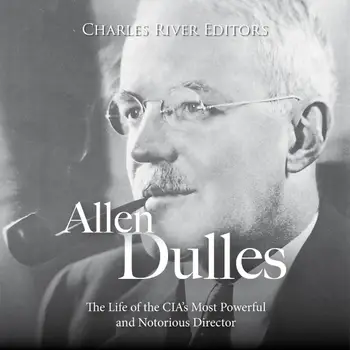
Allen Dulles: The Life of the CIA’s Most Powerful and Notorious Director

The 28-year period from 1933-1961, bracketed on one end by Hitler’s rise to power in Germany and on the other by the very height of the Cold War, was marked by a remarkably stable succession of American presidents. In fact, only three men held office in this period, and that predictability led to a general stability among government agencies. Conversely, the CIA had five different directors in its first 15 years, from 1946-1961, and then nine different directors in the next 20, with four of those directors serving less than a year. But of all the CIA’s directors, none wielded the immense influence or power of Allen Dulles, who, together with his brother, Secretary of State John Foster Dulles, became arguably the two most powerful people in the government after the president.

To this day, Dulles’ eight-year tenure in that office is the longest, and as one of the country’s leading experts in international law, intelligence, and spycraft, he became renowned for his unwavering anti-communist ideology and readiness to take decisive measures to counter what he perceived as a menace to American safety. As such, it would be Dulles who sanctioned many of the CIA’s most notorious operations, including the ousting of Iran's democratically elected government in 1953, spying and experimentation on American citizens, and the disastrous Bay of Pigs. That last episode cost him his job, though he continued to play a role in American political life after President John F. Kennedy forced him out of the CIA in 1961.

By then, however, Dulles had already had an outsized influence on the direction of the country, and to this day his legacy can be felt, even as his reputation continues to be a source of much debate.

Über dieses Buch

The 28-year period from 1933-1961, bracketed on one end by Hitler’s rise to power in Germany and on the other by the very height of the Cold War, was marked by a remarkably stable succession of American presidents. In fact, only three men held office in this period, and that predictability led to a general stability among government agencies. Conversely, the CIA had five different directors in its first 15 years, from 1946-1961, and then nine different directors in the next 20, with four of those directors serving less than a year. But of all the CIA’s directors, none wielded the immense influence or power of Allen Dulles, who, together with his brother, Secretary of State John Foster Dulles, became arguably the two most powerful people in the government after the president.

To this day, Dulles’ eight-year tenure in that office is the longest, and as one of the country’s leading experts in international law, intelligence, and spycraft, he became renowned for his unwavering anti-communist ideology and readiness to take decisive measures to counter what he perceived as a menace to American safety. As such, it would be Dulles who sanctioned many of the CIA’s most notorious operations, including the ousting of Iran's democratically elected government in 1953, spying and experimentation on American citizens, and the disastrous Bay of Pigs. That last episode cost him his job, though he continued to play a role in American political life after President John F. Kennedy forced him out of the CIA in 1961.

By then, however, Dulles had already had an outsized influence on the direction of the country, and to this day his legacy can be felt, even as his reputation continues to be a source of much debate.
Starte noch heute mit diesem Buch für CHF 0

  • Hole dir während der Testphase vollen Zugriff auf alle Bücher in der App
  • Keine Verpflichtungen, jederzeit kündbar
Jetzt kostenlos testen
Mehr als 52 000 Menschen haben Nextory im App Store und auf Google Play 5 Sterne gegeben.

  1. The Mud Flood Hypothesis: The History of the Conspiracy Theory about the Global Empire of Tartaria

    Charles River Editors

  2. Dick Bong: The Life and Legacy of America’s Greatest Combat Ace during World War II

    Charles River Editors

  3. The Age of Sail’s Most Famous Battles: The History of the Naval Engagements that Shaped Europe in the Early Modern Period

    Charles River Editors

  4. The Iranian Revolution and Iran Hostage Crisis: The History of the Events that Broke American Relations with Iran

    Charles River Editors

  5. The Counter-Reformation: The History of the Catholic Church’s Response to the Protestant Reformation

    Charles River Editors

  6. Persepolis and Susa: The History of the Achaemenid Persian Empire’s Capitals

    Charles River Editors

  7. The Christianization of Rome: The History of the Roman Empire’s Religious Conversion

    Charles River Editors

  8. Indian Removal: The History of the Battles and Policies that Displaced Native Americans East of the Mississippi River

    Charles River Editors

  9. Across the Silk Road and the Atlantic: The History of Marco Polo and Christopher Columbus’ Groundbreaking Voyages

    Charles River Editors

  10. The Dawn of the Age of Exploration: The History of the Initial Expeditions that Led to European Imperialism across the Globe

    Charles River Editors

  11. Kublai Khan and Marco Polo: The History of a Unique Partnership at the Court of the Mongol Empire

    Charles River Editors

  12. The Height of the Cold War: The History of the Events that Brought the Soviet Union and United States to the Brink

    Charles River Editors