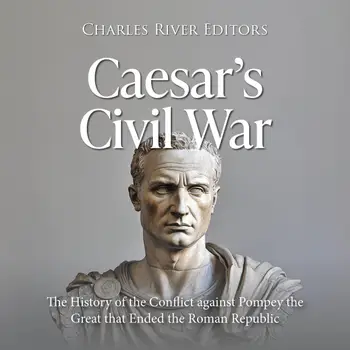
Caesar’s Civil War: The History of the Conflict against Pompey the Great that Ended the Roman Republic

The ultimate conqueror, statesman, dictator, visionary, and opportunist, during his time in power, Julius Caesar expanded the borders of Rome to almost twice their previous size, revolutionized the infrastructure of the Roman state, and destroyed the Roman Republic for good, leaving a line of emperors in its place. His legacy is so strong that his name has become, in many languages, synonymous with power: the emperors of Austria and Germany bore the title Kaiser, and the Tsars of Russia also owe the etymology of their title to Caesar.

Even in his time, Caesar was in many ways larger than life, and because of his legacy as virtual founder of the Roman Empire, much of what was written about – and by – him during his life and immediately after his assassination was politically motivated. The fact that he was murdered on the Ides of March is universal knowledge, but it’s often forgotten that he was stabbed while entering the Curia of Pompey, one of the Senate’s meeting places, in March of 44 BCE. The curia was a theater dedicated to Pompey the Great, Caesar’s rival in the civil war that ended the Republic and made Caesar dictator. When Caesar was stabbed, he fell at the base of a colossal statue of Pompey.

Thanks to Caesar’s victory in the civil war, Pompey is mostly remembered not for being one of Rome’s greatest generals, but for being defeated by Caesar and then ignominiously murdered after he fled to Egypt, where the boy pharaoh Ptolemy XIII decapitated Pompey and offered his head to Caesar as a gift. Although Caesar was there chasing Pompey’s men, he quickly became involved in Egypt’s own civil war. As a consequence of Ptolemy’s barbarity, Caesar impulsively decided to side with his sister Cleopatra in her bid for the throne of Egypt, escalating what was rapidly becoming an all-out civil war.
Über dieses Buch

The ultimate conqueror, statesman, dictator, visionary, and opportunist, during his time in power, Julius Caesar expanded the borders of Rome to almost twice their previous size, revolutionized the infrastructure of the Roman state, and destroyed the Roman Republic for good, leaving a line of emperors in its place. His legacy is so strong that his name has become, in many languages, synonymous with power: the emperors of Austria and Germany bore the title Kaiser, and the Tsars of Russia also owe the etymology of their title to Caesar.

Even in his time, Caesar was in many ways larger than life, and because of his legacy as virtual founder of the Roman Empire, much of what was written about – and by – him during his life and immediately after his assassination was politically motivated. The fact that he was murdered on the Ides of March is universal knowledge, but it’s often forgotten that he was stabbed while entering the Curia of Pompey, one of the Senate’s meeting places, in March of 44 BCE. The curia was a theater dedicated to Pompey the Great, Caesar’s rival in the civil war that ended the Republic and made Caesar dictator. When Caesar was stabbed, he fell at the base of a colossal statue of Pompey.

Thanks to Caesar’s victory in the civil war, Pompey is mostly remembered not for being one of Rome’s greatest generals, but for being defeated by Caesar and then ignominiously murdered after he fled to Egypt, where the boy pharaoh Ptolemy XIII decapitated Pompey and offered his head to Caesar as a gift. Although Caesar was there chasing Pompey’s men, he quickly became involved in Egypt’s own civil war. As a consequence of Ptolemy’s barbarity, Caesar impulsively decided to side with his sister Cleopatra in her bid for the throne of Egypt, escalating what was rapidly becoming an all-out civil war.
Starte noch heute mit diesem Buch für CHF 0

  • Hole dir während der Testphase vollen Zugriff auf alle Bücher in der App
  • Keine Verpflichtungen, jederzeit kündbar
Jetzt kostenlos testen
Mehr als 52 000 Menschen haben Nextory im App Store und auf Google Play 5 Sterne gegeben.

  1. The Iranian Revolution and Iran Hostage Crisis: The History of the Events that Broke American Relations with Iran

    Charles River Editors

  2. The Counter-Reformation: The History of the Catholic Church’s Response to the Protestant Reformation

    Charles River Editors

  3. The Age of Sail’s Most Famous Battles: The History of the Naval Engagements that Shaped Europe in the Early Modern Period

    Charles River Editors

  4. Persepolis and Susa: The History of the Achaemenid Persian Empire’s Capitals

    Charles River Editors

  5. Indian Removal: The History of the Battles and Policies that Displaced Native Americans East of the Mississippi River

    Charles River Editors

  6. The Christianization of Rome: The History of the Roman Empire’s Religious Conversion

    Charles River Editors

  7. Across the Silk Road and the Atlantic: The History of Marco Polo and Christopher Columbus’ Groundbreaking Voyages

    Charles River Editors

  8. Kublai Khan and Marco Polo: The History of a Unique Partnership at the Court of the Mongol Empire

    Charles River Editors

  9. The Height of the Cold War: The History of the Events that Brought the Soviet Union and United States to the Brink

    Charles River Editors

  10. The Dawn of the Age of Exploration: The History of the Initial Expeditions that Led to European Imperialism across the Globe

    Charles River Editors

  11. The Start of the Cold War: The History of the Burgeoning Rivalry Between the United States and Soviet Union

    Charles River Editors

  12. The 332nd Fighter Group: The History of the Tuskegee Airmen’s Fighter Unit during World War II

    Charles River Editors