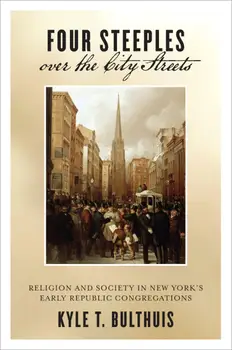
A study of four New York City congregations as they navigate the social and political changes of the late eighteenth and mid-nineteenth centuries.
"An impressive work [that] casts new and important insights onto our understandings of religion, race, and the history of New York. It brings together issues religious history, race class and the city. It will be a great boon to scholars and students in a variety of academic disciplines." —Robert Bruce Mullin, Society for the Promotion of Religion & Learning Professor of History, General Theological Seminary
Throughout the colonial era, New York City's Trinity Episcopal Church, a major city landmark and social cornerstone, had presented itself as a uniting influence, one that connected all believers socially and religiously. As the city grew larger, more impersonal, and socially divided, churches re-formed around race and class-based neighborhoods. Trinity's original vision of a united community proved elusive.
In Four Steeples over the City Streets, Kyle T. Bulthuis examines the histories of four famous church congregations in early Republic New York City—Trinity Episcopal, John Street Methodist, Mother Zion African Methodist, and St. Philip's (African) Episcopal—to uncover the lived experiences of individual New Yorkers and churchgoers.
Drawing on a range of primary sources, Bulthuis reveals how these city churches responded to dramatic urban transformations from colonial times to the mid-nineteenth century. The work adds new dynamics to the stories of well-known New Yorkers such as John Jay, James Harper, and Sojourner Truth. Four Steeples over the City Streets evaluates dynamics of race, class, gender, urban studies, and religious experience, to reveal how the city shaped these churches, and how their respective religious traditions shaped the way they reacted to the city.
This book is a critical addition to the study and history of African American activism and life in the ever-changing metropolis of New York City.


